Join us on a literary world trip!
Add this book to bookshelf
Grey
Write a new comment Default profile 50px
Grey
Subscribe to read the full book or read the first pages for free!
All characters reduced
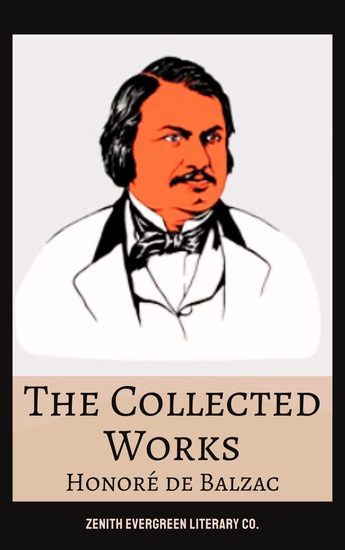
The Collected Works of Honoré de Balzac - Complete Human Comedy Novels and Short Stories - cover

The Collected Works of Honoré de Balzac - Complete Human Comedy Novels and Short Stories

Honoré de Balzac, Zenith Evergreen Literary Co.

Publisher: Zenith Evergreen Literary Co.

  • 0
  • 0
  • 0

Summary

A towering portrait of 19th-century France—love, ambition, greed, and redemption in every page.

The Collected Works of Honoré de Balzac gathers the complete Human Comedy cycle and beyond, showcasing one of the most profound chroniclers of human nature. From Père Goriot to Lost Illusions and Eugénie Grandet, Balzac unveils a vivid tapestry of society, rich with memorable characters, tangled ambitions, and moral struggles.

A master of realism and psychological depth, Balzac's work remains essential for readers seeking the roots of modern fiction.

💬 "Reading Balzac is like entering a universe where every ambition, betrayal, and passion echoes eternally."

🏛️ Why This Collection is Essential:
Includes over 90 complete novels and short stories, plus critical essays

Perfect for fans of Victor Hugo, Émile Zola, Leo Tolstoy, and Charles Dickens

Ideal for students of French literature, realism, and societal critique

📣 Witness the Struggles. Understand the Triumphs. Live the Human Comedy.
Buy The Collected Works of Honoré de Balzac today and explore one of literature's grandest worlds.
Available since: 04/28/2025.
Print length: 19200 pages.

Other books that might interest you

  • Frankenstein - cover

    Frankenstein

    Mary Shelley

    • 0
    • 0
    • 0
    "Frankenstein" by Mary Shelley, published in 1818, is a landmark Gothic novel that explores themes of ambition, creation, responsibility, and the consequences of playing God. Victor Frankenstein, a young man from Geneva, grows up in a loving and supportive family. He is deeply interested in science and becomes obsessed with understanding the secrets of life. After studying at the University of Ingolstadt, Victor discovers the method for creating life and becomes consumed with the idea of building a living being. However, when he finally brings the creature to life, he is horrified by its monstrous appearance. Overwhelmed by fear and disgust, Victor abandons the creature and flees, leaving it to fend for itself. Victor's ambition leads to his downfall, and the novel explores the consequences of overreaching human limits. The novel raises questions about the inherent nature of beings and whether the creature was born evil or became that way due to its treatment by society. The quest for forbidden knowledge and the consequences of scientific hubris are central to the narrative. In our times of Artificial Intelligence, the theme is of striking actuality.
    Show book
  • White Snake The - Story Time Episode 59 (Unabridged) - cover

    White Snake The - Story Time...

    Brothers Grimm

    • 0
    • 0
    • 0
    A wise King receives a covered dish every evening. A young servant is intrigued one night when he retrieves the King's dish and discovers a coiled white snake under the cover. The servant takes a small bite and discovers that he can now understand and communicate with animals.
    Show book
  • A Portrait of the Artist as a Young Man - cover

    A Portrait of the Artist as a...

    James Joyce

    • 0
    • 0
    • 0
    A Portrait of the Artist as a Young Man is the first novel of Irish writer James Joyce.    A Künstlerroman in a modernist style, it traces the religious and intellectual awakening of young Stephen Dedalus, a fictional alter ego of Joyce and an allusion to Daedalus, the consummate craftsman of Greek mythology. Stephen questions and rebels against the Catholic and Irish conventions under which he has grown, culminating in his self-exile from Ireland to Europe. The work uses techniques that Joyce developed more fully in Ulysses and Finnegans Wake.    A Portrait began life in 1903 as Stephen Hero--a projected 63-chapter autobiographical novel in a realistic style. After 25 chapters, Joyce abandoned Stephen Hero in 1907 and set to reworking its themes and protagonist into a condensed five-chapter novel, dispensing with strict realism and making extensive use of free indirect speech that allows the reader to peer into Stephen's developing consciousness. American modernist poet Ezra Pound had the novel serialised in the English literary magazine The Egoist in 1914 and 1915, and published as a book in 1916 by B. W. Huebsch of New York. The publication of A Portrait and the short story collection Dubliners (1914) earned Joyce a place at the forefront of literary modernism.
    Show book
  • A May Night - cover

    A May Night

    Nikolai Gogol

    • 0
    • 0
    • 0
    "May Night, or the Drowned Maiden", 1831 is the third tale in the collection Evenings on a Farm Near Dikanka by Nikolai Gogol. It was made into the opera May Night by Nikolai Rimsky-Korsakov in 1878–79 and also a Ukrainian setting by Mykola Lysenko.
    This story comes from the unnamed story-teller (who was previously responsible for "The Fair at Sorochyntsi").
    In this tale, a young Cossack named Levko, the son of the mayor, is in love with Hanna. He comes to her house to talk about marriage and mentions that his father is not pleased with the idea, though he doesn't say anything directly and merely ignores him. As they are walking on the outskirts of the village, Hanna asks about an old hut with a moss-covered roof and overgrown apple trees surrounding it. He tells her the story of a beautiful young girl whose father took care of her after her mother died and loved her dearly. Eventually, he married another woman who she discovered was a witch when she cut the paw of a cat that tried to kill her and her stepmother appeared soon after with her hand bandaged. The witch had power over her father, however, and eventually she is thrown out of the house and throws herself into the nearby pond in despair. She reigns over a group of maidens who also drowned in the pond, but once, when she got a hold of the witch as she was near the pond, she turned into a maiden and the ghost of the young girl has been unable to pick her out of the group ever since, asking any young man she comes upon to guess for her...
    Show book
  • Gulliver's Travels into Several Remote Nations of the World - cover

    Gulliver's Travels into Several...

    Jonathan Swift

    • 0
    • 0
    • 0
    Dive into the heart of satire with Jonathan Swift's Gulliver's Travels, a timeless masterpiece that has captivated readers for centuries. Beyond the surface of this enchanting tale of shipwrecks and fantastical realms lies a sharp critique of society, politics, and human nature. Through the extraordinary voyages of Lemuel Gulliver, Swift takes us on an adventure to the tiny world of Lilliput, the giant lands of Brobdingnag, and beyond, each a mirror reflecting the absurdities of our own world. 
    Swift's brilliant satire has not only defined a genre but also influenced countless works of literature and philosophy. Gulliver's Travels is more than just an adventure story; it’s a profound commentary on the human condition, power, and pride, all delivered with Swift’s signature wit. This edition not only brings the classic tale to life but also includes critical essays that illuminate Swift's enduring relevance and the depth of his critique on the societal constructs of his time and ours. 
    Whether you’re drawn to epic tales, intrigued by satire, or seeking insight into humanity's complexities, Gulliver's Travels is an unforgettable journey that promises to entertain, challenge, and provoke thought long after the final page is turned. 
    This audiobook was narrated and produced by RAM Studios, where humans and artificial intelligence collaborate to create an excellent listening experience. (The reading is done primarily by AI)
    Show book
  • Billy Budd - cover

    Billy Budd

    Herman Melville

    • 0
    • 0
    • 0
    "Billy Budd" is a novella written by Herman Melville, completed shortly before his death in 1891. It tells the story of Billy Budd, a handsome and popular sailor who becomes embroiled in a conflict with his ship's master-at-arms, John Claggart, on board a British naval vessel during the late 18th century. The novella explores themes of innocence, morality, justice, and the inherent conflict between good and evil.The narrative centers around the character of Billy Budd, a young and virtuous sailor admired by his peers for his exceptional charm and simplicity. However, his life takes a dramatic turn when he is falsely accused of inciting mutiny by Claggart, a malevolent and envious officer. The novella delves into the psychological dynamics between the two characters and the moral dilemmas faced by the ship's captain, Captain Vere, as he grapples with the decision of how to handle the situation."Billy Budd" explores the clash between absolute goodness and institutional authority, with Melville examining the complexities and ambiguities of human nature. The novella raises profound questions about the nature of justice, the corrupting influence of power, and the struggle to maintain one's moral integrity in a society driven by hierarchy and oppression.Melville's writing in "Billy Budd" is characterized by his rich prose, nuanced characterization, and philosophical inquiries. The novella incorporates nautical terminology and imagery, drawing on Melville's own experiences as a sailor, and employs a multi-layered narrative that invites readers to contemplate deeper moral and existential questions.
    Show book