Junte-se a nós em uma viagem ao mundo dos livros!
Adicionar este livro à prateleira
Grey
Deixe um novo comentário Default profile 50px
Grey
Assine para ler o livro completo ou leia as primeiras páginas de graça!
All characters reduced
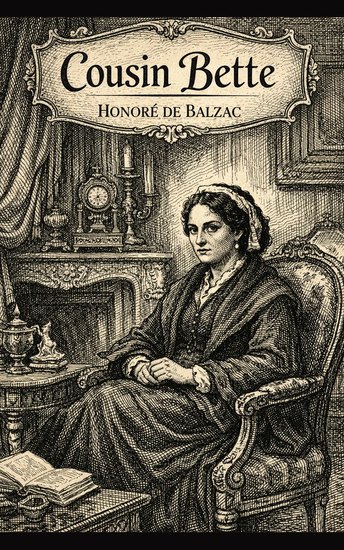
Cousin Bette - cover
LER

Cousin Bette

Honoré de Balzac

Editora: CLXBX

  • 0
  • 0
  • 0

Sinopse

Cousin Bette is one of Honoré de Balzac's most intense and psychologically penetrating novels, a dark and compelling exploration of envy, ambition, betrayal, and the destructive power of resentment. As a central work in Balzac's monumental series La Comédie Humaine, this gripping narrative dissects the moral decay beneath the glittering surface of Parisian high society in the 19th century.

At the heart of the story is Lisbeth Fischer—known as Cousin Bette—a poor relation of the wealthy Hulot family. Overlooked, unmarried, and long overshadowed by her more beautiful and fortunate relatives, Bette harbors a quiet but growing bitterness. Years of neglect and humiliation ferment into a calculated desire for revenge. Intelligent, patient, and ruthlessly observant, she waits for the perfect moment to strike.

The Hulot family, outwardly respectable and socially prominent, is already weakened by hidden excesses and moral failings. Baron Hulot's reckless indulgence and financial irresponsibility threaten the family's stability, while vanity and ambition blind its members to the dangers gathering around them. Into this fragile environment steps Bette, who forms a strategic alliance with the captivating and manipulative Valérie Marneffe—a woman equally skilled in deception and social maneuvering.

Together, they orchestrate a web of emotional manipulation, financial exploitation, and calculated betrayal that slowly ensnares the Hulots and their associates. Balzac masterfully traces how greed, lust, pride, and vengeance intertwine, exposing the vulnerability of those who believe themselves secure. What unfolds is not merely personal revenge but a broader commentary on the corrosive effects of unchecked desire and social ambition.

Through vivid characterization and intricate plotting, Balzac reveals the fragile foundations of wealth and respectability. The novel examines the shifting social structures of post-Napoleonic France, where fortunes rise and fall with alarming speed and moral compromise often replaces virtue. In this world, appearances mask desperation, loyalty is tested by self-interest, and even family bonds can become battlegrounds.

Yet Cousin Bette is more than a tale of vengeance. It is a profound study of human psychology. Balzac portrays Bette not as a simple villain, but as a deeply wounded individual shaped by exclusion and disappointment. Her calculated schemes are driven by long-suppressed pain, making her both terrifying and tragically human. Likewise, the weaknesses of her adversaries render them complicit in their own downfall.

Balzac's prose is rich, incisive, and unflinching in its realism. With remarkable detail, he captures the rhythms of Parisian life—its salons, studios, households, and financial dealings—while dissecting the moral tensions beneath them. The novel's emotional intensity and sharp social critique make it one of Balzac's most enduring and modern works.

Dark, dramatic, and deeply insightful, Cousin Bette remains a powerful meditation on envy, power, and the consequences of hidden resentment. It is a timeless exploration of how personal grievances, when nurtured in silence, can erupt into forces capable of destroying families, fortunes, and lives. For readers who appreciate classic literature rich in character depth and social commentary, this unforgettable novel offers a gripping and thought-provoking journey into the complexities of the human heart.
Disponível desde: 18/02/2026.
Comprimento de impressão: 539 páginas.

Outros livros que poderiam interessá-lo

  • Sophistication - From their pens to your ears genius in every story - cover

    Sophistication - From their pens...

    Sherwood Anderson

    • 0
    • 0
    • 0
    Sherwood Anderson was born on 13th September 1876 in Camden, Ohio. 
    When his father’s business failed the family was forced to move on a regular basis before finally settling in Clyde, Ohio.   
    Anderson, one of 7 children, left school at 14 to take a number of jobs to help with the family finances. These were difficult years. 
    He moved to Chicago in search of opportunities before joining the Army for the US-Spanish War of 1898.  He then entered Wittenberg Academy in Springfield, Ohio to complete his education before moving back to Chicago to take up a writing job. 
    In 1904 he married Cornelia Lane, her family had resources and Anderson was keen, with this family backing, to run a business. 
    The early years of their marriage produced 3 children but a nervous breakdown in 1907 and another in 1912, despite his success as a business entrepreneur, resulted in him abandoning his family and deciding that a literary career would be best for him.   
    A move back to Chicago resulted in a job in advertising, a divorce from Cornelia and marriage to Tennessee Mitchell.  
    That same year his first book ‘Windy McPherson’s Son’ was released and in 1919, his most famous book, ‘Winesburg, Ohio’, a collection of short stories about life in an Ohio town was released. 
    Anderson continued to write short stories, novels and non-fiction but his only true bestseller came with ‘Dark Laughter’.  His influence on writers that followed, from Faulkner to Hemingway, was immense. He also married a further two times.   
    Sherwood Anderson died in in Colón, Panama, on the 8th March, 1941. He was 64. An autopsy revealed that a swallowed toothpick had resulted in peritonitis. 
    His headstone epitaph reads ‘Life, Not Death is the Great Adventure.’
    Ver livro
  • All’s Well That Ends Well - cover

    All’s Well That Ends Well

    Tom Wheelwright, William...

    • 0
    • 0
    • 0
    The young and virtuous physician’s daughter Helena desperately loves Count Bertram, but he regards her as beneath his notice. 
    When Helena cures the king of France of a mortal illness, he rewards her with Bertram’s hand, but before their marriage can be consummated, the count flees. To win her husband back again, Helena forms a daring and resourceful plan. 
    A plot to unmask the strutting soldier Parolles makes up another strand in this sometimes disturbing comedy of deception and disguise. 
    ACT IScene 1. Bertram, the young Count of Rossillion, is leaving home to take his place at the court of the King of France, who is gravely ill. Bertram bids farewell to his mother the widowed Countess, her friend the old lord Lafew and the young and virtuous Helena, daugther of a famous doctor now deceased, who lives as a dependent in the old Countess’ household. Helena is passionately in love with Bertram, though without hope because he is so far above her in birth. Parolles, a blustering soldier who has attached himself to Bertram, is also going to the French court and Helena determines to follow. She has learned the mysteries of medicine from her father; if she can cure the King, she may win Bertram’s heart.Scene 2. The ailing King tells of war between the Florentines and Sienese; he will give permission to any young gentleman of France who wishes to go to Italy in search of glory. Bertram arrives and the King greets him warmly. Scene 3. The Countess gently forces Helena to admit her love for Bertram and reveal her plan to attempt the King’s cure. The old lady kindly offers her support. 
    ACT IIScene 1. Lafew announces the arrival at court of a young woman who claims to be able to heal the King. The King is deeply skeptical, but Helena persuades him to allow her to make the attempt. Should she succeed, the King is to grant her the husband of her choice.Scene 2. The Countess’ fool Lavatch is to be sent to the court. He claims that he has a response that will serve him in all social situations, but the Countess exposes his folly.Scene 3. Helena has restored the King to joyful health. He offers her the hand in marriage of any of the young lords at court, but when she chooses Bertram he recoils in horror. Angrily, the King commands Bertram to wed Helena instantly. The marriage takes place, but Bertram vows that he will never sleep with his bride and determines to steal away to the Italian wars at once.Scene 4. Helena receives a letter from Bertram telling her that he has been called away and ordering her to take leave of the King.Scene 5. Lafew warns Bertram that Parolles is a hollow sham. Helena enters and Bertram dismisses her curtly, instructing her to return to the Countess. 
    ACT IIIScene 1. The Duke of Florence prepares to welcome the young Frenchmen who come to fight on his behalf.Scene 2. Helena has received a letter from Bertram: until she can get the ring from his finger, which he has vowed never to remove, and produce a child that she has conceived by him, she will never be able to call him husband.Scene 3. The Duke of Florence, impressed by Bertram’s military promise, has given him an important command. Scene 4. The Countess has received a letter from Helena telling her that she has gone on a pilgrimage to atone for her sin in aspiring to Bertram’s love and freeing him from his responsibility for her. The Countess bitterly deplores her son’s arrogance and blindness.Scene 5. Helena has come to Florence where she meets a kindly widow and her beautiful daughter, Diana. The widow tells her that Bertram has fought heroically in the war but also that he has been attempting to seduce Diana. Scene 6. The French soldiers hatch a plot to convince Bertram of Parolles’ cowardliness; pretending to be enemy soldiers, they will capture him, then see if he is prepared to betray his friends.Scene 7. Helena, too, is setting a plot. Diana is to pretend to yield to Bertram’s suit on condition that he give her his ring. She
    Ver livro
  • A Christmas Mistake - cover

    A Christmas Mistake

    Lucy Maud Montgomery

    • 0
    • 0
    • 0
    Some mistakes carve wounds. Others, however, carve paths—twisting, unexpected roads that lead straight to the heart of what truly matters. In A Christmas Mistake, Montgomery paints a holiday tale where a simple misunderstanding reshapes lives in ways neither regret nor logic could predict. The charm of this story lies in its warmth, its humanity, and the quiet wisdom that sometimes, what seems like misfortune is nothing more than fate wrapped in disguise. Witty, touching, and utterly Montgomery, this is Christmas storytelling at its finest—where mishaps become blessings and where the wrong road just might lead to the right home.
    Ver livro
  • Middlemarch - A crowning masterpiece of Literary Fiction exploring the passionate ideals intricate marriages and scandalous gossip that bind a provincial English town - cover

    Middlemarch - A crowning...

    George Eliot

    • 0
    • 0
    • 0
    Before the gossip settles, a devastatingly unequal marriage will change the provincial town of Middlemarch forever. 
    In the tightly knit, observing community of Middlemarch, ambitious minds and restless hearts collide. Dorothea Brooke is a young woman of fierce, unyielding idealism, yearning for a life of intellectual grandeur and meaningful purpose. Blind to the affections of the eligible young Sir James Chettam, she becomes captivated by the austere, elderly scholar Edward Casaubon, believing she has found her epic destiny. But as Dorothea eagerly plunges into a premature engagement to aid him in his esoteric research, the brilliant facade of her chosen life threatens to crumble into an isolating reality. 
    Surrounded by a rich tapestry of town gossips, scheming relatives, and societal expectations, Dorothea's journey is only the beginning. As political tides turn and personal desires war with duty, every secret and whispered truth in this intricate web will be laid bare. 
    Why you will love this: A pinnacle of English Literary Fiction, this classic audiobook weaves unforgettable character studies with domestic tragedy and romantic tension. Fans of complex heroines, slow-burn psychological depth, and nineteenth-century provincial sagas will be utterly immersed in Eliot's meticulously crafted world. 
    About the Author: George Eliot, the pen name of Mary Ann Evans, was one of the leading writers of the Victorian era. Celebrated for her penetrating psychological insight and fierce intellect, her works dismantled societal norms and elevated the English novel to a sublime art form.
    Ver livro
  • Little Women (Part 1) - cover

    Little Women (Part 1)

    Louisa May Alcott

    • 0
    • 0
    • 0
    Little Women (Part 1): Four sisters and their mother, whom they call Marmee, live in a new neighborhood (loosely based on Concord) in Massachusetts in genteel poverty. Having lost all his money, their father is serving as a chaplain for the Union Army in the American Civil War, far from home. The mother and daughters face their first Christmas without him. When Marmee asks her daughters to give their Christmas breakfast away to an impoverished family, the girls and their mother venture into town laden with baskets to feed the hungry children. When they return, they discover their wealthy, elderly neighbor Mr. Laurence has sent over a decadent surprise dinner to make up for their breakfast. The two families become acquainted following these acts of kindness.
    Little Women is a coming-of-age novel written by American novelist Louisa May Alcott, originally published in two volumes in 1868 and 1869. The story follows the lives of the four March sisters—Meg, Jo, Beth, and Amy—and details their passage from childhood to womanhood. Loosely based on the lives of the author and her three sisters, it is classified as an autobiographical or semi-autobiographical novel.
    Ver livro
  • War and Peace Book 11 - cover

    War and Peace Book 11

    Leo Tolstoy

    • 0
    • 0
    • 0
    In Book 11 of War and Peace, post-war Russia navigates peace and rebuilding. Pierre Bezukhov, having found purpose, engages in philanthropy and philosophical pursuits. Natasha Rostova blossoms into a mature woman, embracing family life with renewed vigor. Nikolai Rostov faces financial challenges but perseveres, exemplifying duty and honor. Marya Bolkonskaya finds fulfillment in managing her estate and caring for her younger siblings. Tolstoy explores themes of contentment, responsibility, and the quiet joys of everyday life. As characters settle into their roles, they reflect on personal growth and the enduring strength of familial bonds, offering a poignant conclusion to their journeys.
    Ver livro