Join us on a literary world trip!
Add this book to bookshelf
Grey
Write a new comment Default profile 50px
Grey
Subscribe to read the full book or read the first pages for free!
All characters reduced
Odyssey - [Annotated & Illustrated] - cover

Odyssey - [Annotated & Illustrated]

Homeros, Samuel Butler

Publisher: E-Kitap Projesi & Cheapest Books

  • 0
  • 0
  • 0

Summary

The Odyssey (Greek: Odysseia) is one of two major ancient Greek epic poems attributed to Homer. It is, in part, a sequel to the Iliad, the other work ascribed to Homer. The poem is fundamental to the modern Western canon, and is the second oldest extant work of Western literature, the Iliad being the oldest. It is believed to have been composed near the end of the 8th century BC, somewhere in Ionia, the Greek coastal region of Anatolia.

The poem mainly centers on the Greek hero Odysseus (known as Ulysses in Roman myths) and his journey home after the fall of Troy. It takes Odysseus ten years to reach Ithaca after the ten-year Trojan War. In his absence, it is assumed he has died, and his wife Penelope and son Telemachus must deal with a group of unruly suitors, the Mnesteres or Proci, who compete for Penelope's hand in marriage.

It continues to be read in the Homeric Greek and translated into modern languages around the world. Many scholars believe that the original poem was composed in an oral tradition by an aoidos (epic poet/singer), perhaps a rhapsode (professional performer), and was more likely intended to be heard than read. The details of the ancient oral performance, and the story's conversion to a written work inspire continual debate among scholars. The Odyssey was written in a poetic dialect of Greek—a literary amalgam of Aeolic Greek, Ionic Greek, and other Ancient Greek dialects—and comprises 12,110 lines of dactylic hexameter. Among the most noteworthy elements of the text are its non-linear plot, and the influence on events of choices made by women and serfs, besides the actions of fighting men. In the English language as well as many others, the word odyssey has come to refer to an epic voyage.

The Odyssey has a lost sequel, the Telegony, which was not written by Homer. It was usually attributed in Antiquity to Cinaethon of Sparta, but in one source was said to have been stolen from Musaeus by Eugamon or Eugammon of Cyrene (see Cyclic poets).
Available since: 01/19/2024.
Print length: 500 pages.
Other books that might interest you

  • John Fisher and Thomas More - Keeping Their Souls While Losing Their Heads - cover

    John Fisher and Thomas More -...

    Robert J. Conrad Jr.

    • 0
    • 0
    • 0
    In 1929, nearly four hundred years after the deaths of Saints Thomas More and John Fisher, G.K. Chesterton observed in words equally attributable to Fisher, “Blessed Thomas More is more important at this moment than at any moment since his death, even perhaps the great moment of his dying; but he is not quite so important as he will be in a hundred years.” Judge Robert J Conrad, Jr. anticipates Chesterton’s one-hundred-year mark in a collection of stories from the lives of More and Fisher, demonstrating how their sanctity and integrity carried them and those who loved them through tumultuous and heart-wrenching times which, perhaps surprisingly, bear a striking resemblance to the present epoch. At first blush, nothing could appear more different than the pre-industrial sixteenth century and the tech-centered modern era. But a closer examination presents a similar tale of political maneuvering and hostile hearings, legal corruption, viral pandemics, riots, suppression of speech, loss of religious liberty, and a profound indifference for truth. Judge Conrad effortlessly weaves together tales of both men and what made them who they were—family, faith, friendship, oaths, vocation, detachment, conscience—inviting those who strive for holiness down the same narrow path these two martyrs walked with a clarity founded upon the truth of Christ’s Church, and a wit that charmed even their persecutors.  Both these men refused to consent to the theological farce that would permit the king’s divorce and remarriage and drive a wedge into the unity of the Christian world, and both paid for their convictions with their lives. More died the king’s good servant and God’s first. Fisher approached his execution with joy befit for a wedding. And yet, both stand today, long after they are gone, as models of courage in a time when it is desperately needed. 
    Show book
  • What Is Metaphysics What Is Philosophy and Other Writings - cover

    What Is Metaphysics What Is...

    Martin Heidegger

    • 0
    • 0
    • 0
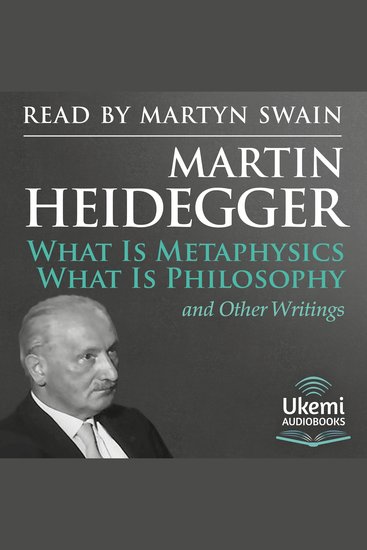
    This recording contains four important and related works by Heidegger: 'What Is Philosophy', 'What Is Metaphysics', 'On the Essence of Truth' and 'The Question of Being'. 
     
    It starts with 'What Is Philosophy', which originated as a lecture given in Normandy in 1955, and was first published a year later. The translators acknowledge that 'What Is Metaphysics' is often regarded as a particularly key work, they feel that 'a better preliminary understanding' of Heidegger can be obtained from 'What is Philosophy'. They write: Heidegger 'is concerned with the fact that philosophy has lost its receptivity to the Being of being/entity. In other words, philosophy no longer seeks the groundless ground of Being which allows us to ask meaningful questions about being/entity, or its appearances. Heidegger uses Being as the ‘inner light’, that illumination through which we become conscious of our meaning or of our existence and of existence itself. The light allows us to know that we are 'beings'. 
     
    The second work on this recording, then, is the more famous essay 'What Is Metaphysics', published in 1929, to which some 14 years later he added a 'Postscript'. Both texts are presented here. Heidegger states that rather than enter into a discussion about metaphysics, he sets out to ‘discuss a definite metaphysical question.... Our project begins with the presentation of a metaphysical question, then goes on to its development and ends with its answer'. 
     
    In 'On the Essence of Truth', (1930) Heidegger explains: 'The question as to the nature of truth is not concerned with whether truth is the truth of practical experience or of economic calculation...or the truth of scientific research or art...or religious belief...but what is ‘the mark of truth of every kind.' 
     
    The final essay on this recording is 'The Question of Being' (1955). Its original title, (in a literal translation from German), was 'Concerning the Line', and was included in a publication honouring the 60th birthday of the philosopher Ernst Jünger. Heidegger wrote it in the form of a letter in response to an earlier treatise Jünger dedicated to Heidegger called 'Across the Line'. Heidegger questions Jünger’s notion of ‘zero line’, of nihilism: the essence of nihilism stems from a discussion of Being as being/entity. 
     
    Translations by Jean T. Wilde and William Kluback ('What Is Philosophy' and 'The Question of Being') and R. F. C. Hull ('What Is Metaphysics' and 'On the Essence of Truth').
    Show book
  • Mother-Daughter Startup - cover

    Mother-Daughter Startup

    Poorvi Gupta

    • 0
    • 0
    • 0
    Mother-daughter startup Indulgeo Essentials boasts of a women-only team
    Show book
  • Summary of The High 5 Habit - Take control of your life with one simple habit by Mel Robbins - cover

    Summary of The High 5 Habit -...

    BOOK TIGERS

    • 0
    • 0
    • 0
    Do you have an unrealized dream in your life but have been too scared to go for it? 
    Do you struggle with self-doubt, but are willing to put in the effort to do better? 
    We all have periods in our lives when we need to feel encouraged and uplifted. We may still be able to get by in life, assisting others and doing what needs to be done, but this means we are neglecting someone extremely important: ourselves. This book will teach you how to take care of yourself. A simple action each morning really can make a significant difference in our lives as you take steps to immediately boost your confidence, happiness, and results. 
    This book, Summary of The High 5 Habit: Take Control of Your Life with One Simple Habit By Mel Robbins, is an unofficial summary and analysis of the original which includes: 
    ·    Book Summary Overview 
    ·    Chapter by Chapter Analysis 
    ·    Background Information about the book 
    ·    Background information about the author 
    ·    Trivia questions, Discussion questions 
    ·    And much more… 
    This book will show you how to take better care of yourself, giving the love and encouragement you deserve. Even if your biggest dream never comes to pass, learning to be your own master puts you on the right path and can lead to greater success. 
    Scroll up and click Add to Cart for your copy now! 
    Disclaimer: 
    This is an UNOFFICIAL summary and analysis, not the original book. 
    It is designed to record all the key points of the original and will provide you with an overview before or after reading the original.
    Show book
  • The Heavy Water War - Beating Hitler to the Bomb - cover

    The Heavy Water War - Beating...

    John Sadler

    • 0
    • 0
    • 0
    During the course of the Second World War, the Allies mounted a series of attempts to prevent Germany from manufacturing heavy water utilising hydroelectric plants in occupied Norway. These efforts comprised a mix of bomber and Commando raids. The overall aim was to stop Nazi Germany building a nuclear bomb. In fact, Hitler was never as close as the Allies thought, but the idea that his regime could construct and deploy such a device was the ultimate doomsday scenario, one that would have tilted the balance in favour of the Nazis. The mere threat might have been sufficient to force a negotiated peace with the perception of a Nazi bomb hanging over the world like a nuclear-powered sword of Damocles. 
     
    Production, and therefore the Allied target, centred on the Vemork Power Station standing by the Rjukan Waterfall at Telemark. A series of daring raids – Operations Grouse, Freshman and Gunnerside – neutralised the plant’s capacity. In Operation Freshman, every single glider-borne paratrooper was either captured or killed. In February 1943, a force of SOE-trained Norwegian Commandos succeeded in sabotaging the plant’s production capacity. Further manufacturing effort was abandoned, and the Nazis attempted to spirit away the heavy water they had on the ferry SF Hydro. The Norwegians managed to sink the vessel in the deep waters of Lake Tinn. Using primary source material and published on the 80th anniversary of the sinking of the Hydro, The Heavy Water War tells a story of extraordinary courage and endurance. The stakes in any special forces raid in history have never been higher.
    Show book
  • The Timeline of Intelligent Life on Earth - cover

    The Timeline of Intelligent Life...

    Martin K. Ettington

    • 0
    • 0
    • 0
    I’m fascinated with Ancient History because there are continuous new discoveries which push back the dawn of civilization by thousands of years. In the last couple of decades, the discoveries at Gobekli Tepe in eastern Turkey pushed back man-made structures to the time period of 9,000-11,000 B.C. Thousands of years before the next know civilizations existed.This book includes my research on ancient sites around the world, underground structures, giants, the destruction of civilization about 10,500 B.C., the real Atlantis, and out of place objects which can be millions of years old.With this collection of a wide variety of information I decided that what is needed is a full timeline of intelligent life on Earth from millions of years ago to the present. There are a lot of gaps in this information but enough records, findings, and discoveries exist to propose an initial timeline of intelligent life on Earth going back hundreds of millions of years.Yes-I’m saying intelligent life has existed on Earth that long, and since humanity and even primates don’t exist in those times at all, aliens must have lived on the Earth at that time. There are three parts to this book:Part One - Millions of Years AgoThis includes stories of aliens existing on Earth in our history, and many out of place objects made by intelligent beings, and the fossil record which provides supporting evidence that intelligent life did exist at those times.Part Two - The Unknown Civilizations of ManHere we have evidence of structures built by man but way before any accepted records that civilization or man made constructions existed. Some of these things may go back 100,000 years ago.Part Three – Post Ice Age CivilizationsThis part includes evidence that the Younger Dryas event was actually comets striking the Earth which caused major disasters and probably the destruction of civilizations about 10,500 B.C.My intention is that this timeline will provide a skeleton to be filled in.
    Show book