Join us on a literary world trip!
Add this book to bookshelf
Grey
Write a new comment Default profile 50px
Grey
Subscribe to read the full book or read the first pages for free!
All characters reduced
History of English Literature (Vol 1-3) - A Deep Dive into English Literary Evolution and Criticism - cover

History of English Literature (Vol 1-3) - A Deep Dive into English Literary Evolution and Criticism

Hippolyte Taine

Translator Henry Van Laun

Publisher: Good Press

  • 0
  • 0
  • 0

Summary

Hippolyte Taine's "History of English Literature" (Volumes 1-3) stands as a seminal work that intricately weaves together literary analysis and cultural criticism, offering a comprehensive exploration of the evolution of English literature from its origins to the 19th century. Taine employs a meticulous approach, utilizing a blend of psychological, sociological, and environmental factors to elucidate the influences shaping literary movements. His writing style, rich in erudition and clarity, invites readers to appreciate the interplay between literature and the social fabric of its time, drawing connections between pivotal texts and the historical circumstances of their creation. Taine, a prominent figure in 19th-century literary criticism, was influenced by the intellectual currents of positivism and empiricism. His background in philosophy and keen interest in the sciences informed his belief that literature is an expression of the collective psyche of a society. His travels and encounters with various literary forms further fueled his desire to analyze the intrinsic link between culture and literature, leading to the inception of this monumental work. "History of English Literature" is an indispensable resource for scholars, students, and casual readers alike who seek to deepen their understanding of literary development and its contextual underpinnings. Taine's profound insights not only enrich the appreciation of English literary heritage but also provoke thoughtful reflection on how literature mirrors the human experience across time.
Available since: 12/23/2023.
Print length: 1755 pages.
Other books that might interest you

  • Survivability - Confronting the Unmitigated Risks & Unprecedented Threats of Today’s Geo-Poli-Cyber™ Warfare to Survive and Competitively Thrive into the 21st Century - cover

    Survivability - Confronting the...

    Khaled Fattal

    • 0
    • 0
    • 0
    Today, safeguarding nation-states, organizations, and citizens has less to do with security (cyber and non-cyber) but has everything to do with Survivability.We are now in the 'Era of the Unprecedented': since 2010, Geo-Poli-Cyber™ warfare has been increasing in intensity. The motivation of its perpetrators is often driven by political, ideological, ‘religious’ and extremist objectives, rather than financial gain. Many top decision makers and citizens are unaware of this reality or the implications it has on their sovereignties, businesses, lives and livelihoods, and most do not know how to mitigate it. This trend has seen governments and businesses constantly breached by high-impact cyberattacks, confirming the ineptitude of best in class cyber security strategies, solutions, policies and procedures. Yet, they continue implementing what they know is failing and ineffective. 
    The 2020 pandemic revealed a fundamental flaw in many Western democratic nations; their failure to appropriately prepare for a threat they knew was coming and the cost of this in human lives. This pandemic has shed light on the weaknesses of the current international order and economic, political, legal and democratic models and structures that enable it. It has also called into question the capacity of existing cyber security protocols and designs to protect nations, companies and citizens. The question remains: are governments ready for cyber terrorism, election meddling, fake news and the malicious use of artificial intelligence and quantum computing? How about them all happening at the same time? Survivability provides potential answers to this and other pressing concerns.
    Show book
  • Healing Anxious Attachment for Black Women - Stop Overthinking and Toxic Thoughts Discover Your Attachment Style and Become More Secure in Life and Love While Building Healthy Relationships - cover

    Healing Anxious Attachment for...

    BW HARRIET

    • 0
    • 0
    • 0
    Are your relationships marked by overthinking, insecurity, or a constant need for reassurance? Do you find yourself questioning your worth or struggling to break free from unhealthy patterns?It’s time to reclaim your power, heal past wounds, and create the fulfilling relationships you deserve. 
    This empowering guide blends insightful psychology, cultural wisdom, and practical strategies to help you break free from anxious attachment patterns and thrive in life and love. 
    What You’ll Discover:The Roots of Anxious Attachment: Uncover how childhood experiences, cultural expectations, and societal pressures shape your attachment style.Healing Past Wounds: Explore actionable steps to release the pain of the past and replace toxic thoughts with affirming beliefs.Building Self-Worth and Emotional Independence: Learn how to embrace your inherent value while fostering a healthy balance of connection and autonomy.Creating Healthy Relationships: Master the art of setting boundaries, expressing your needs, and forming secure, loving connections with others.Long-Term Growth: Reinforce your healing journey with daily rituals, affirmations, and practical exercises that empower you to thrive in every area of your life. 
    You are not defined by your past. You have the power to rewrite your narrative, create healthy connections, and embrace your worthiness. Anxious Attachment for Black Women is your guide to doing just that—one small, intentional step at a time.It’s time to stop overthinking, start healing, and become the confident, secure, and empowered woman you’re meant to be.
    Show book
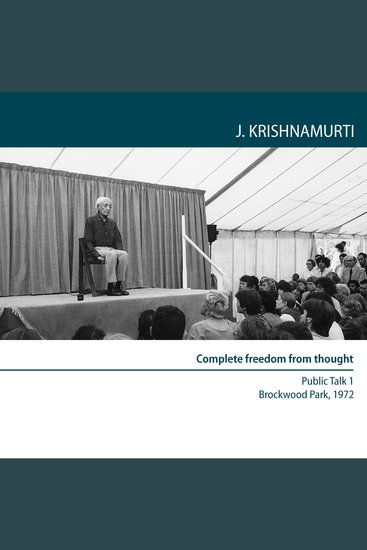
  • Complete Freedom From Thought - Brockwood Park 1972 Public Talk 1 - cover

    Complete Freedom From Thought -...

    Jiddu Krishnamurti

    • 0
    • 0
    • 0
    Complete freedom from thought - 9 September 1972 
    • Learning is instant perception and action. What place has thought in learning? 
    • To learn about freedom must thought be completely silent? Does insight into 
    freedom take time? 
    • Can thinking, however rational, bring about a psychological revolution in us? 
    • Is thought always conditioned? Is freedom the non-existence of thought? 
    • My very being is related to thought. If you want to see something new, what do 
    you do? 
    • To have insight, let go of the old and listen. 
    • Learning is not memorizing. 
    • Q: Is feeling another way of thinking? 
    • Q: Isn’t the need to love and be loved essential? 
    • Needing love is love of self.
    Show book
  • The Complex PTSD Treatment Manual - An Integrative Mind-Body Approach to Trauma Recovery - cover

    The Complex PTSD Treatment...

    Arielle Schwartz

    • 0
    • 0
    • 0
    In The Complex PTSD Treatment Manual, clinicians will find the road map they need to conduct successful therapy with clients who have experienced prolonged exposure to traumatic events. Combining the science and art of therapy, Dr. Arielle Schwartz seamlessly integrates research-based interventions with the essentials of healing to create a whole-person approach to trauma treatment. 


    Drawing from her years of experience in working with trauma survivors, Dr. Schwartz provides clinicians with the tools they need to become a trustworthy companion to trauma survivors and become capable of guiding a healing journey for clients with a history of abuse or neglect. In this book, you will find: 


    ● Essential interventions that strengthen mindful body awareness, enhance distress tolerance, cultivate self-compassion, and facilitate trauma recovery 


    ● Practices and self-reflection points to utilize in each stage of the client's therapeutic process 


    ● Integration of several therapeutic approaches for trauma treatment, including relational therapy, mindful body awareness, parts work therapy, CBT, EMDR, somatic psychology, and practices drawn from complementary and alternative medicine
    Show book
  • Simple Sabotage Field Manual - cover

    Simple Sabotage Field Manual

    Office of Strategic Services

    • 0
    • 0
    • 0
    Originally classified and issued by the Office of Strategic Services (OSS) in 1944, the Simple Sabotage Field Manual is a fascinating glimpse into the art of covert disruption. Designed to empower resistance fighters and ordinary civilians in enemy-occupied territories, this manual details ingenious yet subtle techniques to undermine organizations, supply chains, and industrial efficiency—all without drawing suspicion.   
    Inside, you’ll discover:   
    ✅ How to slow down bureaucracies & industries with everyday inefficiencies   
    ✅ Tactics to disrupt transportation, communication, and workplace productivity   
    ✅ Psychological methods to create confusion & mismanagement   
    ✅ Techniques still studied today in intelligence and organizational sabotage   
    Whether you're a history enthusiast, military strategist, or just intrigued by the psychology of disruption, this declassified wartime manual offers a remarkable look into how simple acts of resistance can have massive strategic consequences.   
    📖 Perfect for:   
    ✔️ Fans of WWII espionage history   
    ✔️ Intelligence & security professionals   
    ✔️ Business leaders studying inefficiency & workplace dynamics   
    ✔️ Readers interested in guerrilla tactics & psychological warfare
    Show book
  • Most Famous Silent Film Actors The: The History of the Actors Who Helped Shape Hollywood in the Roaring Twenties - cover

    Most Famous Silent Film Actors...

    Editors Charles River

    • 0
    • 0
    • 0
    Only a select few actors become international stars in their time, but none had as unique a career as Charlie Chaplin. Chaplin was the first true film star, and he managed to do so even when films were still silent. He has been honored with too many awards to count, and the fact that his name remains instantly recognizable nearly a century after his first film is a testament to his influence. Chaplin is known for the singular blend of pathos and humor evinced by his films, and it is not uncommon for audiences to laugh and cry at alternate points of a Chaplin film, a trait that continues to endear audiences even to this day. 
    In the 1920s, the burgeoning movie industry was starting to come into its own, and alongside actor and director Charlie Chaplin, Buster Keaton was at the peak of Hollywood. It’s no surprise that Keaton was so effective in silent films, because he had been practicing comedy in his family’s vaudeville acts as “The Little Boy Who Can’t Be Damaged”, becoming a popular performer by the age of 5. Indeed, his physical form of comedy, which initially involved having his father throwing him around the stage, translated well onto the screen, and some of his slapstick and other comic gags remain legendary even today, in part because Keaton practiced his own stunts.  
    Everything about Rudolph Valentino, from his body to the characters he played, was exotic. His career may have been abbreviated by his premature death at the age of 31, but Valentino popularized the (somewhat racist) stereotype of the “Latin lover” in Hollywood, and even his name was markedly more out of the ordinary than those of other actors. In an era dominated by hyper-masculine actors like Douglas Fairbanks, or comedians such as Charlie Chaplin and Buster Keaton, Valentino had a more ethnic and mysterious appeal, and he was lusted after by women to a degree that remains unsurpassed in the industry.
    Show book