Join us on a literary world trip!
Add this book to bookshelf
Grey
Write a new comment Default profile 50px
Grey
Subscribe to read the full book or read the first pages for free!
All characters reduced
Tai Chi for Seniors Over 60 - The Comprehensive Guide to Mastering Essential Forms Enhancing Balance and Stability and Releasing Chronic Pain through Slow Mindful Movement - cover

Tai Chi for Seniors Over 60 - The Comprehensive Guide to Mastering Essential Forms Enhancing Balance and Stability and Releasing Chronic Pain through Slow Mindful Movement

Hibbert Sidney

Publisher: BookRix

  • 0
  • 0
  • 0

Summary

Transform Your Golden Years with the Ancient Art of Tai ChiDiscover how slow, mindful movement can dramatically improve your balance, ease chronic pain, and restore your confidence in just minutes a day."Tai Chi for Seniors Over 60" is your complete step-by-step guide to mastering this gentle yet powerful practice—no prior experience needed.Inside, you'll find:• Essential tai chi forms broken down into simple, easy-to-follow movements• Fall prevention techniques clinically proven to enhance stability and coordination• Pain relief strategies for arthritis, joint stiffness, and chronic discomfort•Balance and strength exercises specifically designed for the 60+ body• Breathing and meditation practices to reduce stress and calm the mind• Safety modifications for all fitness levels and physical limitations • Progressive programs that grow with you at your own paceWhether you're dealing with balance issues, seeking natural pain management, or simply want to feel stronger and more flexible, this comprehensive guide meets you exactly where you are. No gym required. No special equipment. Just you, your breath, and gentle movements that heal from the inside out.Buy your copy now and take the first step toward greater stability, less pain, and vibrant aging!
Available since: 02/08/2026.
Print length: 122 pages.


Other books that might interest you

  • Racing to Victory - A Comprehensive Guide to Track and Field - cover

    Racing to Victory - A...

    Zane Ryder

    • 0
    • 0
    • 0
    Track and field is one of the oldest and most celebrated sports in human history, dating back to ancient civilizations. Rooted in the basic human movements of running, jumping, and throwing, it has evolved into a dynamic and diverse athletic discipline that tests physical prowess, mental resilience, and strategic thinking. This chapter provides an overview of the sport, its rich history, and the variety of events that make up its exciting landscape. 
    The origins of track and field can be traced to the ancient Olympic Games in Greece, where events such as the stadion race—a short sprint—and the pentathlon captivated audiences. Over centuries, the sport expanded and adapted, becoming a cornerstone of modern athletics. Today, it encompasses a wide range of events, divided into three main categories: track events, field events, and combined events. 
    Track events include sprints, middle-distance and long-distance races, hurdles, and relays. These races test speed, endurance, and teamwork, often decided by fractions of a second. Field events, on the other hand, showcase an athlete's power and precision. Competitors excel in throwing disciplines such as shot put, discus, and javelin, as well as jumping events like the long jump, high jump, triple jump, and pole vault. Combined events, such as the decathlon and heptathlon, require athletes to master a mix of track and field disciplines, demanding unparalleled versatility.
    Show book
  • The Road to Barcelona - The Glory of 72 and My Life in Football - cover

    The Road to Barcelona - The...

    David B. Smith

    • 0
    • 0
    • 0
    'EIGHT YEARS WITH RANGERS, MORE THAN 300 GAMES, INCREDIBLE HIGHS, PAINFUL LOWS – AND IT ALL CAME DOWN TO ONE NIGHT IN THE NOU CAMP'
    24 May 1972. The biggest night in the history of Rangers. Having overcome the might of Italian giants Torino and Beckenbauer's Bayern Munich en route to the final of the European Cup Winners' Cup, Dynamo Moscow stood between the Light Blues and the trophy.
    The stage was set in Barcelona for an unsung hero: Dave Smith. Creator of two of the goals on the night and arguably man of the match.
    In a rollercoaster career, Smith joined the Ibrox club from Aberdeen in 1966 for a record fee. He tasted defeat in the 1967 European Cup Winners' Cup final and had his career blighted by two horrific leg breaks during a period in which he also experienced the tragedy of the Ibrox disaster.
    But by 1972 Smith was a lynchpin of Willie Waddell's team. Playing as sweeper, he dicated the tempo of games with his vision and pinpoint passing. The star of the Nou Camp victory was voted Player of the Year in Scotland to cap the most memorable of seasons.
    He departed Rangers in 1974, making a shock switch to Arbroath after a fallout with new Ibrox manager Jock Wallace, before going on to star overseas in South Africa and then alongside George Best for the LA Aztecs in America. Rejecting the chance to join Paris Saint-Germain, Smith chose to end his career in Scotland's lower leagues as player-manager at Berwick Rangers where he would find success and happiness playing the game the way it was meant to be played.
    Show book
  • Ultimate Frisbee Fundamentals - Skills and Strategies for Success - cover

    Ultimate Frisbee Fundamentals -...

    Zane Ryder

    • 0
    • 0
    • 0
    Ultimate Frisbee, often referred to simply as "Ultimate," is a fast-paced, non-contact team sport played with a flying disc. Combining elements of soccer, basketball, and American football, it emphasizes athleticism, strategy, and sportsmanship. Originating in the late 1960s in the United States, Ultimate has grown into a global phenomenon, with leagues and tournaments held across the world. 
    The game is typically played between two teams of seven players on a rectangular field with end zones at each end. The objective is to score points by catching the disc in the opposing team’s end zone. Players advance the disc by passing it to teammates, as running while holding the disc is not allowed. A turnover occurs if the disc is intercepted, dropped, or thrown out of bounds, giving the opposing team possession. 
    One of the defining features of Ultimate Frisbee is the "Spirit of the Game," a principle that emphasizes fair play, mutual respect, and self-officiation. Players are responsible for calling fouls, resolving disputes, and ensuring the game is played in an honest and respectful manner. This unique approach fosters a sense of community and camaraderie among players.
    Show book
  • How Soccer Explains the World - An Unlikely Theory of Globalization - cover

    How Soccer Explains the World -...

    Franklin Foer

    • 0
    • 0
    • 0
    “An eccentric, fascinating exposé of a world most of us know nothing about. . . . Bristles with anecdotes that are almost impossible to believe.” —New York Times Book Review 
    “Terrific. . . . A travelogue full of important insights into both cultural change and persistence. . . . Foer’s soccer odyssey lends weight to the argument that a humane world order is possible.” — Washington Post Book World 
    A groundbreaking work—named one of the five most influential sports books of the decade by Sports Illustrated—How Soccer Explains the World is a unique and brilliantly illuminating look at soccer, the world’s most popular sport, as a lens through which to view the pressing issues of our age, from the clash of civilizations to the global economy. 
    From Brazil to Bosnia, and Italy to Iran, this is an eye-opening chronicle of how a beautiful sport and its fanatical followers can highlight the fault lines of a society, whether it’s terrorism, poverty, anti-Semitism, or radical Islam—issues that now have an impact on all of us. Filled with blazing intelligence, colorful characters, wry humor, and an equal passion for soccer and humanity, How Soccer Explains the World is an utterly original book that makes sense of our troubled times.
    Show book
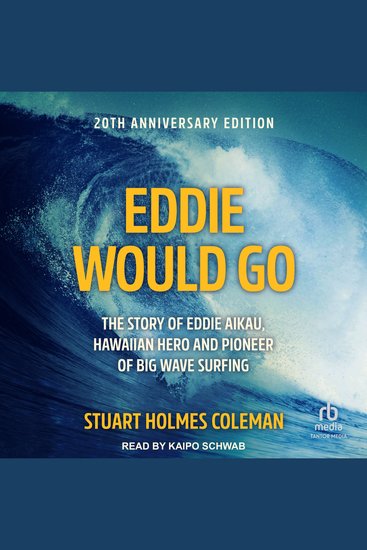
  • Eddie Would Go - The Story of Eddie Aikau Hawaiian Hero and Pioneer of Big Wave Surfing - cover

    Eddie Would Go - The Story of...

    Stuart Holmes Coleman

    • 0
    • 0
    • 0
    From surfer and writer Stuart Holmes Coleman, Eddie Would Go is the compelling story of Eddie Aikau's legendary life and legacy, a pipeline into the exhilarating world of surfing, and an important chronicle of the Hawaiian Renaissance and the emergence of modern Hawaii. 


    In the 1970s, a decade before bumper stickers and T-shirts bearing the phrase Eddie Would Go began popping up all over the Hawaiian islands and throughout the surfing world, Eddie Aikau was proving what it meant to be a "waterman." As a fearless and gifted surfer, he rode the biggest waves in the world; as the first and most famous Waimea Bay lifeguard on the North Shore, he saved hundreds of lives from its treacherous waters; and as a proud Hawaiian, he sacrificed his life to save the crew aboard the voyaging canoe Hokule'a.
    Show book
  • Official US Army Survival Guide The: Updated Edition - FM 30-0570 (FM 21-76) - cover

    Official US Army Survival Guide...

    US Army, Rick Carlile

    • 0
    • 0
    • 0
    Over 15 hours of life-saving survival information: the most extensive and comprehensive survival audiobook available anywhere.
    
    Created and trusted by US military forces, expertly adapted for the audiobook format.
    
    Essential preparedness for any survival situation. Listen and learn survival skills while you work, rest, or travel, and store it on your personal device so you'll have it when you need it.
    
    The indispensable field manual for preppers, hunters, campers, outdoorspeople, hikers and more.
    
     
    PREFACE
    
     
    As a soldier, you can be sent to any area of the world. It may be in a temperate, tropical, arctic, or subarctic region. You expect to have all your personal equipment and your unit members with you wherever you go. However, there is no guarantee it will be so. You could find yourself alone in a remote area—possibly enemy territory—with little or no personal gear. This manual provides information and describes basic techniques that will enable you to survive and return alive should you find yourself in such a situation. 
     
    If you are a trainer, use this information as a base on which to build survival training. You know the areas to which your unit is likely to deploy, the means by which it will travel, and the territory through which it will travel. Read what this manual says about survival in those particular areas and find out all you can about those areas. Read other books on survival. Develop a survival-training program that will enable your unit members to meet any survival situation they may face. It can make the difference between life and death.
    
     
    CONTENTS
    
     
    Chapter 1. Introduction.
     
    Chapter 2. Psychology of Survival.
     
    Chapter 3. Survival Planning and Survival Kits.
     
    Chapter 4. Basic Survival Medicine.
     
    Chapter 5. Shelters.
     
    Chapter 6. Water Procurement.
     
    Chapter 7. Firecraft.
     
    Chapter 8. Food Procurement.
     
    Chapter 9. Survival Use of Plants.
     
    Chapter 10. Poisonous Plants.
     
    Chapter 11. Dangerous Animals.
     
    Chapter 12. Field-Expedient Weapons, Tools, and Equipment.
     
    Chapter 13. Desert Survival.
     
    Chapter 14. Tropical Survival.
     
    Chapter 15. Cold Weather Survival.
     
    Chapter 16. Sea Survival.
     
    Chapter 17. Expedient Water Crossings.
     
    Chapter 18. Field-Expedient Direction Finding.
     
    Chapter 19. Signaling Techniques.
     
    Chapter 20. Survival Movement in Hostile Areas.
     
    Chapter 21. Camouflage.
     
    Chapter 22. Contact with People.
     
    Chapter 23. Survival in Man-Made Hazards.
     
    Appendix A. Survival Kits.
     
    Appendix B. Edible and Medicinal Plants.
     
    Appendix C. Poisonous Plants.
     
    Appendix D. Dangerous Insects and Arachnids.
     
    Appendix E. Venomous Snakes and Lizards.
     
    Appendix F. Dangerous Fish and Mollusks.
     
    Appendix G. Ropes and Knots.
     
    Appendix H. Clouds: Foretellers of Weather.
     
    Appendix I. Evasion Plan of Action Format.
     
    Glossary.
    
     
    Provided for information purposes only. Any action you take is at your own risk.
    
     
    Published in the U.S.A. by CARLILE MEDIA.
    Show book