Join us on a literary world trip!
Add this book to bookshelf
Grey
Write a new comment Default profile 50px
Grey
Subscribe to read the full book or read the first pages for free!
All characters reduced
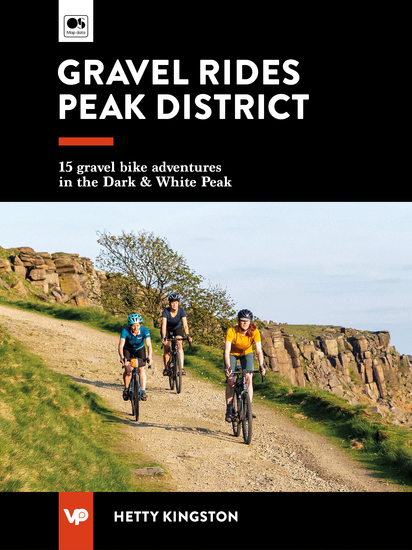
Gravel Rides Peak District - 15 gravel bike adventures in the Dark & White Peak - cover

Gravel Rides Peak District - 15 gravel bike adventures in the Dark & White Peak

Hetty Kingston

Publisher: Vertebrate Publishing

  • 0
  • 0
  • 0

Summary

Gravel Rides Peak District showcases 15 of the best gravel bike rides in the stunning Peak District National Park. From 18 to 107 kilometres in length and covering a variety of terrain, there is something for every gravel cyclist.
Explore the fast-rolling, smooth gravel of disused railway lines on the High Peak Trail and Monsal Trail, traverse the breathtaking gritstone Eastern Edges on the edge of Sheffield, and discover unexpected gravel delights tucked away in the most unexpected places in the Dark and White Peak.
Researched, ridden and written by Peak local Hetty Kingston, the routes feature clear and easy-to-use Ordnance Survey maps; easy-to-follow directions; details of distance, timings and difficulty gradings; stunning action photography; refreshment stops and local knowledge; and a detailed appendix. Also included is a link to downloadable GPX files.
Available since: 07/04/2024.
Print length: 128 pages.

Other books that might interest you

  • Kamakura Shogunate - Samurai Power and the Mongol Invasions - cover

    Kamakura Shogunate - Samurai...

    Rolf Hedger

    • 0
    • 0
    • 0
    The rise of the Kamakura Shogunate marks a pivotal moment in Japanese history, transitioning from the aristocratic Heian period to the feudal system dominated by the samurai. This era began with the victory of Minamoto no Yoritomo, who, after the Genpei War (1180-1185), established a new form of governance centered in Kamakura, a small coastal town far from the imperial capital of Kyoto. 
    The Genpei War was a civil conflict between the Taira and Minamoto clans, which ultimately ended with the defeat of the Taira in the Battle of Dan-no-ura in 1185. Minamoto no Yoritomo, the leader of the Minamoto clan, emerged as the victor, but his triumph was not simply a personal or clan-based success. Yoritomo's victory laid the foundation for a shift in the political landscape of Japan. The Taira had represented the old courtly aristocracy that governed Japan through the imperial system, but the rise of the Minamoto signaled the beginning of samurai dominance and a move toward military rule. 
    In 1192, Yoritomo was granted the title of shogun by the emperor, an act that formalized his military authority. This title, meaning "generalissimo" or "commander of the army," was traditionally given to military leaders in times of war but had never been used as the primary governing title before. This marked the official beginning of the Kamakura Shogunate, a military dictatorship that would rule Japan for over a century. Though the emperor remained the nominal ruler, Yoritomo’s power was based in Kamakura, far from the imperial court, which shifted the balance of power from the capital to the military elite.
    Show book
  • The Autonomous Cruiser - cover

    The Autonomous Cruiser

    Michelle Monro

    • 0
    • 0
    • 0
    With the expansion of the cruising sector, it is difficult to keep up as the goalposts keep changing, but one thing hasn't changed: the travel industry's inability to provide a disabled traveller with what they need to plan a stress-free adventure.
    Information on accessibility can be hard to find and the internet is filled with dead and out-of-date sites. Being disabled can be hard enough but I believe information is power, the power to be able to control our choices and know what we are going to come up against when we pick a cruise.
    This general how-to on cruising is the first of its kind, aimed at giving you the power to make your own choices, take control and organise the perfect seafaring holiday, getting the best out of both the ship and its destinations.
    Bon Voyage
    Show book
  • Peru - A Historical and Economic Exploration - cover

    Peru - A Historical and Economic...

    Anya Solace

    • 0
    • 0
    • 0
    Peru, a nation of remarkable diversity, is a land where history and economy intertwine to shape its identity. Situated on the western coast of South America, it is home to towering Andean peaks, vast coastal deserts, and the lush Amazon rainforest. These geographic variations have influenced its people, cultures, and economic activities for centuries. From ancient civilizations to modern industries, Peru’s journey has been one of resilience, adaptation, and transformation. Understanding its past and present is key to appreciating the forces that have shaped the country’s economic and social landscape.  
    The history of Peru is as rich and complex as its terrain. Long before Spanish colonization, the region was home to advanced societies that flourished through agriculture, trade, and engineering. The Inca Empire, with its vast network of roads and innovative agricultural terraces, stands as one of the greatest pre-Columbian civilizations in the Americas. However, the arrival of the Spanish in the 16th century marked a turning point. Colonization led to profound economic and political changes, as the Spanish exploited Peru’s vast silver mines and established a rigid social hierarchy. This period set the foundation for many of the economic structures that persisted for centuries.  
    Peru’s economic evolution has been shaped by both internal and external forces. Following independence in the 19th century, the country faced political instability and economic challenges, struggling to define its national identity. The exploitation of natural resources remained central to the economy, from guano and rubber in the 19th century to copper and gold in the modern era. Industrialization and foreign investment played key roles in Peru’s economic development, but these also led to periods of inequality and social unrest.
    Show book
  • Flowers of War - cover

    Flowers of War

    Llŷr Gwyn Lewis

    • 0
    • 0
    • 0
    When the author is given a small package, containing letters and papers relating to his grandfather's brother, who was killed in Syria during the Second World War, it leads him on an extended personal journey. An exploration of history, imagination and the process of memory, shifting imperceptibly from autobiography to travelogue, from letters and diaries to official records, from text to visual image.
    
    In his first prose work Lewis reveals a rare and consummate literary talent. Deeply rooted in his Welsh identity, this young writer locates his own and his family's experience within the wider European world in a thoughtful, mature and highly original book.
    
    Flowers of War is a translation of Rhyw Flodau Rhyfel (Y Lolfa, 2014), which won the Creative Non-Fiction category in the 2015 Wales Book of the Year award.
    Show book
  • The Eighty Years War - The Netherlands War of Independence against the Spanish - cover

    The Eighty Years War - The...

    Kelly Mass

    • 0
    • 0
    • 0
    The war between the protestant Netherlands, mostly led by William of Orange, and Catholic Spain, was one of the marks in Dutch history. This war has determined the beliefs of many people who now live about the three rivers that go through the country: Most of the people north of the rivers are protestant, and most of the believers below them (even throughout Belgium as well) are Catholic. This is no coincidence. 
    The war in the 1600s has become a symbol of Dutch resistance, independence, and the royal family (of Orange). In that sense, traditions date back hundreds of years, some them that have their roots in this century. Learn more about what caused the 80 years of war between these two countries, how France was involved, and how it helped form the boundaries and borders of those countries today.
    Show book
  • The Big Quiet - One Woman's Horseback Ride Home - cover

    The Big Quiet - One Woman's...

    Lisa D. Stewart

    • 0
    • 0
    • 0
    At 54, Lisa Stewart set out to regain the fearless girl she once had been, riding her horse, Chief, 500 miles home. Hot, homeless, and on horseback, she snapped back into every original cell. On an extraordinary homegoing from Kansas City to Bates and Vernon Counties in Missouri, Lisa exhausted herself, faced her past, trusted strangers, and stayed in the middle of her frightened horse to document modern rural America, the people, animals, and land.
    Show book