Join us on a literary world trip!
Add this book to bookshelf
Grey
Write a new comment Default profile 50px
Grey
Subscribe to read the full book or read the first pages for free!
All characters reduced
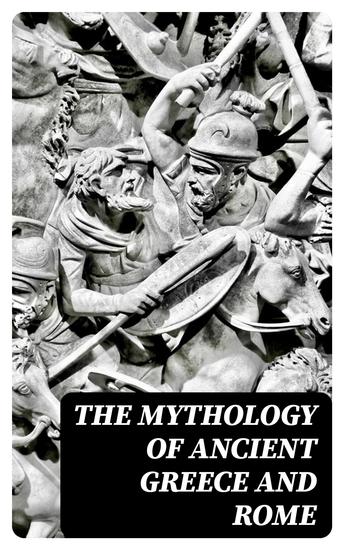
The Mythology of Ancient Greece and Rome - Theogony Iliad Odyssey & Metamorphoses - cover

The Mythology of Ancient Greece and Rome - Theogony Iliad Odyssey & Metamorphoses

Homer Homer, Ovid, E. M. Berens, Hesiod, Jessie M. Tatlock

Translator Hugh G. Evelyn-White, Henry Thomas Riley, Samuel Butler

Publisher: DigiCat

  • 0
  • 0
  • 0

Summary

The Mythology of Ancient Greece and Rome offers an unparalleled exploration of the mythological tapestry woven by some of antiquity's most revered storytellers. The anthology captures the profound and intricate interplay between divine antics and human aspirations, spanning Homeric epics, the transformative tales of Ovid, and the instructive musings of Hesiod. This collection delves into myth's role in shaping cultural identity, offering a diverse array of narratives from epic battles to intimate allegories that reflect timeless human dilemmas. Carefully selected, these stories represent a multitude of styles and narrative forms, inviting readers to appreciate the literary and historical significance of myth. This carefully curated collection brings together the insightful commentaries of E. M. Berens and Jessie M. Tatlock with the timeless narratives of classical titans like Homer and Ovid. Berens and Tatlock's editorial guidance illuminates the collection's themes, bridging ancient narratives with modern understanding. These authors hail from different epochs, providing a panoramic view of Greek and Roman mythology's evolution while embracing the nuances of historical and cultural change. Such collaboration underscores the enduring nature of these stories, capturing the imagination and intellect of generations across diverse literary landscapes. The Mythology of Ancient Greece and Rome is an essential read for anyone seeking to deepen their understanding of classical narratives. This anthology is more than a collection of mythological tales; it serves as an educational platform to explore the diverse interpretations and storytelling methods of these legendary authors. Readers are invited to engage with the philosophical and cultural dialogues embedded within this anthology, enriching their perception of myth as a vital constituent of both ancient and contemporary discourse.
Available since: 05/17/2022.
Print length: 14333 pages.
Other books that might interest you

  • Killer Stories - Conversations with South African murderers - cover

    Killer Stories - Conversations...

    Brin Hodgskiss, Nicole Engelbrecht

    • 0
    • 0
    • 0
    'If you made me angry, to me, for that anger to go away, I have to get hold of you ... I have to do something to you.' 
    'I didn't feel myself. I felt numb, like a zombie, like a switch had been flicked and a light had gone off.' 
    These are the words of some of South Africa's most terrifying serial killers, who spoke to psychologist Brin Hodgskiss in the bowels of the country's most secure prisons. 
    Hodgskiss interviewed several of the most notorious serial killers and his recordings sat gathering dust until recently, when top true-crime podcaster Nicole Engelbrecht found his research online. The two connected and now they bring their love of storytelling to this highly readable book. 
    In Killer Stories, Hodgskiss combines his interviews with the tenets of narrative psychology to take the reader into the minds of the killers and shares with us the ways in which his own journey as a psychologist and human being contributed to his deeper understanding of them. The book intertwines the killers' versions of the truth and the true-crime stories behind them, re-telling their killing sprees in gripping detail. 
    Journey with the authors as they lay out how the stories these men told themselves about their lives contributed to where they ended up – and how those stories aren't that different from those we all tell ourselves.
    Show book
  • Inspiration An - From their pens to your ears genius in every story - cover

    Inspiration An - From their pens...

    George Gissing

    • 0
    • 0
    • 0
    George Robert Gissing was born on November 22nd, 1857 in Wakefield, Yorkshire.  
    He was educated at Back Lane School in Wakefield. Gissing loved school. He was enthusiastic with a thirst for learning and always diligent.  By the age of ten he was reading Dickens, a lifelong hero. 
    In 1872 Gissing won a scholarship to Owens College. Whilst there Gissing worked hard but remained solitary. Unfortunately, he had run short of funds and stole from his fellow students. He was arrested, prosecuted, found guilty, expelled and sentenced to a month's hard labour in 1876. 
    On release he decided to start over.  In September 1876 he travelled to the United States. Here he wrote short stories for the Chicago Tribune and other newspapers. On his return home he was ready for novels. 
    Gissing self-published his first novel but it failed to sell.  His second was acquired but never published. His writing career was static.  Something had to change.  And it did. 
    By 1884 The Unclassed was published.  Now everything he wrote was published. Both Isabel Claren-don and Demos appeared in 1886. He mined the lives of the working class as diligently as any capitalist. 
    In 1889 Gissing used the proceeds from the sale of The Nether World to go to Italy. This trip formed the basis for his 1890 work The Emancipated. 
    Gissing's works began to command higher payments. New Grub Street (1891) brought a fee of £250.  
    Short stories followed and in 1895, three novellas were published; Eve's Ransom, The Paying Guest and Sleeping Fires. Gissing was careful to keep up with the changing attitudes of his audience.  
    Unfortunately, he was also diagnosed as suffering from emphysema. The last years of his life were spent as a semi-invalid in France but he continued to write. 1899; The Crown of Life. Our Friend the Charlatan appeared in 1901, followed two years later by The Private Papers of Henry Ryecroft. 
    George Robert Gissing died aged 46 on December 28th, 1903 after catching a chill on a winter walk.
    Show book
  • Marcel Proust - A Very Short Introduction - cover

    Marcel Proust - A Very Short...

    Joshua Landy

    • 0
    • 0
    • 0
    100 years after Proust's death, In Search of Lost Time remains one of the greatest works in World Literature. At 3,000 pages, it can be intimidating to some. This short volume invites first-time readers and veterans alike to view the novel in a new way. 


    Marcel Proust (1871-1922) was arguably France's best-known literary writer. He was the author of stories, essays, translations, and a 3,000-page novel, In Search of Lost Time (1913-27). This book is a brief guide to Proust's magnum opus. 


    Joshua Landy shows why the questions Proust raises are important and exciting for all of us: how we can feel at home in the world; how we can find genuine connection with other human beings; how we can find enchantment in a world without God; how art can transform our lives; whether an artist's life can shed light on their work; what we can know about the world, other people, and ourselves; when not knowing is better than knowing; how sexual orientation affects questions of connection and identity; who we are, deep down; what memory tells us about our inner world; why it might be good to think of our life as a story; how we can feel like a single, unified person when we are torn apart by change and competing desires. Finally, Landy suggests why it's worthwhile to read the novel itself.
    Show book
  • Aristocratic Education - From their pens to your ears genius in every story - cover

    Aristocratic Education - From...

    Stephen Leacock

    • 0
    • 0
    • 0
    Stephen P H Butler Leacock FRSC was born on the 30th December 1869 in Swanmore, near Southampton, England, the third of eleven children. 
    The family emigrated to Canada in 1876 to live on a 100-acre farm in Sutton, Ontario.  There Leacock was home-schooled and later enrolled into the elite private school Upper Canada College in Toronto.  Academically he was very strong and enrolled at the University of Toronto to study languages and literature.  He left there after his alcoholic father abandoned the family and finances were too stretched to continue his attendance.  He now enrolled in a three-month course at Strathroy Collegiate Institute to become a qualified high school teacher and with it a regular income. 
    Leacock published humorous articles in many Canadian and US magazines but his real passion was economics and political theory.  In 1899 he enrolled for postgraduate studies at the University of Chicago and earned his PhD in 1903. 
    His marriage to Beatrix Hamilton produced a single child 15 years later.  Over time father and son developed a love-hate relationship, partially caused by his son’s diminutive stature of only four feet.  
    He accepted a post at McGill University and kept it until he retired in 1936.  His work ‘Elements of Political Science’, was adopted as a standard textbook for two decades and was also his most profitable.  He now also began public speaking and lecturing.  
    In 1910, he privately printed some articles as ‘Literary Lapses’.  It was then released by a recognised publisher, and he became a commercially successful writer.  His collections of light-hearted whimsy, parody, nonsense, and satire were now frequently published along with biographies and several award-winning volumes on Canada. 
    Politically Leacock was a difficult creature.  He opposed women’s right to vote, was a champion of Empire but advocated social welfare legislation and wealth redistribution, but he often caused friction with his racist views. 
    Leacock has been forgotten as an economist, but it’s often said that in 1911 more people had heard of him than had heard of Canada.  For the decade after 1915 Leacock was the most popular humorist in the English-speaking world. 
    Stephen Leacock died on 28th March 1944 of throat cancer in Toronto, Canada.  He was 74.
    Show book
  • Heavy Is the Head - cover

    Heavy Is the Head

    Sumaya Enyegue

    • 0
    • 0
    • 0
    "Where does all the grief go when it's not tugging at your wrist?" Enyegue's debut collection is an ode to girlhood, to Blackness, to generational trauma, sexual assault, and mental health. 
     
    This collection does not aim to heal anyone who reads it, but instead help them confront their own healing. Rather than sugar-coated bullets that enter you lightly, these poems are designed to hurt.  
     
    They are for the girls with difficult names, the boys with softness at their core, and the people with neither. They are meant for the people who are Black, and the people who are not—because we are all tethered together by the heaviness of the human experience.
    Show book
  • The Most Famous Women of the Wild West - cover

    The Most Famous Women of the...

    Editors Charles River

    • 0
    • 0
    • 0
    The most famous woman of the Wild West was also possibly the most colorful and mysterious. “Considered a remarkable good shot and a fearless rider for a girl of my age”, Calamity Jane claimed to be a veteran of the Indian Wars, a scout, and the wife of Wild Bill Hickok, all on the way to becoming a dime novel heroine. While all of those legends have stuck, it’s unclear to what extent if any they are actually true, and even her contemporaries doubted the authenticity of her statements.  
    Belle Starr likely would have been forgotten if not for the mysterious nature of her death and the attempts of dime novel writers to exaggerate her story and turn her into the female equivalent of Jesse James. On February 3, 1889, Starr was ambushed and murdered while riding home, and it’s still unclear who decided to blast her in the back and head with shotguns. That might have been the end of her story, but just months after her unsolved murder, dime novelist Richard K. Fox published Bella Starr, the Bandit Queen, or the Female Jesse James, which breathed new life into her legacy. Since then, Belle Starr has been remembered as one of the most famous women of the Wild West. 
    Annie Oakley would become a national celebrity in her own life for “The Little Sure Shot of the West”, learned her gun skills out of necessity, using them to hunt for food around the Cincinnati area thousands of miles away from the dusty towns, saloons and shootouts that have become symbols the Wild West. . Eventually, she would perform off and on for Buffalo Bill’s show, but she also took her exploits to Europe and even the burgeoning film industry, performing “The Little Sure Shot of the West” for Thomas Edison’s brand new kinetoscope, which could make a film. She also met dignitaries like Queen Victoria and Kaiser Wilhelm of Germany. Annie only became more famous with age, continuing with her skillful performances into her 60s 
    Show book