Join us on a literary world trip!
Add this book to bookshelf
Grey
Write a new comment Default profile 50px
Grey
Subscribe to read the full book or read the first pages for free!
All characters reduced
Pierre; or The Ambiguities - cover

Pierre; or The Ambiguities

Herman Melville

Publisher: DigiCat

  • 0
  • 0
  • 0

Summary

In "Pierre; or The Ambiguities," Herman Melville crafts a complex narrative that delves into the turbulent psyche of its titular character, Pierre Glendinning. This novel, set against the backdrop of early 19th-century American society, explores themes of identity, ambition, and the consequences of idealism through a rich, symbolic prose. Melville employs a fragmented narrative style, interspersed with philosophical musings and dense description, reflecting the tumultuous emotional landscape of his protagonist who grapples with familial obligation, societal expectations, and his own desires. The book stands out within the context of American Romanticism, resonating with the era's preoccupations while also subverting traditional norms of the novel form. Herman Melville, acclaimed for his profound works, including "Moby-Dick," experienced personal turmoil and crises of faith that profoundly influenced his writing. "Pierre" was written during a precarious time in Melville's life, marking his shift from commercial success to literary obscurity. The novel's challenging themes and experimental structure mirror Melville's struggle with his own identity as a writer and individual, paralleling the existential dilemmas faced by Pierre. For readers seeking a deep, introspective exploration of the human condition, "Pierre; or The Ambiguities" is highly recommended. This rich and multifaceted novel invites an engaged reading, challenging its audience to confront their own ambiguities and the complexities of moral choices in life.
Available since: 09/16/2022.
Print length: 390 pages.

Other books that might interest you

  • The Door in the Wall - cover

    The Door in the Wall

    H. G. Wells

    • 0
    • 0
    • 0
    Lionel Wallace, a successful but unhappy politician who reminisces about a magical door he discovered in a wall as a child. This door led him to an enchanted garden, a place of wondrous beauty and joy, which he has since longed to find again. As he navigates his disillusioned adult life, Wallace is haunted by the memory of this garden and the fulfillment it represents. This tale beautifully explores the universal themes of lost innocence, the yearning for a simpler, happier existence, and the conflict between duty and personal desire.
    Show book
  • The Altar of the Dead - A spiritual and philosophical fable about life death and love - cover

    The Altar of the Dead - A...

    Henry James

    • 0
    • 0
    • 0
    Henry James was born 15th April 1843 in New York City. 
     
    His youth was spent travelling with his family receiving what was an "extraordinarily haphazard and promiscuous" education as they journeyed through London, Paris, Geneva, Boulogne-sur-Mer and Newport, Rhode Island, according to the father's current interests and publishing ventures. James studied primarily with tutors and only briefly attended schools.    
     
    Undoubtedly the quality of his writing has ensured his name is enshrined in the American literary tradition.  
     
    James was a committed Anglophile and spent most of his adult life as an expatriate in Europe.  Many of his novels juxtapose the Old World with the New World. Classics such as ‘The Portrait of a Lady’, ‘Daisy Miller’ and ‘The Ambassadors’, display the entanglement between American and European cultures and mentalities. They highlight the differences between the two worlds through following the experiences of American expatriates in Europe.  
     
    A prolific author he was able to easily move across genres to create vivid and totally real worlds and situations and to offer sophisticated observations of human relations as well as realistic, social criticism. 
    As a critic James was unafraid to venture into reviews and essays of those other literary giants around him.  These together with his short stories and, of course, classic novels, make Henry James an author to be not only admired but read, and read often.  
     
    In 1915 Henry James became a British citizen. 
     
    On 28th February 1916, at the age of 72, Henry James died in Chelsea, London. 
     
    He was nominated for the Nobel Prize in Literature in 1911, 1912 and 1916. He never won. 
     
    In this story James examines the effect that the death of a dearly loved person has on a man’s life.  How he copes, how he grieves and how he attempts to move forward.
    Show book
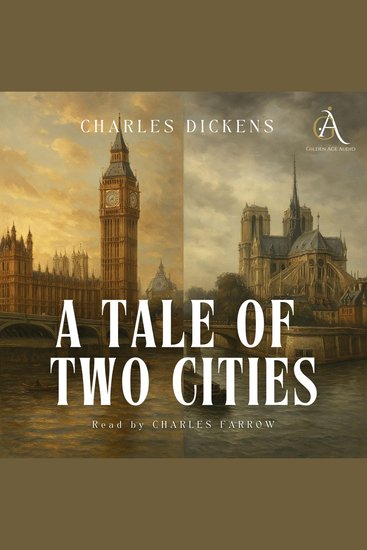
  • Tale of Two Cities A - Audiobook - cover

    Tale of Two Cities A - Audiobook

    Charles Dickens, Classic...

    • 0
    • 0
    • 0
    A Tale of Two Cities is a sweeping historical novel set against the backdrop of the French Revolution, exploring the tumultuous events that shake both Paris and London. The story follows two very different men—Charles Darnay, a French aristocrat who renounces his privilege, and Sydney Carton, a disillusioned English lawyer—whose lives become intertwined through love, sacrifice, and revolution. At the center of their shared fate is Lucie Manette, a symbol of compassion and renewal.With its famous opening line, "It was the best of times, it was the worst of times," Dickens paints a vivid portrait of societal upheaval, personal redemption, and the violence born from oppression. The novel is a powerful meditation on resurrection—of individuals, nations, and ideals—and it builds to one of the most memorable and moving climaxes in all of English literature.
    Show book
  • A Complete Recovery - From their pens to your ears genius in every story - cover

    A Complete Recovery - From their...

    Barry Pain

    • 0
    • 0
    • 0
    Barry Eric Odell Pain was born at 3 Sydney Street in Cambridge on 28th September 1864. He was one of 4 children. 
    He was educated at Sedbergh School and then Corpus Christi College, Cambridge. 
    In 1889, Cornhill Magazine published his short story ‘The Hundred Gates’.  This opened the way for Pain to advance his literary career on several fronts. He became a contributor to Punch and The Speaker, as well as joining the staff of both the Daily Chronicle and Black and White.  
    Pain was also a noted and prominent contributor to The Granta and from 1896 to 1928 a regular contributor to the Windsor Magazine. 
    It is often said that Pain was discovered by Robert Louis Stevenson, who compared his work to that of Guy de Maupassant.  It’s an apt comparison. Pain was a master of disturbing prose but was also able to inject parody and light comedy into many of his works.  A simple premise could in his hands suddenly expand into a world very real but somehow emotionally fraught and on the very edge of darkness. 
    Barry Pain died on 5th May 1928 in Bushey, Hertfordshire.
    Show book
  • The Black Moth - A Romance of the 18th Century - cover

    The Black Moth - A Romance of...

    Georgette Heyer

    • 0
    • 0
    • 0
    When the notorious Lord Tracy Belmanoir, Duke of Andover and also the infamous Black Moth, is caught attempting to abduct the dark-haired Diana Beauleigh by estranged Jack Carstares, the rightful Earl of Wyncham, he's sent scurrying after a thrilling sword fight. Injured in battle, Jack relies on Diana to nurse his wounds and, as their feelings for each other blossom, realizes that he must return to Wyncham, clear his name of previous accusations, and rightly take over as earl. But the Black Moth waits patiently to take what he wants—and he is relentless. Can Jack take over as earl, defeat the Black Moth, and finally be with the woman he loves?
    Show book
  • Crime and Punishment - cover

    Crime and Punishment

    Fyodor Dostoyevsky

    • 0
    • 0
    • 0
    Crime and Punishment is a novel by the Russian author Fyodor Dostoevsky. It was first published in the literary journal The Russian Messenger in twelve monthly installments during 1866. It was later published in a single volume. It is the second of Dostoevsky's full-length novels following his return from ten years of exile in Siberia. Crime and Punishment is considered the first great novel of his mature period of writing. The novel is often cited as one of the supreme achievements in world literature.Crime and Punishment follows the mental anguish and moral dilemmas of Rodion Raskolnikov, an impoverished ex-student in Saint Petersburg who plans to kill an unscrupulous pawnbroker, an old woman who stores money and valuable objects in her flat. He theorises that with the money he could liberate himself from poverty and go on to perform great deeds, and seeks to convince himself that certain crimes are justifiable if they are committed in order to remove obstacles to the higher goals of 'extraordinary' men. Once the deed is done, however, he finds himself racked with confusion, paranoia, and disgust. His theoretical justifications lose all their power as he struggles with guilt and horror and confronts both the internal and external consequences of his deed.
    Show book