Join us on a literary world trip!
Add this book to bookshelf
Grey
Write a new comment Default profile 50px
Grey
Subscribe to read the full book or read the first pages for free!
All characters reduced
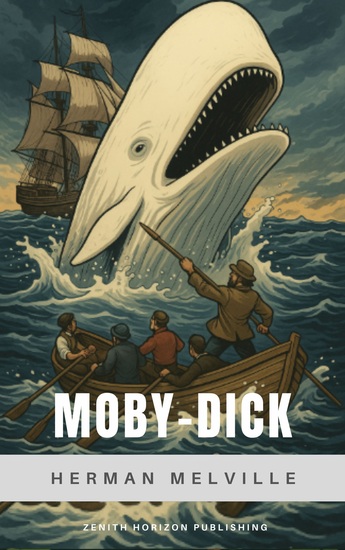
Moby Dick - Herman Melville's Epic Tale of Obsession and the Sea - cover

Moby Dick - Herman Melville's Epic Tale of Obsession and the Sea

Herman Melville, Zenith Horizon Publishing

Publisher: Zenith Horizon Publishing

  • 0
  • 0
  • 0

Summary

"Call me Ishmael."

So begins one of the greatest adventures in literary history. In Moby-Dick, Herman Melville crafts an unforgettable voyage of man versus nature, sanity versus obsession, and fate versus free will. Captain Ahab's relentless pursuit of the white whale drives his crew to the edge of the world—and beyond reason.

A sweeping narrative filled with stormy seas, profound philosophy, and psychological depth, this iconic novel explores revenge, identity, and the destructive power of obsession. Rich in symbolism and vivid in language, it remains a cornerstone of American literature.

🌊 This edition includes:

The complete, unabridged 1851 text

Atmospheric illustrations to enrich your reading journey

Kindle-optimized formatting for a seamless digital experience

⚓ Moby-Dick isn't just a sea story—it's a meditation on what drives us, haunts us, and ultimately defines us.

Set sail on this timeless epic.
Download your illustrated edition today.
Available since: 06/11/2025.
Print length: 637 pages.


Other books that might interest you

  • Shades A Phantasy - Ukranian born Korolenko creates a fictional dialogue of Socrates to examine lifes biggest questions - cover

    Shades A Phantasy - Ukranian...

    Vladimir Korolenko

    • 0
    • 0
    • 0
    Vladimir Galaktionovich Korolenko was born in Zhytomyr, Ukraine, then part of the Russian Empire on 27th July 1853. 
     
    His father died when he was 13 and life was then often struck with bouts of poverty, which resulted in his education being somewhat erratic.   A spell in exile at 23 was followed by another as the politics of the times opposed his volatile but heart-felt passions. 
     
    Writing was also coming to the fore and in 1879 his debut short story telling of a young Narodnik searching for social and spiritual identity, was published. 
     
    In 1881, Korolenko refused to swear allegiance to the new Russian Tsar and was again exiled, this time much farther afield.  He spent the next three years doing manual work, but took time to study local customs and history.  These impressions in exile provided rich material for his writings. 
     
    In 1885 he was allowed to settle in Nizhny, where again he repeatedly questioned the authorities.  That same year ‘Makar's Dream’ established his literary reputation and was part of his first collection ‘Sketches and Stories’, the following year. 
     
    In the early 1890’s when famine struck Central Russia, he went to work on relief missions, collecting donations, supervising the delivery and distribution of food, opening 45 free canteens, all this while writing the graphic reports that would later be published as ‘In the Year of Famine’ in 1893. 
     
    By 1896 despite some psychological disorders, he was well regarded amongst Russian writers and was even a member of the Russian Academy of Sciences.  Throughout his writing career Korolenko was a staunch advocate of human rights, putting that sacred activity above what he called his 'part-time-writing'. 
     
    In the Revolutionary year of 1905, under his editorship, Russkoye Bogatstvo published the Manifest by the Petersburg Soviet of the Workers' deputies. Korolenko was now repeatedly harassed by the authorities, had his flat raided many times and materials confiscated. 
     
    As a lifetime opponent of Tsarism, he guardedly welcomed the Revolution of 1917.  Once the nature of Bolshevism was established, he soon started to criticize it. During the Russian Civil War that ensued, he condemned both the Red Terror and the White Terror.  
     
    Despite suffering from a progressive heart disorder, he collected food packages for children in famine-stricken Moscow and Petrograd as well as organised orphanages and shelters for the homeless.  
     
    Vladimir Korolenko died in Poltava, Ukraine, of the complications of pneumonia on 25th December 1921.  He was 68. 
     
    In this story Korolenko invokes the characters of Socrates and Elpidias who, after their deaths, involve themselves in a debate on God.  This is a tour-de-force of conception and execution.
    Show book
  • In the Fourth Year (Unabridged) - cover

    In the Fourth Year (Unabridged)

    H. G. Wells

    • 0
    • 0
    • 0
    In the Fourth Year is a collection H. G. Wells assembled in the spring of 1918 from essays he had recently published discussing the problem of establishing lasting peace when World War I ended. It is mostly devoted to plans for the League of Nations and the discussion of post-war politics.
    Show book
  • Curious Case of Benjamin Button The - Unabridged - cover

    Curious Case of Benjamin Button...

    F Scott itzgerald

    • 0
    • 0
    • 0
    F. Scott Fitzgerald created the novella "The Curious Case of Benjamin Button" as a short story, originally published in Collier's magazine in 1922.  It tells the tale of Benjamin, son of Roger Button, who was born as an old man and who, over the course of his life, miraculously ages backwards. Beginning life as an octogenarian in his crib, Benjamin grows "older" while his body, conversely, appears younger and younger with each passing birthday. The story takes us through Benjamin's entire life; his difficult adolescence, his marriage, life as a soldier and father and, ultimately, his inevitable descent into infanthood.  At once hilarious, frightening and satiric, Fitzgerald's wonderful story has been adapted for both the stage and screen and is presented here in its original, unabridged format.
    Show book
  • Theresa Raquin - cover

    Theresa Raquin

    Émile Zola

    • 0
    • 0
    • 0
    This intense novel follows Thérèse, trapped in a loveless marriage to her sickly cousin Camille, and her passionate affair with the alluring Laurent. Driven by their desire, the lovers conspire to murder Camille, but their crime sets off a haunting spiral of guilt and paranoia. Zola's masterful exploration of human psychology, moral decay, and the oppressive forces of society blends realism and dramatic intensity, making this novel a gripping study of passion and consequence.
    Show book
  • Sanctuary - cover

    Sanctuary

    Edith Wharton

    • 0
    • 0
    • 0
    “Sanctuary” by Edith Wharton is a compelling psychological novel that explores whether moral character is inborn or shaped by environment. The story centers on Kate Orme, who discovers a dark secret about her fiancé, Denis, as her marriage to him approaches. She becomes painfully aware of Denis’s flawed morality and does everything in her power to instill in their son the highest moral code. The narrative spreads itself over two generations and two men’s moral dilemmas.
    Show book
  • By the Rule of Contrary - cover

    By the Rule of Contrary

    Lucy Maud Montgomery

    • 0
    • 0
    • 0
    Lucy Maud Montgomery (November 30, 1874 – April 24, 1942), published as L. M. Montgomery, was a Canadian author best known for a series of novels beginning in 1908 with Anne of Green Gables. The book was an immediate success. The title character, orphan Anne Shirley, made Montgomery famous in her lifetime and gave her an international following.
    By the Rule of Contrary: "Look here, Burton," said old John Ellis in an ominous tone of voice, "I want to know if what that old busybody of a Mary Keane came here today gossiping about is true. If it is well, I've something to say about the matter!
    Show book