Join us on a literary world trip!
Add this book to bookshelf
Grey
Write a new comment Default profile 50px
Grey
Subscribe to read the full book or read the first pages for free!
All characters reduced
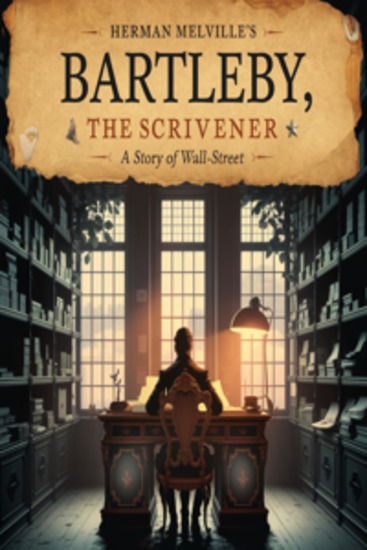
Bartleby The Scrivener (illustrated) - A STORY OF WALL-STREET - cover

Bartleby The Scrivener (illustrated) - A STORY OF WALL-STREET

Herman Melville

Publisher: Swish

  • 0
  • 0
  • 0

Summary

Dive into Herman Melville's timeless classic, Bartleby, The Scrivener: A Story of Wall Street. This thought-provoking tale explores the enigmatic life of Bartleby, a law copyist whose simple, passive resistance to societal norms—summed up in his iconic refrain, "I would prefer not to"—challenges the perceptions of his employer and readers alike. Set in the bustling legal world of 19th-century New York, the story is a profound meditation on isolation, individuality, and humanity's response to the unexplainable. A masterpiece of American literature, this novella continues to resonate with audiences, offering rich themes for reflection and discussion.
Available since: 12/19/2024.

Other books that might interest you

  • House of the Seven Gables The - Audiobook - cover

    House of the Seven Gables The -...

    Nathaniel Hawthorne, Classic...

    • 0
    • 0
    • 0
    The House of the Seven Gables is a gothic masterpiece by Nathaniel Hawthorne, blending family secrets, curses, and redemption. Set in a decaying New England mansion haunted by ancestral sins, the story follows the Pyncheon family as they struggle with the burden of the past and the possibility of renewal.With rich symbolism, mysterious characters, and an atmosphere thick with suspense, Hawthorne explores themes of guilt, inheritance, and the clash between old-world aristocracy and emerging American ideals. It is a haunting and beautifully written novel that continues to captivate readers with its dark elegance.
    Show book
  • Araby - From their pens to your ears genius in every story - cover

    Araby - From their pens to your...

    James Joyce

    • 0
    • 0
    • 0
    James Augustine Aloysius Joyce was born on the 2nd February 1882 in Dublin into a middle-class family, and the eldest of ten surviving siblings 
    Admired as a brilliant student he briefly attended the Christian Brothers-run O'Connell School before excelling at the Jesuit schools of Clongowes and Belvedere.  From there he went on to attend University College Dublin from 1898, studying English, French and Italian 
    In 1902, Joyce was now in his early twenties, and went to Paris to study Medicine but soon abandoned his teachings.  Back in Dublin to attend to his dying Mother he met Nora Barnacle. They bonded immediately into a life-long match. Together they decided to emigrate to Europe.  The couple lived in Trieste, Rome, Paris, and finally Zürich where Joyce pursued a variety of jobs and ventures to supplement his literary pursuits but none of these paid off.  
    After publishing a poetry volume, ‘Chamber Music’, in 1907, his short story collection ‘The Dubliners’, in 1914, helped establish his talent in the rapidly changing world.  
    Although far from home Joyce’s literary heart and works were set in his recollections of Dublin.  Characters are close resemblances of family and friends and indeed enemies.  His landmark work ‘Ulysses’, published in 1922, is set in the streets and alleyways of the city as it parallels Homer’s Odyssey in a variety of styles including its famed stream of consciousness. 
    His pen continued to produce classics of the order of ‘A Portrait of the Artist as A Young Man’ and ‘Finnegan’s Wake’ together with several volumes of poetry and a play ‘The Exiles, in 1918.   
    On the 11th January 1941, Joyce underwent surgery in Zürich for a perforated duodenal ulcer. The next day he fell into a coma. On the 13th after a brief period of lucidity in which he called for his wife and son he passed.  He was 58.
    Show book
  • Millionaire's Proposal - cover

    Millionaire's Proposal

    Lucy Maud Montgomery

    • 0
    • 0
    • 0
    Lucy Maud Montgomery (November 30, 1874 – April 24, 1942), published as L. M. Montgomery, was a Canadian author best known for a series of novels beginning in 1908 with Anne of Green Gables. The book was an immediate success. The title character, orphan Anne Shirley, made Montgomery famous in her lifetime and gave her an international following.
    A Millionaire's Proposal: It is all settled at last, and in another week I shall have left Thrush Hill. I am a little bit sorry and a great bit glad. I am going to Montreal to spend the winter with Alicia.
    Show book
  • Meeting of Minds - Volume IX - cover

    Meeting of Minds - Volume IX

    Steve Allen

    • 0
    • 0
    • 0
    By " assembling" some of the most fascinating figures in world history, Meeting of Minds provided a groundbreaking opportunity for audiences to be exposed to ideas by way of a medium not normally known for its intellectual vigor. Portrayed by actors, panelists engage in stimulating round-table discussions that were conducted like any other talk show but featured prominent influencers from bygone generations— not just philosophers and politicians, but poets, playwrights, and presidents. From activists and artists to international leaders— both famous and infamous— these conversations are unfailingly witty, thought-provoking, and genuinely entertaining.
    An innovative series, Meeting of Minds remains one of the most delightful ways of gaining historical perspective ever devised, and these original soundtrack recordings capture the intellectual and spirited debates of the episodes hosted by Steve Allen.
    This installment breaks the pattern of other episodes by featuring playwright William Shakespeare surrounded not by other illustrious historical figures, but with the fruits of his own imagination. Following a brief discussion of his early life, Shakespeare is joined by the Dark Lady of the Sonnets, Hamlet, Romeo, Othello, and the Ghost of Hamlet's Father. Expounding on the theme of love, the most enigmatic and compelling of Shakespeare's characters challenge each other and their mutual creator to resolve long-standing controversies about their identities and inner conflicts.
    Show book
  • The Piazza Tales - cover

    The Piazza Tales

    Herman Melville

    • 0
    • 0
    • 0
    The Piazza Tales is a collection of six short stories by American writer Herman Melville, published by Dix & Edwards in the United States in May 1856 and in Britain in June. Except for the newly written title story, "The Piazza," all of the stories had appeared in Putnam's Monthly between 1853 and 1855. The collection includes what has long been regarded as three of Melville's most important achievements in the genre of short fiction, "Bartleby, the Scrivener", "Benito Cereno", and "The Encantadas", his sketches of the Galápagos Islands. (Billy Budd, arguably his greatest piece of short fiction, would remain unpublished in his lifetime.)
    Melville had originally intended to entitle the volume Benito Cereno and Other Sketches, but settled on the definitive title after he had written the introductory story. The book received largely favorable reviews, with reviewers especially praising "The Encantadas" but did not sell well enough to get Melville out of his financial straits, probably because short fiction for magazines had little appeal to bookbuyers. From after Melville's rediscovery to the end of the twentieth century, the short works that attracted the most critical attention were "Bartleby," "Benito Cereno" and "The Encantadas," with "The Piazza" a little behind those.
    Show book
  • Love of Life (Unabridged) - cover

    Love of Life (Unabridged)

    Jack London

    • 0
    • 0
    • 0
    Jack London (born John Griffith Chaney, January 12, 1876 - November 22, 1916) was an American author, journalist, and social activist. He was a pioneer in the then-burgeoning world of commercial magazine fiction and was one of the first fiction writers to obtain worldwide celebrity and a large fortune from his fiction alone.
    LOVE OF LIFE: They limped painfully down the bank, and once the foremost of the two men staggered among the rough-strewn rocks. They were tired and weak, and their faces had the drawn expression of patience which comes of hardship long endured. They were heavily burdened with blanket packs which were strapped to their shoulders. Head-straps, passing across the forehead, helped support these packs. Each man carried a rifle. They walked in a stooped posture, the shoulders well forward, the head still farther forward, the eyes bent upon the ground.
    Show book