Join us on a literary world trip!
Add this book to bookshelf
Grey
Write a new comment Default profile 50px
Grey
Subscribe to read the full book or read the first pages for free!
All characters reduced
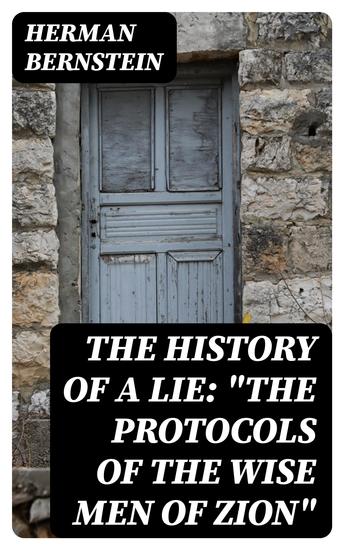
The History of a Lie: "The Protocols of the Wise Men of Zion" - cover

The History of a Lie: "The Protocols of the Wise Men of Zion"

Herman Bernstein

Publisher: DigiCat

  • 0
  • 0
  • 0

Summary

In "The History of a Lie: 'The Protocols of the Wise Men of Zion,'" Herman Bernstein meticulously dissects one of the most pernicious texts of the 20th century, revealing its fabrication and the consequences of its spread. Bernstein's writing is analytical and precise, employing rigorous research to contextualize the text within the socio-political climate of early 20th-century Europe, where anti-Semitic sentiments were proliferating. Through a blend of historical narrative and critical commentary, he exposes the mechanisms of deceit behind the Protocols, demonstrating not only its origins as a literary forgery but also its role in fueling dangerous ideologies that resonate to this day. Herman Bernstein, a Jewish-American journalist and activist, was deeply impacted by the rising tide of anti-Semitic rhetoric and violence during his lifetime, drawing on his experiences to confront the societal forces that perpetuated such myths. His background in journalism equipped him with the skills to unravel convoluted narratives, while his personal connection to the subject matter fueled his passion for accurate representation and truth in facing falsehoods, particularly those aimed at marginalized communities. This book is essential reading for scholars, students, and anyone interested in understanding the historical roots of modern anti-Semitism. Bernstein's work serves not only as a historical document but as a clarion call for vigilance against disinformation, making it a valuable addition to discussions on hate speech, propaganda, and social responsibility.
Available since: 09/16/2022.
Print length: 488 pages.
Other books that might interest you

  • Atonement by Ian McEwan (Book Analysis) - Detailed Summary Analysis and Reading Guide - cover

    Atonement by Ian McEwan (Book...

    Bright Summaries

    • 0
    • 0
    • 0
    Unlock the more straightforward side of Atonement with this concise and insightful summary and analysis!This engaging summary presents an analysis of Atonement by Ian McEwan, a strikingly nuanced and complex novel about two young lovers in the years during and just prior to the Second World War. Robbie Turner is the groundskeeper for the comparatively wealthy Tallis family, but the social differences between them do not stop love from blossoming between him and Cecilia, the oldest daughter of the family. However, when Cecilia's younger sister Briony falsely accuses Robbie of rape, events spiral out of control and are complicated further by the outbreak of the war. Atonement is a powerful reflection on the stories we all tell ourselves, and is the eighth novel by Ian McEwan, who is widely regarded as one of the most influential English writers active today.Find out everything you need to know about Atonement in a fraction of the time!This in-depth and informative reading guide brings you:• A complete plot summary• Character studies• Key themes and symbols• Questions for further reflectionWhy choose BrightSummaries.com?Available in print and digital format, our publications are designed to accompany you on your reading journey. The clear and concise style makes for easy understanding, providing the perfect opportunity to improve your literary knowledge in no time.See the very best of literature in a whole new light with BrightSummaries.com!
    Show book
  • Your Mind and How to Use It - A Manual of Practical Psychology - cover

    Your Mind and How to Use It - A...

    William Walker Atkinson

    • 0
    • 0
    • 0
    Your Mind and How to Use It by William Walker Atkinson is an influential text in the history of self-help literature. It explores the connection between consciousness and the physical world, utilizing a cognitive approach that emphasizes mental discipline as a means of cultivating success and personal growth. The book offers readers practical advice on developing mental habits and skills, such as goal setting, concentration, visualization, and suggestion, to help them realize their ambitions in life. Read in English, unabridged.
    Show book
  • West Virginia and the Civil War - Mountaineers Are Always Free - cover

    West Virginia and the Civil War...

    Mark A. Snell

    • 0
    • 0
    • 0
    The only state born as a result of the Civil War, West Virginia was the most divided state in the nation. About forty thousand of its residents served in the combatant forces about twenty thousand on each side. 


    The Mountain State also saw its fair share of battles, skirmishes, raids, and guerrilla warfare, with places like Harpers Ferry, Philippi, and Rich Mountain becoming household names in 1861. When the Commonwealth of Virginia seceded from the Union on April 17, 1861, leaders primarily from the northwestern region of the state began the political process that eventually led to the creation of West Virginia on June 20, 1863. Renowned Civil War historian Mark A. Snell has written the first thorough history of these West Virginians and their civil war in more than fifty years.
    Show book
  • Hungary - A History of Hungary It´s People and Culture - cover

    Hungary - A History of Hungary...

    Days of History

    • 0
    • 0
    • 0
    Discover the fascinating story of Hungary's past, filled with epic battles, political intrigue, and powerful rulers. Learn about the country's unique culture and traditions that have shaped its identity over centuries. 
     In this book, you'll find:A comprehensive overview of Hungary's history, from its early origins to modern times.A deep dive into the country's most significant historical events, including wars, revolutions, and political movements.An exploration of Hungary's cultural heritage, including its language, music, and art.A look at the lives of Hungary's most famous historical figures, including kings, queens, and military leaders. 
    Get ready to immerse yourself in Hungary's rich history, as you discover the country's complex past and the people who shaped it. 
    Order your copy today and embark on a journey through Hungary's fascinating history.
    Show book
  • The Berlin Airlift - Lifeline to a City - cover

    The Berlin Airlift - Lifeline to...

    Nova Ashford

    • 0
    • 0
    • 0
    In the aftermath of World War II, Europe lay in ruins. Cities were reduced to rubble, economies had collapsed, and millions of people were displaced. Among the most devastated was Germany—a nation carved into four occupation zones controlled by the victorious Allied powers: the United States, the United Kingdom, France, and the Soviet Union. Berlin, the capital, although deep within the Soviet zone, was similarly divided into four sectors. This uneasy arrangement planted the seeds for future conflict. 
    The relationship between the former wartime allies quickly deteriorated. While the Western Allies sought to rebuild Germany along democratic and capitalist lines, the Soviet Union pursued a different vision. Stalin aimed to establish a buffer of satellite states and extend communist influence throughout Eastern Europe. These conflicting ideologies clashed most visibly in Germany, and particularly in Berlin, where the presence of Western powers in the heart of Soviet-controlled territory was seen as a threat. 
    Economic recovery in the Western zones moved quickly with the introduction of the Marshall Plan in 1948, which provided massive American aid to help rebuild war-torn Europe. The Soviets, however, rejected the plan and forbade its acceptance in the Eastern Bloc, viewing it as a tool of Western domination. In West Berlin, the flow of goods, reconstruction efforts, and the adoption of a new currency—the Deutsche Mark—marked a tangible difference in quality of life and future prospects compared to East Berlin and the Soviet zone.
    Show book
  • Into the Dark - What darkness is and why it matters - cover

    Into the Dark - What darkness is...

    Jacqueline Yallop

    • 0
    • 0
    • 0
    'Often poetic ... highly-researched and thought-provoking'New Scientist
    'Gently and thoughtfully enquiring' The Spectator
    
    Can you remember the first time you encountered true darkness? The kind that remains as black and inky whether your eyes are open or closed? Where you can't see your hand in front of your face?
    
    Jacqueline Yallop can. It was in an unfamiliar bedroom while holidaying in Yorkshire as a child, and ever since then she has been fascinated by the dark, by our efforts to capture or avoid it, by the meanings we give to it and the way our brains process it.
    
    Taking a journey into the dark secrets of place, body and mind, she documents a series of night-time walks, exploring both the physical realities of darkness and the psychological dark that helps shape our sense of self. Exploring our enduring love-hate relationship with states of darkness, she considers how we attempt to understand and contain the dark, and, as she comes to terms with her father's deteriorating Alzheimer's, she reflects on how our relationship to the dark can change with time and circumstance.
    
    Darkness captivates, baffles and appals us. It's a shifty thing of many textures, many moods, a state of fascination and of horror, an absence and a presence, solace and threat, a beginning and an end. Into the Dark is the story of the many darks that fascinate and assail us. It faces the darkness full on in all its guises and mysteries, celebrating it as a thing of beauty while peering into the void.
    Show book