Join us on a literary world trip!
Add this book to bookshelf
Grey
Write a new comment Default profile 50px
Grey
Subscribe to read the full book or read the first pages for free!
All characters reduced
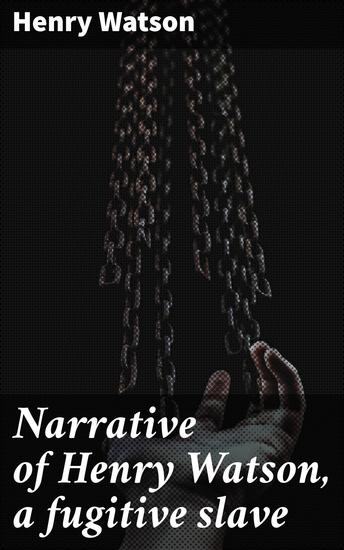
Narrative of Henry Watson a fugitive slave - Journey to Freedom: A Fugitive Slave's Tale of Resilience and Triumph - cover

Narrative of Henry Watson a fugitive slave - Journey to Freedom: A Fugitive Slave's Tale of Resilience and Triumph

Henry Watson

Publisher: Good Press

  • 0
  • 0
  • 0

Summary

In "Narrative of Henry Watson, a Fugitive Slave," Henry Watson provides a harrowing yet poignant account of his life as an enslaved individual seeking freedom in an oppressive society. Written in a first-person narrative style, the text employs vivid imagery and emotional depth, drawing readers into the raw realities of slavery and the yearning for liberation. Positioned within the broader tradition of slave narratives, this work not only highlights Watson's personal journey but also serves as a crucial historical artifact that amplifies the voices of marginalized individuals. The narrative is crafted with a clarity that reflects both personal anguish and a resolute pursuit of agency amidst systemic brutality. Henry Watson was born into a life of servitude, enduring the cruel realities of enslavement that ultimately propelled him to write his narrative. His insightful analysis and vivid descriptions stem from his lived experiences, which are interwoven with a broader socio-political critique of the institution of slavery. Watson's efforts to document his struggles against oppression reflect the larger abolitionist movement, contributing significantly to the discourse surrounding freedom and human rights during the 19th century. I highly recommend "Narrative of Henry Watson, a Fugitive Slave" to readers interested in the complex history of slavery and resistance in America. This deeply reflective narrative not only enlightens but also evokes empathy, allowing readers to witness the strength of the human spirit in the face of unimaginable adversity. It is an essential read for anyone seeking to understand the profound impacts of slavery on personal and collective identity.
Available since: 07/10/2023.
Print length: 35 pages.
Other books that might interest you

  • Dickon the Devil - From their pens to your ears genius in every story - cover

    Dickon the Devil - From their...

    Sheridan Le Fanu

    • 0
    • 0
    • 0
    Joseph Sheridan Le Fanu was born on 28th August 1814 in Dublin into a literary family with Huguenot, Irish and English roots.   
    For a time he and his siblings were tutored but Le Fanu would often immerse himself in the books of his father’s library. 
    In 1833 Le Fanu began his Law studies at Trinity College, Dublin and graduated in 1839. Although called to the bar he instead began a career in journalism.   
    He was also writing. His first fiction story ‘The Ghost and the Bonesetter’ was published in 1838.  In 1843 came the novella ‘Spalatro: From the Notes of Fra Giacomo’, a hero with a particular necrophiliac passion for an undead blood-drinking beauty, a forerunner to his later female vampire ‘Carmilla’.  
    In 1844 Le Fanu married Susanna Bennett with whom he had 4 children. The following year his first novel ‘The C'ock and Anchor’ was published. Works now flowed from his pen and with a rapid increase in family finances they moved, in 1851, to Merrion Square, Dublin, where he remained until his death.  
    In 1858 Susanna died and Le Fanu became reclusive. It was during this period that he produced some of his best work.  Working only by candlelight he wrote through the night, burnishing his reputation as a major figure of 19th Century supernaturalism with many classics including; ‘Green Tea’, ‘Mr Justice Harbottle’, and ‘In a Glass Darkly’.  
    Joseph Thomas Sheridan Le Fanu died in Merrion Square in his native Dublin on February 7th, 1873, at the age of 58.
    Show book
  • On the Hippie Trail - Istanbul to Kathmandu and the Making of a Travel Writer - cover

    On the Hippie Trail - Istanbul...

    Rick Steves

    • 0
    • 0
    • 0
    Stow away with Rick Steves for a glimpse into the unforgettable moments, misadventures, and memories of his 1978 journey on the legendary Hippie Trail. In the 1970s, the ultimate trip for any backpacker was the storied “Hippie Trail” from Istanbul to Kathmandu. A 23-year old Rick Steves made the trek, and like a travel writer in training, he documented everything along the way: jumping off a moving train, making friends in Tehran, getting lost in Lahore, getting high for the first time in Herat, battling leeches in Pokhara, and much more. The experience ignited his love of travel and forever broadened his perspective on the world.   This book contains edited selections from Rick’s journal and travel photos with a 45-years-later preface and postscript reflecting on how the journey changed his life. Stow away with Rick Steves on the adventure of a lifetime through Turkey, Iran, Afghanistan, Pakistan, India, and Nepal.   You know Rick Steves. Now discover the adventure that made him the travel writer he is today.
    Show book
  • Postmortem - What Survives the John Wayne Gacy Murders - cover

    Postmortem - What Survives the...

    Courtney Lund O'Neil

    • 0
    • 0
    • 0
    On a December night in 1978, Courtney Lund O'Neil's mother, teenaged Kim Byers, saw her friend Rob Piest alive for the last time. At the end of his shift at the pharmacy where they both worked, fifteen-year-old Rob went outside to speak to a contractor named John Wayne Gacy about a possible job. That night Rob became Gacy's final victim; his body was later found in the Des Plaines River. Kim's testimony, along with a receipt belonging to her found in Gacy's house, proving that Rob had been there, would be pivotal in convicting the serial killer who assaulted and killed over thirty young men and boys. 


    Though she grew up far from Des Plaines, Courtney has lived in the shadow of that nightmare, keenly aware of its impact on her mother. In search of deeper understanding and closure, Courtney and Kim travel back to Illinois. Postmortem transforms their personal journey into a powerful exploration of the ever-widening ripples generated by Gacy's crimes. From the 1970s to the present day, his shadow extends beyond the victims' families and friends—it encompasses the Des Plaines neighborhood forever marked by his horrific murders, generations of the victims' families and friends, those who helped arrest and convict him, and many others. Postmortem is a complex story of loss and violence, grief and guilt, and the legacy that remains long after a killer is caught.
    Show book
  • Under Water - How Holding My Breath Taught Me to Live - cover

    Under Water - How Holding My...

    Claire Walsh

    • 0
    • 0
    • 0
    'I needed to breathe. Not the short, shallow breaths that keep you alive … merely existing. I wanted that breath that starts deep down in your being and fills your lungs and limbs with life.'
    Claire Walsh spent her twenties living the life she thought she was supposed to live, all the while playing hide-and-seek with depression. In her thirties, finding herself single and living with her parents, she decided it was time to chart a different path.
    In Central America Claire discovered freediving, plunging up to 60 metres below the water's surface without the use of breathing apparatus. It taught her the power of breathwork, but more importantly it taught her how to find freedom in the present moment.
    Under Water is a candid and captivating story of what it's like to take part in one of the most dangerous sports in the world, and a reminder that sometimes all we need to do is take a deep breath.
    '20,000 leaues of sparkling adventure and tap-dancing prose.' Ruth Fitzmaurice, author of I Found My Tribe
    Show book
  • Public Enemies - cover

    Public Enemies

    Editors Charles River

    • 0
    • 0
    • 0
    Nobody was ever convicted for the “Saint Valentine’s Day Massacre,” the most famous gangland hit in American history, but it’s an open secret that it was the work of America’s most famous gangster, Al Capone. Indeed, “Scarface” has captured the nation’s popular imagination since Prohibition, managing to be the most notorious gangster in America while living a very visible and high profile life in Chicago. 	In the end, it wasn’t the bodies or the violence that landed Capone in the slammer; it was taxes. After being convicted, Capone managed to continue running his business rackets from behind bars, forcing authorities to move America’s most notorious gangster to America’s most notorious prison on Alcatraz Island.  
    	Two months after Franklin D. Roosevelt’s inauguration in 1933, a petty thief who had spent almost a decade behind bars for attempted theft and aggravated assault was released from jail. By the end of the year, that man, John Dillinger, would be America’s most famous outlaw: Public Enemy Number One. From the time of his first documented heist in early July 1933, until his dramatic death in late July of the following year, he would capture the nation’s attention as had no other outlaw since Jesse James. 
    	The man who became Public Enemy Number One after the deaths of John Dillinger and Pretty Boy Floyd was Lester Joseph Gillis, whose alias “George Nelson” eventually gave way to the nickname “Baby Face Nelson”. Despite the almost playfully innocent nickname, and the fact that he was not as notorious as two of his partners in crime, Dillinger and Floyd, Baby Face Nelson was the worst of them all.  
    While the Barrow Gang was no more murderous than other outlaws of the era, their romantic relationship and the discovery of photographs at one of their hideouts added a more human dimension to Bonnie and Clyde. In some way though, the sensationalized version of their life on the run is less interesting than reality.
    Show book
  • Top 10 Short Stories The - The 19th Century - The English Men - The top ten short stories written from 1800 - 1899 by English male authors - cover

    Top 10 Short Stories The - The...

    Rudyard Kipling

    • 0
    • 0
    • 0
    Short stories have always been a sort of instant access into an author’s brain, their soul and heart.  A few pages can lift our lives into locations, people and experiences with a sweep of landscape, narration, feelings and emotions that is difficult to achieve elsewhere. 
     
    In this series we try to offer up tried and trusted ‘Top Tens’ across many different themes and authors. But any anthology will immediately throw up the questions – Why that story? Why that author?  
     
    The theme itself will form the boundaries for our stories which range from well-known classics, newly told, to stories that modern times have overlooked but perfectly exemplify the theme.  Throughout the volume our authors whether of instant recognition or new to you are all leviathans of literature. 
     
    Some you may disagree with but they will get you thinking; about our choices and about those you would have made.  If this volume takes you on a path to discover more of these miniature masterpieces then we have all gained something. 
     
    The decades of this century see authors of every hue and talent assemble vast realms of fabulous literature that entertain the global audience then and to revisit now.  Genres explode across the landscape.  Genius in every name. 
     
    1 - The Top 10 - The 19th Century - The English Men - An Introduction 
    2 - The Signalman by Charles Dickens 
    3 - The Man Who Would Be King - Part 1 by Rudyard Kipling 
    4 - The Man Who Would Be King - Part 2 by Rudyard Kipling 
    5 - The Magic Shop by H G Wells 
    6 - The Grave by the Handpost by Thomas Hardy 
    7 - The Interlopers by Saki the pseudonym for H H Munro 
    8 - A Little Dinner At Timmin's by William Makepeace Thackeray 
    9 - Lost Hearts by M R James 
    10 - Father Giles Of Ballymoy by Anthony Trollope 
    11 - A Terribly Strange Bed by Wilkie Collins 
    12 - My Astral Body by Anthony Hope
    Show book