Join us on a literary world trip!
Add this book to bookshelf
Grey
Write a new comment Default profile 50px
Grey
Subscribe to read the full book or read the first pages for free!
All characters reduced
History of Science - Complete Edition - cover

History of Science - Complete Edition

Henry Smith Williams, Edward Huntington Williams

Publisher: DigiCat

  • 0
  • 0
  • 0

Summary

The anthology 'History of Science' offers a sweeping exploration of humanity's quest for understanding the natural world, illustrating an intricate tapestry woven with myriad threads of scientific inquiry. It traverses a dynamic range of literary styles, from didactic treatises and historical surveys to richly descriptive narratives. The collection captures the essence of scientific evolution, celebrating both groundbreaking developments and underappreciated yet pivotal contributions. Through its diverse compilation, each piece reveals a different facet of the scientific world, spotlighting pivotal moments in history while collectively forming a cohesive narrative of progress and discovery. The accomplished editors, Henry Smith Williams and Edward Huntington Williams, bring together voices from various cultural and intellectual backgrounds, whose contributions collectively underscore the global and cross-temporal nature of scientific endeavor. The anthology aligns with historical and cultural movements such as the Enlightenment and the Scientific Revolution, reflecting their impacts on various scientific fields. The editors' expertise in the history and philosophy of science ensures the anthology not only educates but also inspires an appreciation for the interconnectedness of scientific pursuits across age and geography. 'History of Science' is an essential read for those seeking to delve into the complexities and triumphs of scientific progress. It invites readers to engage with ideas that transcend individual disciplines, offering a panoramic view of the scientific landscape through multiple lenses. This volume presents an invaluable opportunity to understand how diverse perspectives enrich scientific thought, encouraging readers to appreciate the dialogue fostered by these varied contributions. For anyone curious about the broad canvas of human intellectual achievement, this anthology provides both enlightenment and a profound appreciation for the legacy of scientific inquiry.
Available since: 11/22/2023.
Print length: 982 pages.

Other books that might interest you

  • Hidden in Berlin - A Holocaust Memoir - cover

    Hidden in Berlin - A Holocaust...

    Anonymous

    • 0
    • 0
    • 0
    Lilo and Ernst survived the horrors of WWII in the center of Berlin, but not without help.  
    An incredible tale of survival and kindness. 
    Lilo was just a teenager when the Nazis took away her mother and father in September 1942. She never saw them again. A year later, she received another painful blow when her brother Hans was taken too. She was now alone at 19-years-old in a dangerous and brutal world. Until she heard one familiar voice that called her name, and saved her life.Meanwhile, her boyfriend Ernst was hiding in a small room with his parents, doing all he could to ensure their survival, even when violent explosions and the possibility of exposure threatened to take their lives. They remained hidden for 27 months, but sadly it was only Ernst and his mother who emerged from the shelter after the war. Ernst and Lilo eventually marry, re-locate to America, create a new life, and have a daughter who is the author of this book. 
    This deeply saddening yet touching memoir is not only about the horrific Nazi regime and how it affected both Lilo and Ernst but it is also a memoir to recognize and thank the heroic people who put themselves in danger to save their lives. Without them, we wouldn’t have the opportunity to read their important story.
    Show book
  • The One and the Many - Studies in the Philosophy of Order and Ultimacy - cover

    The One and the Many - Studies...

    R. J. Rushdoony

    • 0
    • 0
    • 0
    The question of where ultimacy lies should be central to the Christian. It is easy to see the social implications of allowing priority to fall to either the one or the many. This volume examines in-depth the Christian solution to the problem of the one and the many - the Trinitarian God. Only in the godhead is this dilemma resolved. Only in the Trinity does there reside an equal ultimacy of unity and plurality. Rushdoony examines the history of Western thought from the standpoint of the one and the many and demonstrates clearly that the most astute thinkers were unable to resolve this philosophical conflict. What is needed now is a complete return to the Trinitarian view of God and its implications for a Christian social order.
    Show book
  • Chimú Empire - The Kingdom of Chan Chan and the Lords of the Northern Coast - cover

    Chimú Empire - The Kingdom of...

    Rolf Hedger

    • 0
    • 0
    • 0
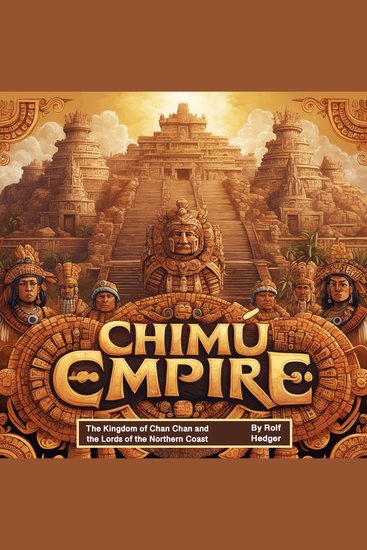
    The Chimú Empire, one of the most prominent pre-Columbian civilizations of the northern coast of Peru, flourished between the 9th and 15th centuries. This advanced civilization is known for its impressive urban centers, most notably the capital city of Chan Chan, which remains the largest adobe city in the world. At its height, the Chimú Empire controlled vast territories, from the southern border of the Moche Valley to the northern regions of present-day Ecuador. The empire was characterized by its highly structured society, advanced technology, and unique artistic traditions, which helped shape the cultural landscape of the Andean region. 
    The roots of the Chimú Empire trace back to the Moche culture, which had a significant influence on the development of the Chimú. However, the Chimú people took the foundational knowledge of their predecessors and expanded upon it, creating a powerful and sophisticated society. They established a series of city-states along the coast, which were eventually unified under the leadership of a single ruler, the Chimú king, who governed from Chan Chan. 
    The Chimú Empire’s political structure was highly organized, with a well-defined hierarchy that ranged from the elite rulers to the common people. The king, or "Sapa Chimú," was considered the most powerful figure, acting as both a political and spiritual leader. The empire was divided into regions, each overseen by local lords who managed administrative and religious duties within their territories. This hierarchical structure helped maintain control over the vast lands and resources of the empire.
    Show book
  • Summary of Counter Gaslighting - A small manual of Counter-manipulation - cover

    Summary of Counter Gaslighting -...

    Dan Crown

    • 0
    • 0
    • 0
    In a world where psychological well-being is paramount, understanding the nuances of manipulative behaviors is crucial. One of the most insidious forms of manipulation is gaslighting. This chapter delves deep into the definition of gaslighting, aiming to equip you with the knowledge to identify and protect yourself from this covert form of emotional abuse. 
    What is Gaslighting? 
    Gaslighting is a form of psychological manipulation in which a person or a group covertly sows seeds of doubt in a targeted individual or group, making them question their own memory, perception, or judgment. It often leads to significant emotional distress, confusion, and a diminished sense of self-worth in the victim. 
    The Core Elements of Gaslighting 
    -Doubt: The manipulator's primary tool is doubt. By questioning the validity of the victim's memories or perceptions, the manipulator creates uncertainty. 
    -Denial: Despite evidence to the contrary, the gaslighter will deny behaviors or events, further confusing the victim. 
    -Discredit: The gaslighter may also discredit the victim to others, isolating the victim and undermining their support system. 
    -Dependency: Over time, the victim may become dependent on the gaslighter for their version of reality, eroding the victim's ability to trust their own judgment.
    Show book
  • Formation of the Federal Reserve The: The Early History of America’s Central Banking System - cover

    Formation of the Federal Reserve...

    Editors Charles River

    • 0
    • 0
    • 0
    Debates over paper money and banking are older than the United States of America itself. 18th and 19th century Americans were deeply ambivalent about paper money and central banks, and political fights over these issues were among the bitterest in American history. In fact, controversies over the country’s central bank birthed both the first (1792-1824) and second (1828-1852) party systems; frequently, policymakers crafted responses to the crisis at hand, and as a result they implemented policies that were inadequate to the challenges the country faced in the future.  
    Indeed, the early administrations' ambivalence toward central banking and paper money, combined with the ad hoc nature of policymakers’ responses, caused severe problems. These issues came to a head during the Panic of 1907, which provoked a major reassessment of America’s banking system. Progressive Era reformers like President Woodrow Wilson walked a tightrope, balancing fears of centralized wealth with the undeniable need for a rational mechanism to help govern the country’s economy. The system they created represented half a loaf, its many compromises and weaknesses corrected by the response to two other crises: the Great Depression and the Cold War. The Federal Reserve System that has existed since the Accord of 1951 has cooled the passionate conflict over central banking and rendered obsolete many of the monetary questions that so animated Americans in previous centuries. 
    Show book
  • When the Last One Fell Silent - Stories of Extinct Creatures - cover

    When the Last One Fell Silent -...

    P Agrawal

    • 0
    • 0
    • 0
    This audiobook is narrated by an AI Voice.   
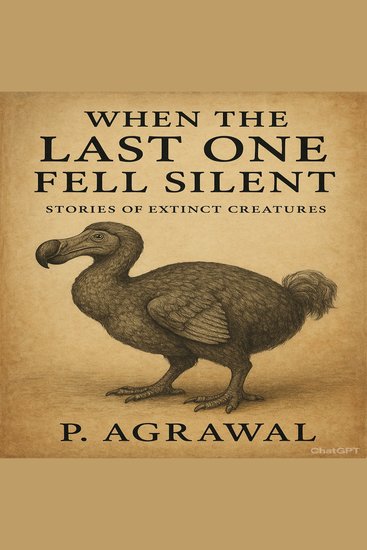
    When the Last One Fell Silent: Stories of Extinct Creatures is a haunting yet deeply human exploration of extinction—told not as dry statistics, but as a series of vivid portraits that bring lost creatures back to life through story, imagery, and reflection. From the island forests where dodos once waddled without fear, to the endless skies once blackened by passenger pigeons, to the misty rainforests where golden toads shimmered like jewels, each chapter of this book immerses readers in the world as it once was—and as it might never be again. 
    Extinction is as old as life itself, but in the last few centuries its rhythm has changed. Where once climate, asteroids, and ice shaped life and loss, today extinction bears the clear mark of one species—our own. This book moves tenderly through history, telling the stories of animals we have lost: the thylacine of Tasmania, hunted more by rumor than truth; the great auk and Steller’s sea cow, slaughtered out of utility and curiosity; the Pyrenean ibex, which briefly flickered back into life through cloning before disappearing again; the mammoths, whose heavy footfalls once trembled across frozen steppes; and the baiji dolphin, the gentle goddess of the Yangtze, drowned beneath the noise of factories and boats. 
    Each chapter does more than recount the facts of extinction. It lingers on the silences that follow. Silence of forests once filled with birds. Silence of oceans where seals no longer bark. Silence of mountains where goats no longer leap. Readers are invited not only to see the loss but to feel it—the grief of the final call, the heaviness of absence, the weight of knowing that these lives were here, and now they are not. 
    At the same time, When the Last One Fell Silent is not simply an elegy. It is also a mirror and a warning. Chapters on myths and legends show how humans carry the memory of vanished animals in stories of dragons, thunder birds, and mermaids.
    Show book