Join us on a literary world trip!
Add this book to bookshelf
Grey
Write a new comment Default profile 50px
Grey
Subscribe to read the full book or read the first pages for free!
All characters reduced
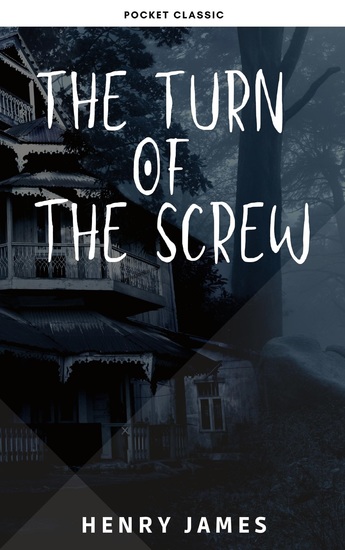
The Turn of the Screw - cover

The Turn of the Screw

Henry James, Pocket Classic

Publisher: Pocket Classic

  • 0
  • 0
  • 0

Summary

The Turn of the Screw is a short novel or a novella written by American writer Henry James. Originally published in 1898, it is ostensibly a ghost story that has lent itself well to operatic and film adaptation. Due to its ambiguous content and narrative skill, The Turn of the Screw became a favorite text of New Criticism.
The account has lent itself to dozens of different interpretations, often mutually exclusive, including those of a Freudian nature. Many critics have tried to determine what exactly is the nature of evil within the story.
Available since: 10/17/2022.
Print length: 114 pages.
Other books that might interest you

  • Bram Stoker - A Short Story Collection - Explore this masterful collection from the author of Dracula - cover

    Bram Stoker - A Short Story...

    Bram Stoker

    • 0
    • 0
    • 0
    Abraham Stoker was born in Dublin, Ireland on the 8th of November 1847, the third of seven children.  
     
    His early years were plagued with such ill-health that he was unable to start school until the age of seven.  He turned the long periods of recovery into an opportunity for thinking and said “I was naturally thoughtful, and the leisure of long illness gave opportunity for many thoughts which were fruitful according to their kind in later years”.  
     
    Strikingly at Trinity College, Dublin his health had returned with such vigour that he was named their University Athlete whilst also achieving a BA in Mathematics with honours.  
     
    At this time his interest in theatre became a job offer to be the Dublin Evening Mail’s theatre critic, co-owned by Sheridan Le Fanu.  He now began to also write short stories and in 1872 ‘The Crystal Cup’ was published.  An interest in art developed and he co-founded the Dublin Sketching Club.  
     
    In 1878 came marriage to Florence Balcombe.  She had formerly been courted by Stoker’s acquaintance, Oscar Wilde.  The marriage produced one child.   
     
    Stoker had some years before reviewed Henry Irving’s Hamlet and had dined with him.  That friendship now resulted in a proposal from Irving to move to London and to manage his Lyceum Theatre.  His numerous commercial innovations ensured both he and the theatre thrived.  Irving would also often take Stoker with him when he toured abroad. 
     
    Despite this busy life Stoker continued to write and these works paved the way for his most famous creation, published in 1897, ‘Dracula’.  It is rightly recognised as one of the greatest horror novels of all time and although not the first with a theme of Vampires, it is undoubtedly the most well-known. 
     
    Stoker also wrote poetry and many excellent short stories and continued to write novels and other works throughout his career. 
     
    Politically Stoker supported Home Rule, though only by peaceful means.  He was also keen on following scientific trends particularly in medicine. 
     
    In 1902 his tenure at the Lyceum Theatre ended and although he continued to write his health was deteriorating, mainly due to a series of debilitating strokes. 
     
    Bram Stoker died on the 20th April 1912, in Pimlico, London.  He was 64.   
     
    1 - Bram Stoker - A Short Story Collection - An Introduction 
    2 - Dracula's Guest by Bram Stoker 
    3 - The Squaw by Bram Stoker 
    4 - The Judge's House by Bram Stoker 
    5 - The Secret of the Growing Gold by Bram Stoker 
    6 - The Burial of the Rats by Bram Stoker
    Show book
  • Silent Scream The: Book summary & analysis - cover

    Silent Scream The: Book summary...

    Hazel Quinn

    • 0
    • 0
    • 0
    This content is an independent and unofficial summary created for informational and educational purposes only. It is not affiliated with, authorized, approved, licensed, or endorsed by the original author or publisher. All rights to the original work belong to its respective copyright holders. This summary is not intended to substitute the original book, but to offer a concise overview and interpretation of its main ideas.
     
    
    A tormented woman awakens each night to the echo of a scream that no living soul can hear—until she follows its ghostly reverberations to a hidden attic door where tortured memories lurk. With every silent cry, the walls bleed fragments of a tragedy that nearly destroyed her family, and she must confront the voiceless horror trapped in her own bloodline before it steals her sanity forever. A chilling psychological thriller that will haunt you long after the final gasp.
    Show book
  • Dia de Los Slashers - cover

    Dia de Los Slashers

    V. Castro

    • 0
    • 0
    • 0
    It's a few weeks until Halloween and Día de Los Muertos. Tula's friend Carmen has convinced her to go to a new event called Night of the Calavera. It's meant to celebrate the two holidays in the nearby town of Driftwood, Texas, not far from Tula in Slaughter Creek. 


    Tula adores Halloween, but Dia de Los Muertos is the night she loves. Every year, she leaves Slaughter Creek and celebrates on her own in a different location. 


    Despite the forecast set for rain after a week of storms, Tula agrees to go to Night of the Calavera, held at an abandoned petting zoo on a farm. Plus, she wants to get her mind off someone she has admired from afar but is unavailable. 


    When they arrive, the event looks like a total flop with not many people there and even fewer vendors. Little does Tula know that the Calavera is real. And it's out for blood. 


    Contains mature themes.
    Show book
  • Tombob - A Short Horror Story - cover

    Tombob - A Short Horror Story

    Michael van der Voort

    • 0
    • 0
    • 0
    When Scotty’s older brother brings home a ventriloquist dummy named Tombob and sets it on their dresser, the seven-year-old tries his best not to be afraid. After all, big boys aren’t scared of dolls. But no matter how hard he tries, Scotty can’t shake the unease creeping up his spine. 
    There’s something about that wooden face—the glossy, staring eyes and the frozen, painted grin—that feels wrong. Unnatural. Watching. 
    He tells himself it’s just his imagination. If he pulls the blanket over his head and squeezes his eyes shut, maybe the feeling will pass. Maybe he’ll drift off to sleep. 
    Then, across the room, a thin, tinny voice slices through the darkness. Slow. Sweet. Unmistakably real.
    Show book
  • The Flowering of the Strange Orchid - cover

    The Flowering of the Strange Orchid

    H. G. Wells

    • 0
    • 0
    • 0
    A short story from the British Library Tales of the Weird collection Evil Roots. The Victorian era saw orchids become one of the most expensive and collectable plants and this short story follows orchid collector Wedderburn who gets more than he bargained for with his latest floral specimen.
    Show book
  • The Colour Out of Space - cover

    The Colour Out of Space

    H. P. Lovecraft

    • 0
    • 0
    • 0
    When a meteorite crashes on the Gardner family's farm in Massachusetts, it releases an indescribable colour, an alien entity that slowly poisons the land, warps nature, and drives the family to madness. The first of Lovecraft's short stories to exhibit his trademark blend of science-fiction and horror, The Colour Out of Space explores themes of isolation, the limits of human understanding, and the terrifying indifference of the universe.
    
    Published in 1927 in the science-fiction magazine Amazing Stories, The Colour Out of Space is considered one of Lovecraft's finest works, and was the author's personal favourite.
    
    Though virtually unknown and financially unsuccessful during his lifetime, H.P. Lovecraft (1890-1937) is now regarded as one of the most influential 20th-century writers of supernatural horror fiction. Widely credited with inventing the "cosmic horror" genre—fiction that explores humanity's insignificance in the face of vast, unknowable cosmic forces—he also created the "Cthulhu Mythos", a shared universe of ancient alien beings and forbidden knowledge that has influenced generations of horror and science fiction writers.
    Show book