Join us on a literary world trip!
Add this book to bookshelf
Grey
Write a new comment Default profile 50px
Grey
Subscribe to read the full book or read the first pages for free!
All characters reduced
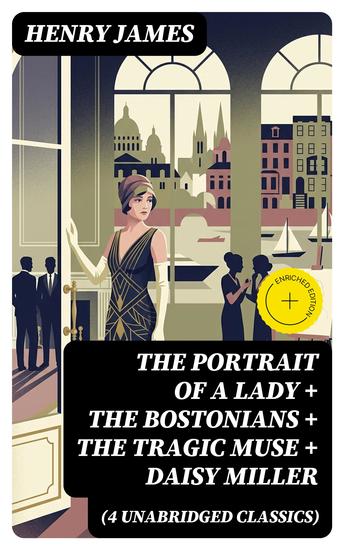
The Portrait of a Lady + The Bostonians + The Tragic Muse + Daisy Miller (4 Unabridged Classics) - Enriched edition - cover

The Portrait of a Lady + The Bostonians + The Tragic Muse + Daisy Miller (4 Unabridged Classics) - Enriched edition

Henry James

Publisher: DigiCat

  • 0
  • 0
  • 0

Summary

Henry James's *The Portrait of a Lady*, *The Bostonians*, *The Tragic Muse*, and *Daisy Miller* are seminal texts that showcase his mastery over psychological realism and intricate character development. Set against the backdrop of 19th-century America and Europe, these novels delve into themes of freedom, gender, class, and the complexities of personal relationships. James's exquisite prose and nuanced narrative techniques, characterized by his use of stream-of-consciousness and a keen sensitivity to social mores, invite readers to explore the inner lives of his protagonists, particularly the struggles of women striving for autonomy in restrictive societal frameworks. Henry James (1843-1916) was a pivotal figure in the transition from Victorian literature to modernism. Born into a family steeped in intellectual discourse, he traveled extensively and was deeply influenced by European culture. His experiences as a transatlantic writer enriched his exploration of identity and belonging, crucial to understanding the dynamics of his characters who often navigate the tensions between their aspirations and societal expectations. I recommend this collection not only for its remarkable literary merit but also for its profound insights into human behavior and the socio-cultural landscapes of the time. Readers will find themselves captivated by James's ability to probe the depths of individual consciousness and societal constructs, making these classics timeless and indispensable for anyone seeking to understand the complexities of life and relationships.

In this enriched edition, we have carefully created added value for your reading experience:
- A comprehensive Introduction outlines these selected works' unifying features, themes, or stylistic evolutions.
- The Author Biography highlights personal milestones and literary influences that shape the entire body of writing.
- A Historical Context section situates the works in their broader era—social currents, cultural trends, and key events that underpin their creation.
- A concise Synopsis (Selection) offers an accessible overview of the included texts, helping readers navigate plotlines and main ideas without revealing critical twists.
- A unified Analysis examines recurring motifs and stylistic hallmarks across the collection, tying the stories together while spotlighting the different work's strengths.
- Reflection questions inspire deeper contemplation of the author's overarching message, inviting readers to draw connections among different texts and relate them to modern contexts.
- Lastly, our hand‐picked Memorable Quotes distill pivotal lines and turning points, serving as touchstones for the collection's central themes.
Available since: 11/13/2023.
Print length: 1615 pages.
Other books that might interest you

  • August Heat - From their pens to your ears genius in every story - cover

    August Heat - From their pens to...

    W F Harvey

    • 0
    • 0
    • 0
    William Fryer Harvey AM was born on 14th April 1885 into a wealthy Quaker family in Leeds, West Yorkshire. 
    He was educated at the Quaker Bootham School in Yorkshire and Leighton Park School in Reading before university at Balliol College, Oxford.  
    His health was fragile and he poured his energies into writing short stories and in 1910 published his first collection ‘Midnight House’. 
    In the Great War he was with the Friends' Ambulance Unit and then served as a surgeon-lieutenant in the Royal Navy.  There he received the Albert Medal for Lifesaving but lung damage received at that time troubled him for the rest of his life. 
    He continued to write short stories, and even a memoir, but by 1925 ill health had forced his retirement to any outside work.  Three years later he published his second collection which contained his macabre classic ‘The Beast with Five fingers’, only one more collection would come from his pen in his lifetime. 
    For many years of his life he now lived in Switzerland with his wife but a yearning to be home saw them come back to England in 1935. 
    W F Harvey died in Letchworth on the 4th June 1937. He was 52.
    Show book
  • Wuthering Heights - cover

    Wuthering Heights

    Emily Brontë

    • 0
    • 0
    • 0
    Step into the windswept moors of Yorkshire in Wuthering Heights, a timeless tale of passion, vengeance, and the enduring power of love. This hauntingly beautiful novel, narrated with gripping intensity, tells the story of Heathcliff, a mysterious and brooding orphan, and Catherine Earnshaw, the headstrong woman whose soul is intertwined with his.
     
    Their tumultuous relationship sets off a chain of events that reverberates through generations, as obsession, betrayal, and unforgiving landscapes shape the destinies of the characters. From the harsh, stormy confines of Wuthering Heights to the relative calm of Thrushcross Grange, the audiobook takes you on a journey of raw emotions and stark contrasts, painting a vivid picture of human resilience and frailty.
     
    The narration captures every nuance of Emily Brontë’s gothic masterpiece, bringing its dark romance and complex characters to life. Whether you’re revisiting this literary classic or discovering it for the first time, this audiobook immerses you in a world of fierce emotions, poetic imagery, and unforgettable storytelling. Perfect for listeners who enjoy deeply moving dramas and atmospheric tales, Wuthering Heights is a compelling experience you won’t want to miss.
    Show book
  • The Valley of Fear - cover

    The Valley of Fear

    Arthur Conan Doyle

    • 0
    • 0
    • 0
    The Valley of Fear plunges listeners into Arthur Conan Doyle’s final Sherlock Holmes novel, a tale brimming with intrigue, danger, and deception. When Holmes and Watson arrive at a remote country manor, they encounter a chilling mystery: is it murder or suicide? Beneath the surface lies a shadowy secret society, and the legendary detective must infiltrate its web to uncover the truth. 
    This story intertwines gripping detective work with a thrilling backstory of treachery and courage, revealing Holmes’s brilliance in the face of sinister plots. 
    Narrated by an advanced AI voice, this audiobook captures the suspense and drama of Doyle’s timeless narrative, offering a compelling experience for both fans of Holmes and newcomers alike.
    Show book
  • Fall Asleep to The Hound of the Baskervilles - A soothing reading for relaxation and sleep - cover

    Fall Asleep to The Hound of the...

    Arthur Conan Doyle

    • 0
    • 0
    • 0
    Dive into the world of Sherlock Holmes with "The Hound of the Baskervilles" by Sir Arthur Conan Doyle, now available as an audiobook from Slumber Studios. Narrated by Elizabeth Grace, this classic detective story has been thoughtfully edited and produced to provide a relaxing listening experience, perfect for helping you fall asleep. 
    At Slumber Studios, we understand the challenges of falling asleep, whether it's due to insomnia or a busy mind. Our audiobooks are designed for sleep, featuring soothing narration and a pace that promotes relaxation. 
    Close your eyes and let Elizabeth Grace's calming voice guide you through the mysterious moors of Dartmoor, where Sherlock Holmes and Dr. Watson investigate the legend of a supernatural hound. The suspenseful plot and vivid descriptions will captivate your imagination, allowing you to unwind and drift into a peaceful sleep. 
    Our audiobooks are carefully crafted with gentle background music and a slower narrative pace to ensure a tranquil night's sleep. Whether you're looking to escape into a story after a hectic day or simply seeking a way to ease into a restful slumber, our audiobooks are here to help. 
    So press play, get comfortable, and let the intrigue of "The Hound of the Baskervilles" lull you into a serene and rejuvenating sleep. Wake up feeling refreshed and ready for a great day.
    Show book
  • Dracula - cover

    Dracula

    Anonymous

    • 0
    • 0
    • 0
    Dracula is an 1897 Gothic horror novel by Irish author Bram Stoker. Famous for introducing the character of the vampire Count Dracula, the novel tells the story of Dracula's attempt to move from Transylvania to England so he may find new blood and spread undead curse, and the battle between Dracula and a small group of men and women led by Professor Abraham Van Helsing. Dracula has been assigned to many literary genres including vampire literature, horror fiction, the gothic novel and invasion literature. The novel touches on themes such as the role of women in Victorian culture, sexual conventions, immigration, colonialism, and post-colonialism. Although Stoker did not invent the vampire, he defined its modern form, and the novel has spawned numerous theatrical, film and television interpretations
    Show book
  • Her Lover - From their pens to your ears genius in every story - cover

    Her Lover - From their pens to...

    Maxim Gorky

    • 0
    • 0
    • 0
    Alexei Maximovich Peshkov was born on 28th March 1868, in Nizhny Novgorod, Russia. 
    Better known as Maxim Gorky he was orphaned at 11 and ran away from home at 12.  At 19 he had already attempted suicide and thereafter travelled, by foot, across the Russian Empire for 5 years. 
    His first book ‘Essays & Stories’ in 1898 was a sensation and so began a long career as an author of short stories, novels and plays.  Gorky saw writing as a moral and political act that would help to change the unjust world around him.  He was an ardent early advocate of the emerging Marxist movement and publicly opposed the Tsarist regime leading several times to his arrest.  
    In 1904 he began his own theatre but the censor banned every play and Gorky was forced to abandon the project. 
    But Gorky was a financially successful author, editor, and playwright and gave monies to political parties as well as for civil rights and social reform.  The brutal shooting of workers, which set in motion the Revolution of 1905, pushed Gorky more decisively toward radical solutions.  
    In 1906 he went to the United States to raise funds for the Bolsheviks. Those experiences including a scandal over travelling with his lover and not his wife deepened his contempt for the ‘bourgeois soul.’ 
    Gorky now moved to Capri in Italy, both for health reasons and to escape the increasingly repressive times in Russia.  
    An amnesty for the 300th anniversary of the Romanov dynasty saw him return to Russia in 1914. His politics remained close to the Bolshevik cause.  But soon, after the 1918 revolution, his essays referred to Lenin as a tyrant for his senseless arrests and repression.  He was soon appealing to the outside world for food aid after the catastrophic crop failure. 
    In October 1921 Gorky returned to Italy, now in Fascist hands, and settled in Sorrento until 1932.  His health worsened with the onset of tuberculosis. 
    He wrote several successful books there but now decided to find an understanding with the communist regime. Stalin invited him home and his return was hailed as a major propaganda victory.  He was decorated with the Order of Lenin, and a province, a park, and various streets re-named in his honour. 
    But he had his faults too.  In 1933, Gorky co-edited a book on the White Sea-Baltic Canal and denied even a single prisoner died during its construction, but thousands had. As well, knowing that some Nazis were homosexual, a phrase was attributed to him that said ‘exterminate all homosexuals and fascism will vanish’.  Although he was himself was quoting another he was decidedly homophobic. 
    With the increase of Stalinist repression in 1935 Gorky was placed under unannounced house arrest. 
    Maxim Gorky died on the 18th June 1936 from pneumonia.  He was 68. 
    Stalin and Molotov were among those who carried Gorky's urn of ashes at his funeral.
    Show book