¡Acompáñanos a viajar por el mundo de los libros!
Añadir este libro a la estantería
Grey
Escribe un nuevo comentario Default profile 50px
Grey
Suscríbete para leer el libro completo o lee las primeras páginas gratis.
All characters reduced
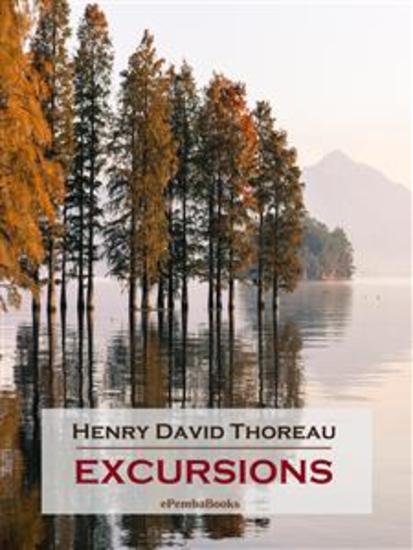
Excursions (Annotated) - cover

Excursions (Annotated)

Henry David Thoreau

Editorial: ePembaBooks

  • 0
  • 0
  • 0

Sinopsis

This edition includes the following editor's analysis: Henry David Thoreau, the indomitable environmentalist


Originally published in 1863, "Excursions" is an anthology of several essays by American transcendentalist and environmentalist Henry David Thoreau. These essays represent Thoreau in many stages of his writing career, ranging from 1842 to 1862.
The anthology was published posthumously and contains an introduction entitled "Biographical Sketch" in which fellow transcendentalist Ralph Waldo Emerson provides a description of Thoreau.

The collection, other than R. W. Emerson's biography of Thoreau, contains nine of Thoreau’s most engaging and popular essays: Natural History of Massachusetts, A Walk to Wachusett, The Landlord, A Winter Walk, The Succession of Forest Trees, Walking, Autumnal Tints, Wild Apples, and Night and Moonlight.
Disponible desde: 25/06/2022.

Otros libros que te pueden interesar

  • History of Colombia - An Overview of Its Politics Corruption and Culture - cover

    History of Colombia - An...

    Kelly Mass

    • 0
    • 0
    • 0
    Colombia’s history is marked by a rich tapestry of indigenous cultures and societies, which laid the foundations for the diverse nation that exists today. Long before the Spanish arrived in 1492, the region was home to advanced civilizations such as the Muisca Confederation, the Quimbaya Civilization, and the Tairona Chiefdoms. These indigenous groups thrived in Colombia's varied geography, establishing complex societies with sophisticated agricultural practices, intricate trade networks, and elaborate spiritual beliefs. 
    The Spanish conquest of the Americas brought significant change to the region. Following Christopher Columbus's arrival in the Caribbean, Spanish explorers began their colonization efforts. In 1538, the Spanish established Bogotá, which became the capital of the Viceroyalty of New Granada. This vast colonial territory included what is now Colombia, Ecuador, Panama, and Venezuela. The Spanish imposed their rule over the indigenous peoples, exploiting both the land and the labor of native communities, which would profoundly shape the future of the region.
    Ver libro
  • German Short Stories for Beginners - Master German Fast with Easy-to-Follow Stories Useful Words and Phrases Practical Exercises Essential Grammar Rules and Everyday Dialogues the Fun Way! - cover

    German Short Stories for...

    Anónimo

    • 0
    • 0
    • 0
    🇩🇪📖 THEY SAID GERMAN WAS HARD. THEY WERE TEACHING IT WRONG 📖🇩🇪 
    Forget memorizing cases and conjugations. This book teaches German through quick, funny stories that make vocabulary stick and grammar feel natural. 
    If you've struggled with textbooks full of tables, confusing rules, and phrases nobody uses—you're not alone. The problem isn't you; it's the method. Traditional books make you study German. This one helps you feel it. 
    Through short, entertaining stories, you'll experience real situations—ordering food, catching trains, checking into hotels—using words native speakers actually say. Each story balances fun and clarity, keeping you engaged while natural repetition locks vocabulary into memory. 
    What's inside: 
    - Mini-stories that teach without feeling like work 
    - Translations that build confidence, not confusion 
    - Everyday phrases that matter in real life 
    - Quick quizzes to track your progress 
    - Downloadable "German Travel Companion Vocabulary Guide" with essential phrases 
    - Grammar explained so simply it feels intuitive 
    By the end, you'll have a solid foundation in real-world German—no burnout, boredom, or overwhelm. 
    Why it works: Your brain remembers stories better than charts. Every lesson uses humor, context, and emotion to help words and patterns sink in naturally. 
    Think you can't learn German? Open the first story, laugh your way through, and discover you don't need grammar drills—just a good plot twist. 
    OPEN THE BOOK. LAUGH AT THE FIRST STORY. REALIZE YOU’RE ALREADY LEARNING
    Ver libro
  • Why You Should Discover the World’s Great Capitals - cover

    Why You Should Discover the...

    Mark Ferdinand

    • 0
    • 0
    • 0
    From the timeless romance of Paris and the grandeur of Rome to the vibrant buzz of New York and the futuristic skyline of Tokyo, the world’s great capitals are destinations that define nations and inspire travelers. Each one is a storybook of culture, history, and innovation waiting to be explored. 
    Mark Ferdinand takes you on a journey through these iconic cities, uncovering their unique charms: royal palaces and political landmarks, bustling markets and artistic treasures, global cuisine and local traditions. Whether it’s a short city break or the adventure of a lifetime, these capitals offer an unforgettable glimpse into the heart of our shared world.
    Ver libro
  • Edo Period - Tokugawa Rule Isolation and the Samurai Code - cover

    Edo Period - Tokugawa Rule...

    Rolf Hedger

    • 0
    • 0
    • 0
    The Edo period in Japan began with the dramatic rise of Tokugawa Ieyasu and the establishment of the Tokugawa Shogunate, which would bring over two centuries of relative peace and stability to the country. This transformation was not immediate but was set into motion by the pivotal Battle of Sekigahara in 1600. Ieyasu, a powerful daimyo and skilled strategist, emerged victorious in this decisive conflict, defeating rival factions and securing his dominance over the fractured Japanese landscape. This battle marked the end of the Warring States period, a time of nearly constant civil war, and laid the foundation for a new era of centralized feudal rule. 
    In 1603, Ieyasu was granted the title of shogun by the emperor, officially establishing the Tokugawa Shogunate. Although the emperor remained a symbolic figurehead, true political power rested with the shogun. Ieyasu’s government was based in Edo, a small fishing village that quickly developed into a sprawling political and economic center—modern-day Tokyo. From here, the Tokugawa clan implemented a system of governance that emphasized strict control, social hierarchy, and regional oversight. The shogunate devised a complex administrative structure that allowed it to maintain authority over hundreds of semi-autonomous domains ruled by daimyo, while ensuring loyalty through a combination of military strength, economic policy, and social regulation. 
    One of the key strategies used by Tokugawa Ieyasu to solidify his power was the creation of the han system. Under this arrangement, each daimyo governed a specific territory but was subject to strict oversight from the shogunate. The policy of sankin-kotai, or alternate attendance, required daimyo to spend alternating years in Edo, effectively draining their resources and keeping them under close surveillance. Their families were often kept in Edo as virtual hostages, ensuring obedience and discouraging rebellion.
    Ver libro
  • History of Argentina - From the Arrival of the Spanish to the 20th Century - cover

    History of Argentina - From the...

    Kelly Mass

    • 0
    • 0
    • 0
    Argentina's history is a rich tapestry that can be divided into four distinct periods: the pre-Columbian or early history (up to the sixteenth century), the colonial period (1530–1810), the nation-building period (1810–1880), and contemporary history (from approximately 1880 to the present). Each phase shaped the region, transforming it from sparsely inhabited land into the modern Argentine Republic. 
    Human presence in what is now Argentina dates back approximately 13,000 years, with evidence of early settlements in Patagonia. Archaeological findings suggest human activity through the Paleolithic, Mesolithic, and Neolithic periods. However, a significant depopulation of large interior areas occurred between 4000 and 2000 B.C., likely due to a prolonged period of drought. Over time, indigenous peoples in the region evolved into diverse cultural groups with varying levels of complexity. 
    Uruguayan archaeologist Raúl Campá Soler categorized Argentina’s indigenous peoples into three groups: basic hunters and food gatherers without pottery; advanced gatherers and hunters; and basic farmers who developed pottery. The Pampas and Patagonia were dominated by the first group, while the second included tribes like the Charrúa, Minuane, and Guaraní. The third group, inhabiting regions such as the Quebrada de Humahuaca, adopted farming practices and pottery.
    Ver libro
  • Gravel Rides Northumberland - 15 gravel bike adventures in North East England - cover

    Gravel Rides Northumberland - 15...

    Anónimo

    • 0
    • 0
    • 0
    Gravel Rides Northumberland showcases 15 of the best gravel bike rides across North East England. From 10 to 104 kilometres in length and covering a variety of terrain, there is something for every gravel cyclist.
    From the gentle beauty of the Reiver Trails and South Tyne Trail to the wild uplands of Kielder and the Cheviots, Gravel Rides Northumberland captures the region's full variety. Riders can enjoy peaceful commons, hidden forests and rolling valleys, with everything from easy lowland spins to remote and challenging routes through the most dramatic and rewarding landscapes of Northumberland and the North Pennines.
    Researched, ridden and written by local author Jordan Matthews, the routes feature clear and easy-to-use Ordnance Survey maps; easy-to-follow directions; details of distance, timings and difficulty gradings; stunning action photography; refreshment stops and local knowledge; and a detailed appendix. Also included is a link to downloadable GPX files.
    Ver libro