Join us on a literary world trip!
Add this book to bookshelf
Grey
Write a new comment Default profile 50px
Grey
Subscribe to read the full book or read the first pages for free!
All characters reduced
A History of the Inquisition of Spain (Vol 1-4) - Complete Edition - cover

A History of the Inquisition of Spain (Vol 1-4) - Complete Edition

Henry Charles Lea

Publisher: DigiCat

  • 0
  • 0
  • 0

Summary

Henry Charles Lea's monumental work, "A History of the Inquisition of Spain," spans four volumes and provides an exhaustive examination of one of the most controversial institutions of the medieval period. Lea employs a meticulous historical analysis and a rigorous methodology to dissect the political, religious, and social implications of the Inquisition. His literary style is characterized by clarity and precision, woven within a scholarly narrative that reflects the complex intellectual currents of the 19th century. This text stands as a pivotal contribution to the fields of religious history and legal studies, contextualized against the backdrop of the Enlightenment and the rise of modern secular thought. Lea, an American historian born in 1825, was deeply influenced by the tumultuous societal changes of his time, particularly debates around democracy, tolerance, and human rights. His extensive travels and studies across Europe fostered an acute awareness of the destructive power wielded by religious institutions, prompting him to delve into the Inquisition's dark legacy. His commitment to historical precision and ethical inquiry underscores the importance of understanding the past critically and comprehensively. Readers seeking an intricate understanding of the Inquisition will find Lea's work indispensable. With its thorough research and engaging narrative, "A History of the Inquisition of Spain" not only educates but also provokes thought about the consequences of intolerance, making it essential reading for anyone interested in the intersections of faith, power, and justice.
Available since: 11/16/2023.
Print length: 2447 pages.

Other books that might interest you

  • If Your Adolescent Has Bipolar Disorder - An Essential Resource for Parents - cover

    If Your Adolescent Has Bipolar...

    MD Tami D. Benton, MD Dwight L....

    • 0
    • 0
    • 0
    While coping with teenage moodiness can be difficult under any circumstances, it can be especially challenging if a teenager has a serious mood disorder. This concise book is the definitive guide to understanding and getting effective help for adolescents with bipolar disorder, designed for parents and other adults in contact with afflicted teens. It combines the most current scientific expertise available today—including the newest treatments and medications and the latest research findings on bipolar disorder—with no-nonsense, hands-on advice from parents who have faced this mood disorder in their own children. 


    Among other topics, the book addresses the roots of bipolar disorder, red flags to look out for, treatment options for young people, and practical strategies for helping a teen cope at home and at school. It concludes on a hopeful note, by reviewing the latest scientific evidence on treating this mood disorder. A growing body of research now shows that early diagnosis and treatment of bipolar disorder may reduce the severity of the disease, both now and in the future. Including chapters on sex, drugs, social media, and life after high school, this book will provide the information and tools parents need to help adolescents achieve the best possible outcome.
    Show book
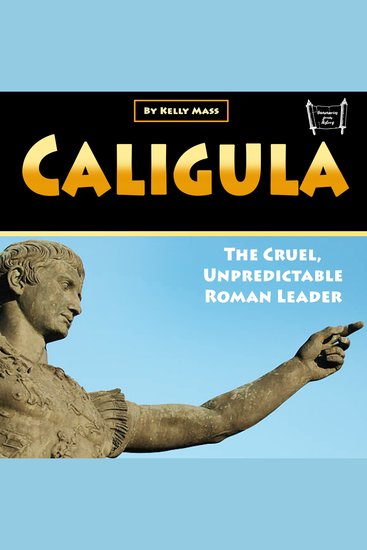
  • Caligula - The Cruel Unpredictable Roman Leader - cover

    Caligula - The Cruel...

    Kelly Mass

    • 0
    • 0
    • 0
    Gaius Caesar Augustus Germanicus, better known as Caligula, served as the third Roman Emperor from 37 to 41 AD. Born into the illustrious Julio-Claudian dynasty, he was the son of Germanicus, a beloved Roman general, and Agrippina the Elder, Augustus' granddaughter. His lineage placed him firmly within the first reigning family of the Roman Empire, setting the stage for his eventual rise to power. 
    The Roman Empire had already undergone significant transitions by the time Caligula entered the world. Tiberius, his great-uncle, succeeded Augustus as emperor in 14 AD, adopting Germanicus as his son. Caligula’s early years were shaped by the Roman military campaigns under Germanicus in Germania, where he earned the nickname “Caligula,” meaning “little boot,” due to the small military boots he wore as a child during these campaigns with his father’s troops. 
    When Germanicus died under mysterious circumstances in Antioch in 19 AD, Caligula’s family was plunged into turmoil. Agrippina, now a widow, returned to Rome with her six children, only to become embroiled in a bitter conflict with Tiberius. Her family’s tragic fall resulted in the deaths or exile of most of her children, leaving Caligula as the only surviving male. In 26 AD, Tiberius withdrew to the island of Capri, where he lived in seclusion. Caligula followed him in 31 AD, and after Tiberius' death in 37 AD, Caligula ascended to the throne as emperor.
    Show book
  • Retirement planing with real estate building passive income for the future - cover

    Retirement planing with real...

    AHMED MUSA

    • 0
    • 0
    • 0
    Retirement Planning with Real Estate: Building Passive Income for the Future is a comprehensive guide designed to help individuals unlock the potential of real estate as a cornerstone of their retirement strategy. This book provides practical insights and actionable steps to create sustainable, passive income streams that secure financial freedom during your golden years. 
    Whether you’re a seasoned investor or new to real estate, this guide takes you through proven strategies, from selecting the right properties to managing investments effectively, while balancing risks and rewards. Explore the benefits of rental properties, real estate syndications, REITs, and more, as you learn how to diversify your portfolio and adapt to market trends. 
    Packed with real-world examples, expert advice, and tools to navigate challenges, Retirement Planning with Real Estate empowers you to take control of your financial future, build wealth, and enjoy the retirement lifestyle you’ve always envisioned.
    Show book
  • On the Nature of the Gods - cover

    On the Nature of the Gods

    Cicero

    • 0
    • 0
    • 0
    "On the Nature of the Gods" by Cicero is a profound philosophical work that delves into the nature and existence of the gods. In this thought-provoking treatise, Cicero engages in a series of dialogues between representatives of different philosophical schools, each presenting their arguments regarding the divine. Through these discussions, Cicero explores the various theories of the gods, their attributes, and their role in the universe. Drawing on the teachings of prominent Greek philosophers such as Epicurus, Stoicism, and the Academic school, Cicero skillfully presents the contrasting viewpoints on the nature of the gods. He navigates through complex philosophical arguments, dissecting each perspective with intellectual rigor and eloquence. The dialogues explore questions of theology, ethics, and the human relationship with the divine, offering readers a comprehensive overview of the different philosophical approaches to understanding and interpreting the gods. Read in English, unabridged.
    Show book
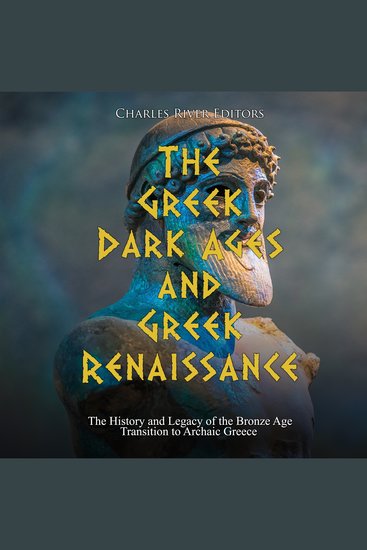
  • Greek Dark Ages and Greek Renaissance The: The History and Legacy of the Bronze Age Transition to Archaic Greece - cover

    Greek Dark Ages and Greek...

    Editors Charles River

    • 0
    • 0
    • 0
    The Greek Dark Ages, sometimes referred to as the Homeric Age or the Geometric Period, spans the era of Greek history from the end of the Mycenaean civilization around 1100 BCE and the emergence of the Greek poleis in the 9th century BCE. It is an era that has provided little in terms of extant archaeological evidence, which in part explains the name “Dark Ages,” but this lack of evidence has led some archaeologists and historians to make the very great assumption that little of any real significance occurred during these 200 years. Instead, they view it as a sort of hiatus between the collapse of the Mycenaean culture and the emergence of Archaic Greece. As with other so-called “Dark Ages,” this assessment is simplified, and an absence of evidence should never be assumed as evidence of absence. 
    If anything, the collapse of the Mycenaeans was a drawn-out affair, and while the early centuries of the Dark Ages might beseen as a continuation of this trend, even in the worst years, there was a degree of continuity and even some innovations. These changes including the beginnings of the use of iron as an alternative to bronze and some religious practices that continued to be observed. Furthermore, enough remained to form the basis of a recovery in economic, cultural, and artistic aspects of life in the later stage of the era, and in the political sphere, changes necessitated by the collapse in the economic system certainly paved the way for the rise of the polis, which would prove so fundamental in Greece in the centuries that followed.  
    This laid the groundwork for the Greek Renaissance of the 8th century. During that time, the Greek alphabet developed and the earliest surviving Greek literature was composed, while in terms of art and architecture, sculptures and red-figure pottery began. Warfare changed significantly as well when the hoplite became the core infantry.
    Show book
  • Data Bias Uncovered: How the World Neglects Half Its Population - Unlock the Truth in Data Bias! Powerful audio insights on worldwide population disparity - cover

    Data Bias Uncovered: How the...

    Archer Collins

    • 0
    • 0
    • 0
    Data Bias Uncovered: How the World Neglects Half Its Population 
    ⭐⭐ Simplified Audio Guide ⭐⭐ 
    Are you aiming to advance in your career and deepen your understanding by mastering how biases in data affect half of the global population? 
    Looking for a thorough guide that covers all you need to know to challenge biases and promote inclusive data awareness? 
    Your search is over! 
    This audiobook is your go-to resource for expanding your knowledge, applying your skills, and participating in thought-provoking exercises. With this, you're set for success. 
    Updated for the latest understanding of data biases. 
    Key features of this enriched guide: 
    - Profound insights about data biases and their global implications 
    - Detailed explanations of how biases manifest in data 
    - Effective strategies for identifying and mitigating data biases 
    Our guide stands out with its comprehensive coverage, critical for your comprehension and empowerment. Concepts aren't just glossed over; they're explored in detail. 
    Please note that this guide is an independent resource designed to enhance your understanding of data biases and is not affiliated with any official entity. 
    Structured with clarity and written in straightforward language, our guide on data bias ensures seamless transitions between topics. Say goodbye to convoluted jargon and hello to clear, precise, and technically accurate content. 
    So, why wait? Click the BUY NOW button, secure your guide, and start your journey toward challenging biases and fostering inclusive data awareness today!
    Show book