Join us on a literary world trip!
Add this book to bookshelf
Grey
Write a new comment Default profile 50px
Grey
Subscribe to read the full book or read the first pages for free!
All characters reduced
History of the United States During Thomas Jefferson's Administrations (All 4 Volumes) - cover

History of the United States During Thomas Jefferson's Administrations (All 4 Volumes)

Henry Adams

Publisher: e-artnow

  • 0
  • 0
  • 0

Summary

The presidency of Thomas Jefferson began on March 4, 1801, when he was inaugurated as the third President of the United States, and ended on March 4, 1809. In domestic affairs Jefferson sought to put the principles of republicanism into action. In foreign affairs, the major developments were the acquisition of the gigantic Louisiana Purchase from France in 1803, an embargo against trade with both Great Britain and France, and worsening relations with Britain as the United States tried to remain neutral in the midst of the Napoleonic Wars that engulfed Europe.  Contents: Physical and Economical Conditions  Popular Characteristics  American Ideals  The Inauguration  Organization  Legislation  The Judiciary Debate  Personalities  The Spanish Court  Toussaint Louverture  Closure of the Mississippi  Monroe's Mission  Rupture of the Peace of Amiens  The Louisiana Treaty  Claim to West Florida  Constitutional Difficulties  The Louisiana Debate  Louisiana Legislation  Impeachments  The Yazoo Claims  The Trial of Justice Chase  Quarrel with Yrujo  Pinckney's Diplomacy  Monroe and Talleyrand  Cordiality with England  Anthony Merry  Jefferson's Enemies  England and Tripoli  Internal Improvement  Monroe's Diplomacy  Cabinet Vacillations  The Florida Message  The Two-Million Act  John Randolph's Schism  Madison's Enemies  Domestic Affairs  Burr's Schemes  Escape Past Fort Massac  Claiborne and Wilkinson  Collapse of the Conspiracy  The Berlin Decree  Monroe's Treaty  Rejection of Monroe's Treaty  Burr's Trial  The "Chesapeake" and "Leopard"  Demands and Disavowals  Perceval and Canning  The Orders in Council  No More Neutrals  Insults and Popularity  The Embargo  The Mission of George Rose  Measures of Defence  The Rise of a British Party  The Enforcement of Embargo  The Cost of Embargo  The Dos de Maio  England's Reply to the Embargo  Failure of Embargo  Perplexity and Confusion  Diplomacy and Conspiracy  General Factiousness  Repeal of Embargo  Jefferson's Retirement
Available since: 12/14/2023.
Print length: 1126 pages.
Other books that might interest you

  • In the Shadow of Our Ancestors - cover

    In the Shadow of Our Ancestors

    Wayne Arthurson

    • 0
    • 0
    • 0
    Searching through the annals of North American history uncovers the diverse and astounding contributions by the Natives of the Americas who formed the world we know today.
    		 
    In the Shadow of Our Ancestors explores the rich history of the indigenous peoples of North America and leaves us in awe of their stunning achievements and inventions:
    		 
    The Great Law of Peace — The ideals, words and symbols of the Iroquois Confederacy inspired the governments of the New World to form democracies that recognized, in their constitutions, the rights of all people.
    		 
    Potatoes — The lowly potato, a staple food of Natives for almost 15,000 years, was unknown outside the Americas until Europeans arrived; now, with almost 4000 varieties, it is the fourth most-consumed agricultural product in the world.
    		 
    Sacagawea — The settlement of western North America was inspired and influenced by the results of the Lewis and Clark expedition in the early 1800s, with the journey’s success made possible because of a Native woman named Sacagawea, whose presence paved the way for the explorers to be seen as a peaceful party.
    Show book
  • Self Reliance - cover

    Self Reliance

    Ralph Waldo Emerson

    • 0
    • 0
    • 0
    When Ralph Waldo Emerson published his seminal essay on self-reliance in 1841, the United States was still reeling from the effects of a calamitous financial collapse four years earlier.
    
    His positive vision for the power of individualism and personal responsibility was issued in a climate of panic and uncertainty, at a time when the values of society and humanity were shifting. Emerson's call to independence remains as relevant and energizing as ever.
    Show book
  • The History and Legacy of Ancient Greece’s Most Influential City-States - cover

    The History and Legacy of...

    Editors Charles River

    • 0
    • 0
    • 0
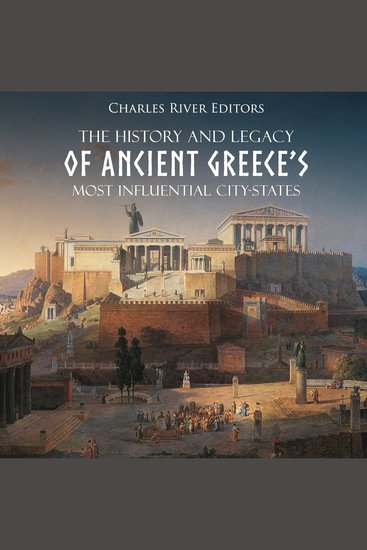
    Athens is chiefly remembered for two reasons: its political system, which would in time form the nucleus of all Western democratic systems of government, and the remarkable number of outstanding individuals which, during the Golden Age of Athens, lived and flourished in the enlightened city-state. The Ancient Athenians formed the backbone of the West’s entire culture, from the arts to philosophy and everything in between. 
    The most unique city-state in Ancient Greece was Sparta, which continues to fascinate contemporaneous society. It is not entirely clear why Sparta placed such a great emphasis on having a militaristic society, but the result was that military fitness was a preoccupation from birth. 
    In the Archaic and Classical periods, Rhodes often stood as a prime exemplar of the highs and lows of its fellow Greek cities, and as the largest island of the Dodecanese, Rhodes’ history is largely in line with that of the rest of those islands. Rhodes would reach the zenith of its power in the Hellenistic period following the death of Alexander the Great in 323 B.C.  
    Modern perceptions of Classical Greece are almost invariably based on Athens and Sparta, but Thebes was also a key player in the history of the region in this pivotal period. Indeed, it was, in fact, Thebes that was the major power for many of the years preceding the emergence of Macedon. The reasons for so little being known about Thebes and its contributions to ancient Greek civilization are complex, but the fact that it was totally destroyed by Alexander the Great is certainly one. 
    Ancient Corinth had actually been founded in the 10th century B.C. and was, for most of its history, the richest port and the largest city in all of Greece. Corinth had a population in excess of 90,000 in 400 B.C., but the Romans leveled this original city in 146 B.C., killing all the male inhabitants and selling the women and children into slavery.
    Show book
  • EMDR Toolbox - cover

    EMDR Toolbox

    Brittany Forrester

    • 0
    • 0
    • 0
    Eye MovementDesensitization and Reprocessing (EMDR) therapy is an extensively researched, effective psychotherapy method proven to help people recover from trauma and other distressing life experiences, including PTSD, anxiety, depression, and panic disorders.During EMDR therapy sessions, your live traumatic or triggering experiences in brief doses while the therapist directs your eye movements.EMDR is effective because recalling distressing events is often less emotionally upsetting when your attention is diverted. This allows you to be exposed to memories or thoughts without having a strong psychological response.In this book, you will listen to the following:the history of EMDRthe basics of EMDR therapythe mechanisms underlying EMDR therapythe implications for psychotherapyand much more!
    Show book
  • Beirut Inferno: The Untold Story of a Fateful Attack - "Unlock the Secrets of Beirut Inferno! Engage with audio lessons for an unforgettable experience" - cover

    Beirut Inferno: The Untold Story...

    Jasper Loraine

    • 0
    • 0
    • 0
    Beirut Inferno: The Untold Story of a Fateful Attack  
    ⭐⭐ Simplified Guide & Explanations Included ⭐⭐ 
    Are you looking to uncover the hidden narratives and understand the resilience and hope that emerged from an urban catastrophe? 
    Seeking a thorough narrative that provides all the essential elements to grasp the impact and significance of this fateful event? 
    Your search ends here! 
    This guide serves as your definitive companion for deepening your awareness, comprehending the events, and engaging with detailed accounts. With this, you're prepared for an enlightening journey. 
    Updated to reflect the latest insights and analyses. 
    Key features of this enriched guide: 
    - Profound insights about the fateful attack on Beirut 
    - Detailed explanations of the events leading to and following the attack 
    - Effective strategies for understanding and connecting with the narrative 
    Our guide stands out through its comprehensive coverage, essential for a complete grasp of the complexities involved. Concepts aren't merely touched upon; they are thoroughly explored with accuracy. 
    Please note that this guide is an independent resource designed purely for educational and informational purposes. 
    Designed with a clear structure and easy-to-understand language, our guide ensures smooth transitions between topics. Say goodbye to dense jargon and welcome clear, precise, and accurate content. 
    So, why wait? Click the BUY NOW button, secure your guide, and embark on your journey to understanding Beirut Inferno: The Untold Story of a Fateful Attack success!
    Show book
  • Socrates Meets Descartes - The Father of Philosophy Cross-Examines the Father of Modern Philosophy - cover

    Socrates Meets Descartes - The...

    Peter Kreeft

    • 0
    • 0
    • 0
    In the Socrates Meets series, Peter Kreeft revives the classic method of bringing philosophy to life through dialogue. In eight innovative volumes, he uncovers the principles, assumptions, and sometimes dangerous conclusions of some of history’s most influential minds.  Each dialogue imagines a purgatory where we can listen in on conversations between Socrates and the great thinkers who, centuries later, picked up the philosopher’s torch. Each conversation investigates one of the philosopher’s key works, a short, readable classic that raises central questions both for philosophy and for life. In this volume, Socrates cross-examines René Descartes, the father of modern philosophy and author of the Discourse on Method, exploring the certainty of human knowledge.
    Show book