Join us on a literary world trip!
Add this book to bookshelf
Grey
Write a new comment Default profile 50px
Grey
Subscribe to read the full book or read the first pages for free!
All characters reduced
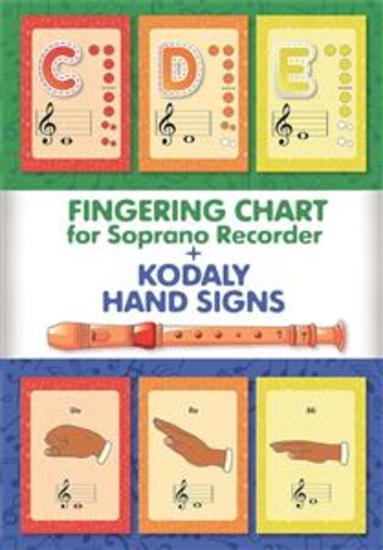
Fingering Chart for Soprano Recorder + Kodaly Hand Signs - cover

Fingering Chart for Soprano Recorder + Kodaly Hand Signs

Helen Winter

Publisher: Helen Winter

  • 0
  • 0
  • 0

Summary

This e-book contains Kodaly’s hand system, along with recorder fingering charts, for each note. This correspondence between note, hand sign, and finger position on the recorder is further enhanced by the inclusion of chromatic notes.
The set includes 18 pictures with fingering positions for the soprano recorder, with pitch names and notations. The musical notes included are:

C С# D D# E F F# G G# A Bb B C D E F F# G

Low F, Low F#, High F, and High F# have different fingering for Baroque and Germanic recorders. These charts are suitable for both styles of a soprano recorder.

One side of the page shows the recorder fingering chart with note name and staff position, and the reverse side depicts the Kodaly (Curwen) hand sign for the corresponding note. Both sides are chroma note color-coded.
Cut out the fingering charts and use them as visual aids for yourself, your kids, or your students. Use one side if you are learning or teaching the recorder fingerings and the opposite side for singing and solmization.
The size of the cut-out will be 7x10 inches (181x260 mm).
Available since: 11/01/2023.
Other books that might interest you

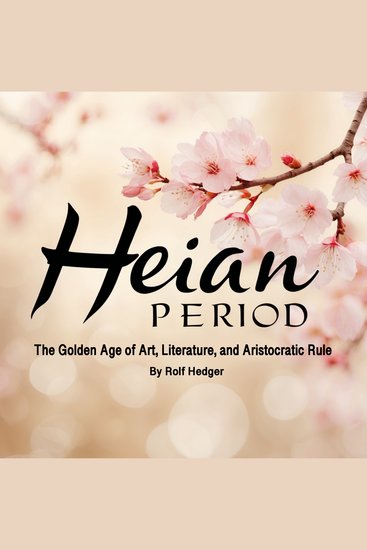
  • Heian Period - The Golden Age of Art Literature and Aristocratic Rule - cover

    Heian Period - The Golden Age of...

    Rolf Hedger

    • 0
    • 0
    • 0
    The Heian Period, spanning from 794 to 1185 CE, marks one of the most culturally rich and politically significant eras in Japanese history. This chapter lays the groundwork for understanding the historical context, political dynamics, and societal structure that defined the early stages of the Heian era. The period officially began when Emperor Kanmu moved the imperial capital from Nara to Heian-kyō, present-day Kyoto. This relocation was intended to establish a new seat of power free from the influence of powerful Buddhist monasteries that had grown too entwined with politics in Nara. 
    The move to Heian-kyō signified more than a change in geography—it was the beginning of a new political and cultural identity. The city was meticulously planned, modeled after the Chinese capital of Chang’an, with a grid-like structure that reflected a vision of order and centralized authority. However, over time, the influence of the emperor waned as powerful aristocratic families, particularly the Fujiwara clan, rose to prominence. By marrying their daughters into the imperial family and acting as regents, the Fujiwara effectively controlled the court, shaping policy and governance from behind the scenes. 
    The political landscape of early Heian Japan was one of ceremonial grandeur and subtle manipulation. Real power resided in the hands of a few elite families, and the imperial court became increasingly detached from the provinces. This created a division between the cultured, refined life of the capital and the often turbulent realities of rural Japan, where local warrior clans began to assert their own authority.
    Show book
  • All My Sons - cover

    All My Sons

    Arthur Miller

    • 0
    • 0
    • 0
    World War II is over and a family, mourning a son missing in action, plants a memorial tree and tries to go on with their lives. A storm blows down the tree and a devastating family secret is uprooted, setting the characters on a terrifying journey towards truth. Based upon a true story, All My Son is a classic drama by one of America’s greatest playwrights. 
     
    At the heart of All My Sons lies a scathing criticism of the American Dream. After its publication Arthur Miller was called to appear before the House Un-American Activities Committee, where he famously refused to give evidence against others. 
     
    Tony Award Winner for Best Author (1947) 
     
    AudioFile Magazine review: “One of the strengths of L.A. Theatre Works is their skill at selecting quality plays previously unavailable on audio. Arthur Miller’s 1947 breakthrough play is at once a postwar family drama, an indictment of false societal values and a searing tragedy. James Farentino plays businessman Joe Keller with a gruff bluster that sometimes masks a sacrificial love for his son Chris (Arye Gross), an idealist home from the war. Julie Harris, as the mother, Kate, is alternately needy, demanding, lovingly solicitous and willfully blind to the past. The live responses of the audience underscore the touches of humor that season the early acts of this landmark American drama.” 
     
    An L.A. Theatre Works full-cast performance featuring James Farentino, Arye Gross, Julie Harris, Mitchell Hebert, Naomi Jacobson, Barbara Klein, Paul Morella, Michaeleen O'Neil, Nathan Taylor and Jerry Whiddon.
    Show book
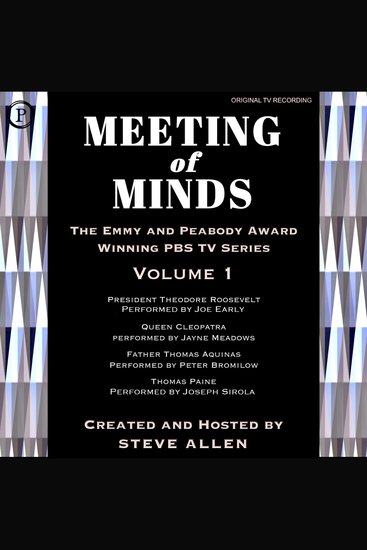
  • Meeting of Minds - Volume I - cover

    Meeting of Minds - Volume I

    Steve Allen

    • 0
    • 0
    • 0
    By " assembling" some of the most fascinating figures in world history, Meeting of Minds provided a groundbreaking opportunity for audiences to be exposed to ideas by way of a medium not normally known for its intellectual vigor. Portrayed by actors, panelists engage in stimulating round-table discussions that were conducted like any other talk show but featured prominent influencers from bygone generations— not just philosophers and politicians, but poets, playwrights, and presidents. From activists and artists to international leaders— both famous and infamous— these conversations are unfailingly witty, thought-provoking, and genuinely entertaining.
    An innovative series, Meeting of Minds remains one of the most delightful ways of gaining historical perspective ever devised, and these original soundtrack recordings capture the intellectual and spirited debates of the episodes hosted by Steve Allen. The panelists featured in this volume are President Theodore Roosevelt, Queen Cleopatra, theologian Thomas Aquinas, and American revolutionary Thomas Paine.
    Show book
  • Hollywood Stage - Alias Jimmy Valentine - The golden age of cinema brought to your ears - cover

    Hollywood Stage - Alias Jimmy...

    Various Authors

    • 0
    • 0
    • 0
    Hollywood is indelibly printed in our minds as the ‘go-to place for entertainment and has been for decades.  When there really did seem to be more stars in Hollywood than in Heaven Hollywood Stage had them performing films as radio plays – on the sponsors dime of course.  The Hollywood Ringmaster himself, Cecil B DeMille unveils the treasures and the stars for you right here…..
    Show book
  • Hollywood Stage - Nobody Lives Forever - The golden age of cinema brought to your ears - cover

    Hollywood Stage - Nobody Lives...

    Various Authors

    • 0
    • 0
    • 0
    Hollywood is indelibly printed in our minds as the ‘go-to place for entertainment and has been for decades. When there really did seem to be more stars in Hollywood than in Heaven Hollywood Stage had them performing films as radio plays – on the sponsors dime of course.  The Hollywood director William Keighly unveils the treasure and the stars for you right here…..
    Show book
  • Hollywood Stage - Our Town - The golden age of cinema brought to your ears - cover

    Hollywood Stage - Our Town - The...

    Various Authors

    • 0
    • 0
    • 0
    Hollywood is indelibly printed in our minds as the ‘go-to place for entertainment and has been for decades.  When there really did seem to be more stars in Hollywood than in Heaven Hollywood Stage had them performing films as radio plays – on the sponsors dime of course.  The Hollywood Ringmaster himself, Cecil B DeMille unveils the treasures and the stars for you right here…..
    Show book