Join us on a literary world trip!
Add this book to bookshelf
Grey
Write a new comment Default profile 50px
Grey
Subscribe to read the full book or read the first pages for free!
All characters reduced
Yemen in Crisis - Autocracy Neo-Liberalism and the Disintegration of a State - cover

Yemen in Crisis - Autocracy Neo-Liberalism and the Disintegration of a State

Helen Lackner

Publisher: Saqi Books

  • 0
  • 0
  • 0

Summary

Yemen is in the grip of its most severe crisis in years. The civil war between the Huthi rebels and the Western and Arab supporters of the regime has resulted in thousands killed and three million displaced. Those who remain suffer severe food shortages and a collapsed economy. The struggle for power in the Arab world's poorest but strategically vital nation has serious implications for the region and beyond. While Egypt and Saudi Arabia fear that a Huthi takeover would threaten free passage of oil through the Bab al-Mandab strait, western governments fear a rise of attacks from al-Qa'ida and IS as the country becomes more unstable. In this invaluable analysis, Helen Lackner uncovers the social and political conflicts that threaten the very survival of the state and its people. She reveals the corruption of the country's US-backed autocratic regime and how it failed to address national impoverishment and to plan an equitable economy for Yemen's growing population.
Available since: 01/10/2023.
Print length: 416 pages.


Other books that might interest you

  • Climate Optimism - Celebrating Systemic Change Around the World - cover

    Climate Optimism - Celebrating...

    Zahra Biabani

    • 0
    • 0
    • 0
    Change the way you think about the future. The fate of humanity can be daunting, but we don't need to live in that space. First, we need to change our attitude in order to implement nature-based solutions to deal with climate change. Good news: there are environmental trends and examples to change the way you think about how we can protect the planet. 


    Get to know Zahra Biabani, a climate activist, influencer, CEO, and writer. After unexpectedly establishing a career as an online sustainability educator and influencer, Zahra decided to jump headfirst into the waters of entrepreneurship and authorship. Climate Optimism is her way to spread hope. 


    Inside, you'll find: 


    ● Real stories on environmental sustainability in other countries that are working 


    ● A mix of unique solutions and practical advice on how to face climate change 


    ● Good news on how to change the way you think and feel about the climate crisis 


    If you're looking for a sustainable living book or books for activists centered on environmentalism like A Field Guide to Climate Anxiety, The Intersectional Environmentalist, or Sustainable Badass, you'll love Climate Optimism.
    Show book
  • Dark Justice - Inside the World of Paedophile Hunters - cover

    Dark Justice - Inside the World...

    Mark de Rond

    • 0
    • 0
    • 0
    It is difficult to imagine a more heinous crime than the sexual abuse of children. Yet, terrifyingly, a new case of child sexual abuse is reported every seven minutes. In response to this crisis, self-appointed groups of citizens are fashioning themselves as pedophile hunters." Operating outside the law, these groups use social media to bait and expose those seeking to engage children sexually, both on- and offline. Their work has been remarkably effective, but at what cost? Following four years of unprecedented access to the UK's most prolific team of pedophile hunters, Mark de Rond offers balanced and insightful answers to the perplexing question of why these groups persist in using extreme methods to hold predators to account in view of less harmful alternatives. In doing so, he invites us to consider the societal impacts of pedophile hunters on our laws and institutions, as well as societal cohesion and safety. 


    Contains mature themes.
    Show book
  • Crusades in Europe The: The History of the Catholic Crusaders’ Campaigns against the Ottomans and Christians across the Continent - cover

    Crusades in Europe The: The...

    Editors Charles River

    • 0
    • 0
    • 0
    Christianity was not a state religion for its first three centuries, and it was only when Emperor Constantine the Great declared it so in the early 4th century that the Church was faced with the thorny problem of state-sanctioned violence. The first major Christian authority to justify the use of arms in defense of Church and State was Augustine, Bishop of Hippo, who wrote in the 5th century, “They who have waged war in obedience to the divine command or in conformity with His laws, have represented in their persons the public justice or the wisdom of government, and in this capacity have put to death wicked men; such persons have by no means violated the commandment, ‘Thou shalt not kill.’”  
    	This opinion gained increasing influence in Western Christianity, though in the East, the attitude was (and continues to be) more nuanced. War was tolerated as a regrettable necessity in a world wounded by sin but never blessed. Canon law enacted in the Byzantine (Eastern Roman) Empire tended to treat soldiers who had killed as sinners needing to repent, and Bishop Basil of Caesarea (d. c. 330) believed that they needed to abstain from receiving communion for three years after battle. It was not that that the Eastern Roman Empire was a particularly peaceable state–far from it, in fact: it was engaged in almost continuous warfare for its entire existence. However, its conflicts were mostly defensive in character, fighting barbarians, Persians, or Muslims, and the idea of consecrating arms for the cause of Christianity was considered alien to its spirit.  
    At the Council of Clermont in July 1095, Pope Urban II canonized religious war by urging Western Europe's nobility to take up arms in defense of the Byzantine Empire against the Muslims, thus launching the Crusades, and religious military orders such as the Knights of Saint John, the Templars, and the Hospitallers arose.
    Show book
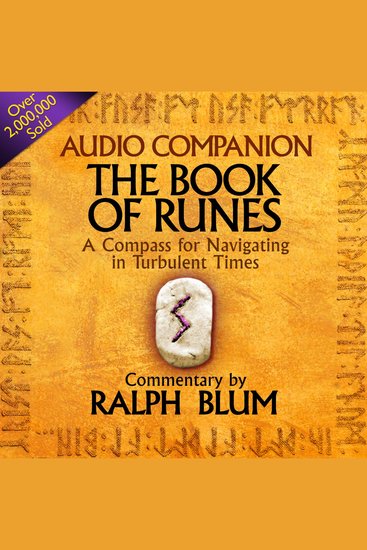
  • The Book of Runes Audio Companion with Ralph Blum - INSIGHT INTO THE PRESENT AND FUTURE — A SYSTEM FOR PRACTICAL DECISION-MAKING - cover

    The Book of Runes Audio...

    Ralph H. Blum

    • 0
    • 0
    • 0
    AN ANCIENT ORACLE FOR CONTEMPORARY LIFE
     
    INSIGHT INTO THE PRESENT AND FUTURE — A SYSTEM FOR PRACTICAL DECISION-MAKING
     
    A recording of bestselling author Ralph Blum recounting his personal odyssey of discovery, and guiding you through a meditative exploration of the mystery and power of the Viking Runes. Also included is a guidebook to the interpretation of Isa and Sowelu, and illustrations of the Runic alphabet, its derivations and modern English equivalents.
     
    Ralph Blum received his degree in Russian studies at Harvard. Following a period in Italy as a Fulbright Scholar, he returned to Harvard, where he did graduate work in anthropology. He is an anthropologist, writer and publisher, and has been working with the Viking Runes as a tool for self-counseling since 1980.
    Show book
  • How to Analyze People - Understand Human Behavior Read People’s True Characters and Decode Body Language - cover

    How to Analyze People -...

    Derek North

    • 0
    • 0
    • 0
    Ever wish you could see through people—know what they’re really thinking, feeling, or hiding behind a smile? 
    Every day, you're surrounded by clues. In conversations. On first dates. At work. During negotiations. 
    And yet—most people miss them. They hear words, but not intentions. They sense tension, but can't explain it. They nod along, but don’t really understand. 
    This audiobook changes that. 
    It gives you the power to analyze people quickly, read body language like a pro, and decode the real motivations behind their behavior—even when they don’t say a word. 
    Whether you're dealing with clients, colleagues, family, or strangers—you’ll start noticing things others completely miss. 
    You’ll discover how to:Understand the core mechanics of human behavior—and what really drives people.Decode micro-expressions and nonverbal cues to tell when someone’s bluffing or holding back.Spot emotional triggers and deal with difficult people without escalating.Apply behavioral psychology in real-life scenarios—from the office to romantic relationships.Recognize patterns in body language across eyes, face, posture, and gestures.Build trust faster using empathy-based communication, not manipulation.Read someone’s personality type and adjust your approach for instant rapport.Tap into your own emotions with clarity—and avoid being hijacked by them.Learn the psychology of habit-forming (and how to break or build new habits for good). 
    You don’t need to be a mind reader. You just need to know what to look for—and how to interpret it.If you're ready to understand people on a whole new level—this is where it starts.
    Show book
  • Mayflower - Its History Passengers and Voyage to the New Land - cover

    Mayflower - Its History...

    Kelly Mass

    • 0
    • 0
    • 0
    In 1620, a group of English families, known now as the Pilgrims, were carried from England to the New World on the Mayflower. When the Mayflower finally showed up in America on November twenty-first, 1620, it had 102 guests and a team of around 30 on board and was anchored off Cape Cod. 
    The Pilgrims, as opposed to their Puritan coworkers, chose to break away from the Church of England because of its Roman Catholic heritage and the church's hesitation to reform, requiring them to pray in personal instead of in the church. In 1608, a group of English families left England for the Netherlands, where they could practice their faith without fear of persecution. As early as 1620, the Plymouth Group population had determined to cross the Atlantic to the New World, which they viewed as a "new Promised Land." 
    Due to hold-ups and challenges, the Pilgrims were only able to take one ship, the Mayflower, to reach America in early October. It was a pretty hard winter season when they showed up in November, and they were unprepared. Consequently, hardly half of the original Pilgrims made it through the first winter season at Plymouth, Massachusetts. All of the settlers may have died if near Native tribes had not taught them how to collect food and other survival methods. On that first fall harvest, they gathered with Native Americans to celebrate what would end up being referred to as the first Thanksgiving in America.
    Show book