Join us on a literary world trip!
Add this book to bookshelf
Grey
Write a new comment Default profile 50px
Grey
Subscribe to read the full book or read the first pages for free!
All characters reduced
Malleus Maleficarum - The Hammer of Witches - cover

Malleus Maleficarum - The Hammer of Witches

Heinrich Kramer

Publisher: DigiCat

  • 0
  • 0
  • 0

Summary

Malleus Maleficarum, also known as The Hammer of Witches, emerges as a seminal work of the late 15th century, authored by Heinrich Kramer alongside Jacob Sprenger. This treatise is notorious for its detailed incitement against witchcraft, exploring the theological, judicial, and societal ramifications of witch hunts during the European witch craze. Divided into three distinct parts, the work combines instructive narratives, exegeses of scripture, and procedural manuals for conducting witch trials, employing a didactic yet alarming literary style that reflects the fears and superstitions of a turbulent epoch dominated by faith and fear. Heinrich Kramer, a Dominican friar and inquisitor, draws upon his experiences in the ecclesiastical courts, which were rife with growing tensions surrounding heresy and witchcraft. His role in advancing anti-witchcraft theories can be contextualized within the broader movement of the Reformation period, driven by anxieties about moral decay, societal disorder, and the influence of women in a patriarchal society. This background shaped Kramer's views, compelling him to interlace theological doctrine with legal imperatives against perceived witches. Malleus Maleficarum remains a critical text for understanding the complexities of early modern European society and the historical context of witch trials. Scholars of witchcraft, gender studies, and religious history will find the book invaluable, as it dissects the intersection of fear, governance, and superstition, offering a chilling glimpse into the psyche of an era where the very fabric of reality was questioned in the face of the supernatural.
Available since: 11/13/2022.
Print length: 402 pages.
Other books that might interest you

  • The Science of Reading Body Language - Read Between the Lines: Understanding Physical Communication - cover

    The Science of Reading Body...

    Nathaniel Hart

    • 0
    • 0
    • 0
    We communicate constantly, not just through words but through a rich tapestry of unspoken cues. From the subtle flicker of an eyebrow to the unconscious shift in posture, our bodies are constantly broadcasting messages, often revealing more than consciously intended. 
    This book serves as a guide to understanding this complex and fascinating world of nonverbal communication. We will embark on a journey to unlock the secrets hidden within human interaction.  
    We will explore the evolutionary basis of nonverbal communication, tracing its origins back to our primal ancestors and examining how these innate cues continue to shape our interactions today. 
    We will delve into the significant role of culture in shaping body language, understanding how societal norms and individual experiences influence our expression and interpretation of nonverbal signals. We will examine the anatomy of nonverbal cues in detail, providing a comprehensive overview of facial expressions, posture, gestures, proxemics (the use of space), and paralanguage (vocal cues), each with their own nuanced meanings and power to reveal emotions, intentions, and social dynamics. We'll investigate the art of integrating verbal and nonverbal cues to achieve a deeper understanding of communication, and learn to detect those inconsistencies that might signal deception or underlying emotions. Through practical exercises and real-world examples, you will hone your observational skills, and ability to spot subtle clues others miss. 
    The book goes beyond simply identifying individual cues, guiding you to integrate these observations into a holistic understanding of behavior, fostering enhanced empathy and providing insights into the motivations and feelings behind nonverbal expressions. 
    Ultimately, the knowledge within this book equips you to navigate the intricacies of human interaction with newfound confidence and understanding, enriching your life by fostering stronger and more meaningful relationships.
    Show book
  • The Correlation-Causation Fallacy - Assuming Correlation Implies Causation - cover

    The Correlation-Causation...

    William Rands

    • 0
    • 0
    • 0
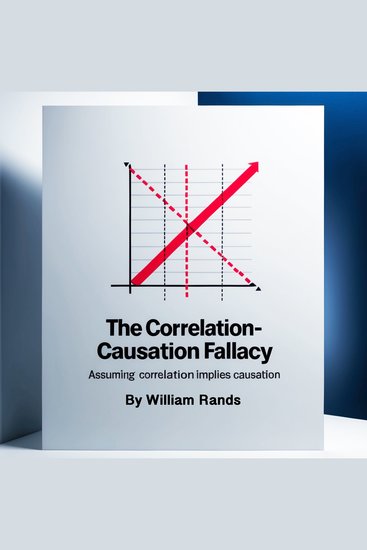
    The correlation-causation fallacy is a common error in reasoning where people mistakenly believe that because two events or variables are correlated, one must have caused the other. This fallacy is not only widespread but can have significant consequences in various aspects of life, including science, policy-making, and everyday decision-making. It stems from the human tendency to look for patterns and explanations, often leading us to draw conclusions from observed associations without carefully analyzing the underlying mechanisms at play. 
    At its core, the fallacy occurs when a correlation—meaning two variables move together in some way—is confused with a causal relationship, where one variable directly influences or causes changes in the other. Correlation does not imply causation, a principle that is fundamental to sound scientific reasoning and critical thinking. For example, if there is a correlation between the number of hours spent watching TV and the number of people eating unhealthy food, it would be erroneous to conclude that watching TV causes people to eat poorly. Other factors, such as time spent sitting idle or lifestyle choices, could be influencing both variables. The danger of assuming causation based on correlation is that it leads to misguided conclusions, decisions, and actions. 
    This fallacy can often be found in media reports, advertising, and even scientific studies. Headlines like "Studies show that eating chocolate improves memory!" or "Increased spending on education leads to higher student performance" may imply a direct causal relationship based on observed correlations, but they neglect to account for potential confounding variables or the possibility of coincidence. In more complex situations, the misinterpretation of correlations can lead to flawed public policies, ineffective interventions, and misplaced public fear or optimism.
    Show book
  • Park Cruising - What Happens When We Wander Off the Path - cover

    Park Cruising - What Happens...

    Marcus McCann

    • 0
    • 0
    • 0
    An intimate look at one of culture's most enduring taboos: public sex. 


    Park Cruising takes a long look at the men who cruise for sex in urban parks. Human rights lawyer Marcus McCann uses park cruising as a point of departure for discussions of consent, empathy, public health, municipal planning, and our relationship to strangers. Prompted by his work opposing a police sting in a suburban park, McCann's ruminations go beyond targeted enforcement and police indifference to violence to examine cruising as a type of world-building. 


    The result is a series of insightful and poetic walks through history, law, literature, and popular representations of cruising in search of the social value of sex. What McCann ultimately reveals is a world of connection, care, and unexpected lessons about the value of pleasure. 


    Contains mature themes.
    Show book
  • Göbekli Tepe: The History and Mystery of One of the World’s Oldest Neolithic Sites - cover

    Göbekli Tepe: The History and...

    Editors Charles River

    • 0
    • 0
    • 0
    The Neolithic period came before the Bronze Age and is generally regarded as the final subdivision of the Stone Age. During this time, communities domesticated plants and certain animals but still relied on hunting and gathering to a considerable extent, and beginning sometime around 7000 BCE, handmade pottery was developed, along with more advanced stone axes that enabled people to clear vast forests. Thanks to tools like that, the sizes of these Neolithic communities ranged from thousands to as few as a hundred, and they spread across the world with a variety of cultures and languages. One aspect these cultures had in common was that they relied on similar tools made of stone, wood, and bone. 
    Despite the fact some Neolithic communities grew to considerable sizes, they’re typically not considered when people think of the first ancient civilizations or the first major cities, so when German archaeologists discovered the archaeological site of Göbekli Tepe in southeastern Turkey in the 1990s, it created an academic firestorm that is still raging. Far from being just another settlement, Göbekli Tepe has been described as the world’s first temple and perhaps one of the locations where human civilization began. Subsequent archaeological work at Göbekli Tepe has revealed that the site was a spiritual center for the local population during a time when humans were undergoing a transition as hunter-gatherers in the Paleolithic Period to a more sedentary lifestyle in the Neolithic Period, more than 10,000 years ago. Further research in the disciplines of anthropology, religion, and history indicate that the activity at Göbekli Tepe subsequently set the tone for elements of Neolithic and Bronze Age religion and ideology in the Near East, especially in Anatolia (roughly equivalent with modern Turkey).
    Show book
  • Relationship-based Treatment of Children and their Parents - An Integrative Guide to Neurobiology Attachment Regulation and Discipline - cover

    Relationship-based Treatment of...

    Kat Scherer, Elizabeth...

    • 0
    • 0
    • 0
    Immediate interventions for struggling families, integrating four distinct areas of psychology. 


    Children and families burdened with attachment disruption, emotional distress, or psychological disorders need effective and immediate assistance. They do not have the time to wait for long-term interventions or developmental changes to improve the parent-child relationship. Here, psychologists Elizabeth A. Sylvester and Kat Scherer provide the most effective approach in such situations: interventions that impact the entire family at relational, emotional, and cognitive-behavioral levels, and that give parents agency to have rapid therapeutic impact on their children's lives and well-being. 


    This addition to the celebrated Norton Series on Interpersonal Neurobiology integrates four distinct areas of psychology: neurobiology, attachment theory, emotion, and relationship-based discipline. This integration produces a clear point of entry for therapists working with struggling families and provides interventions that are logical, doable, and highly effective.
    Show book
  • The Tales of a Tiger - Memoirs from the Vietnam War - cover

    The Tales of a Tiger - Memoirs...

    Michael R. Farley

    • 0
    • 0
    • 0
    This is an autobiography of my three tours of combat duty, as a USAF member, in the Vietnam War. It was written over a period of several years.....
    Show book