Unisciti a noi in un viaggio nel mondo dei libri!
Aggiungi questo libro allo scaffale
Grey
Scrivi un nuovo commento Default profile 50px
Grey
Iscriviti per leggere l'intero libro o leggi le prime pagine gratuitamente!
All characters reduced
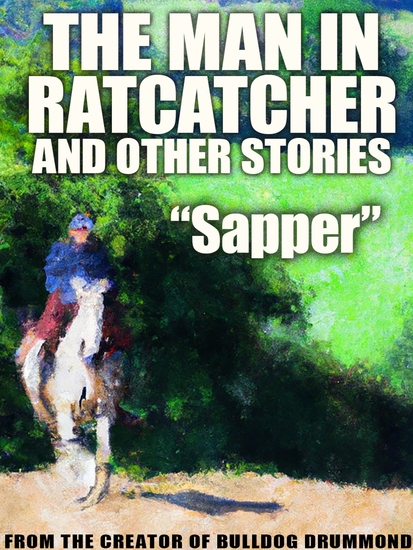
The Man in Ratcatcher and Other Stories - cover

The Man in Ratcatcher and Other Stories

"Sapper", H.C. McNeile

Casa editrice: Wildside Press

  • 0
  • 0
  • 0

Sinossi

This collection assembles 11 tales by "Sapper" (H.C. McNeile), including his most famous ghost story, "The House by the Headland." Included are:
 
INTRODUCTION, by John BetancourtTHE MAN IN RATCATCHERAN ARROW AT A VENTURETHE HOUSE BY THE HEADLANDTHE MAN WHO WOULD NOT PLAY CARDSA QUESTION OF PERSONALITYTHE UNBROKEN LINETHE REAL TESTGOOD HUNTING, OLD CHAPTHE MAN WITH HIS HAND IN HIS POCKETA PAYMENT ON ACCOUNTTHE POSER
Disponibile da: 28/10/2022.
Lunghezza di stampa: 201 pagine.

Altri libri che potrebbero interessarti

  • The White Seal - The First Jungle Book - cover

    The White Seal - The First...

    Rudyard Kipling

    • 0
    • 0
    • 0
    "The White Seal" is a short story by the Nobel Prize-winning British author Rudyard Kipling. It first appeared in print in the August 1893 issue of the London-based magazine National Review. It was published again in 1894 as part of the anthology The Jungle Book.
    Unusually for a story in The Jungle Book, none of the action in "The White Seal" takes place in India. The story proper begins on an island in the Bering Sea between Russia and Alaska. The title character and protagonist, Kotick, is the first white seal ever to have been born on the island. When Kotick discovers that some of the seals on the island are killed by hunters for their skins every year, he sets off on a quest to find an island where seals can live without fear because no humans have ever visited it. His quest takes him all over the Pacific Ocean and beyond.
    Mostra libro
  • Her Lover - From their pens to your ears genius in every story - cover

    Her Lover - From their pens to...

    Maxim Gorky

    • 0
    • 0
    • 0
    Alexei Maximovich Peshkov was born on 28th March 1868, in Nizhny Novgorod, Russia. 
    Better known as Maxim Gorky he was orphaned at 11 and ran away from home at 12.  At 19 he had already attempted suicide and thereafter travelled, by foot, across the Russian Empire for 5 years. 
    His first book ‘Essays & Stories’ in 1898 was a sensation and so began a long career as an author of short stories, novels and plays.  Gorky saw writing as a moral and political act that would help to change the unjust world around him.  He was an ardent early advocate of the emerging Marxist movement and publicly opposed the Tsarist regime leading several times to his arrest.  
    In 1904 he began his own theatre but the censor banned every play and Gorky was forced to abandon the project. 
    But Gorky was a financially successful author, editor, and playwright and gave monies to political parties as well as for civil rights and social reform.  The brutal shooting of workers, which set in motion the Revolution of 1905, pushed Gorky more decisively toward radical solutions.  
    In 1906 he went to the United States to raise funds for the Bolsheviks. Those experiences including a scandal over travelling with his lover and not his wife deepened his contempt for the ‘bourgeois soul.’ 
    Gorky now moved to Capri in Italy, both for health reasons and to escape the increasingly repressive times in Russia.  
    An amnesty for the 300th anniversary of the Romanov dynasty saw him return to Russia in 1914. His politics remained close to the Bolshevik cause.  But soon, after the 1918 revolution, his essays referred to Lenin as a tyrant for his senseless arrests and repression.  He was soon appealing to the outside world for food aid after the catastrophic crop failure. 
    In October 1921 Gorky returned to Italy, now in Fascist hands, and settled in Sorrento until 1932.  His health worsened with the onset of tuberculosis. 
    He wrote several successful books there but now decided to find an understanding with the communist regime. Stalin invited him home and his return was hailed as a major propaganda victory.  He was decorated with the Order of Lenin, and a province, a park, and various streets re-named in his honour. 
    But he had his faults too.  In 1933, Gorky co-edited a book on the White Sea-Baltic Canal and denied even a single prisoner died during its construction, but thousands had. As well, knowing that some Nazis were homosexual, a phrase was attributed to him that said ‘exterminate all homosexuals and fascism will vanish’.  Although he was himself was quoting another he was decidedly homophobic. 
    With the increase of Stalinist repression in 1935 Gorky was placed under unannounced house arrest. 
    Maxim Gorky died on the 18th June 1936 from pneumonia.  He was 68. 
    Stalin and Molotov were among those who carried Gorky's urn of ashes at his funeral.
    Mostra libro
  • Crime and Punishment - Key Insights - cover

    Crime and Punishment - Key Insights

    Fyodor Dostoevsky

    • 0
    • 0
    • 0
    Step into one of the most gripping psychological novels ever written, a story that explores the weight of conscience, the torment of guilt, and the possibility of redemption. Crime and Punishment follows Raskolnikov, a brilliant but impoverished student in St. Petersburg who believes he can commit the perfect crime in the name of a greater good. When he murders a pawnbroker, his world unravels—not through the law at first, but through his own mind. Haunted, paranoid, and consumed by inner conflict, he discovers that punishment begins long before judgment is pronounced.
    Mostra libro
  • The Black Cat - cover

    The Black Cat

    Edgar Allan Poe

    • 0
    • 0
    • 0
    Title: The Black Cat 
    Author: Edgar Allan Poe 
    Narrator: Jonathan Dunne 
    Original Publication: 1843 
    Public Domain: Yes 
    Series Placement: Number 12 in the Timeless Terrors series 
    Description: 
    The Black Cat by Edgar Allan Poe is a dark tale of guilt, madness, and the supernatural. First published in 1843 in The Saturday Evening Post, it tells the story of a man whose descent into alcoholism and cruelty leads to shocking acts of violence, culminating in a horrifying confrontation with a seemingly malevolent feline. 
    Told through the first-person perspective of the increasingly unreliable narrator, the story explores themes of conscience, obsession, and the terrifying consequences of unchecked human depravity. Poe’s mastery of psychological horror and gothic atmosphere makes this a timeless classic. 
    This recording, narrated by Amazon bestselling horror author Jonathan Dunne, brings to life the creeping tension, psychological dread, and macabre details that define Poe’s work. While the text is in the public domain, this performance is an original work and copyright © 2025 Jonathan Dunne. 
    Listeners should be prepared for a disturbing meditation on guilt, horror, and the dark impulses that lurk within the human psyche.
    Mostra libro
  • One None and a Hundred-thousand - cover

    One None and a Hundred-thousand

    Luigi Pirandello

    • 0
    • 0
    • 0
    A seemingly ordinary man's world shatters when his wife points out a minor physical flaw. This sparks an existential crisis in Vitangelo Moscarda, as he realizes everyone perceives him differently, creating "a hundred thousand" versions of himself. Trapped by societal masks and questioning his own sanity, Vitangelo embarks on a radical journey to break free and discover his true identity. This thought-provoking novel by Luigi Pirandello explores the fluidity of self, the power of perception, and the struggle for authenticity in a world obsessed with masks.
    Mostra libro
  • Rats - A Short Story Collection - The horror of rats assails us in this engrossing inescapable collection - cover

    Rats - A Short Story Collection...

    Bram Stoker, HP Lovecraft, M R...

    • 0
    • 0
    • 0
    An urban myth is often quoted that you are never further than six feet from a rat in any built-up area.  The true figure is nearer one hundred and fifty feet but that too seems too close for comfort. 
     
    Wherever these creatures settle there is an undeniable fear amongst most of us that they are malevolent, vile and disgusting creatures.  A chill and a shudder are our bodies natural reactions.  Fear lurks in our hearts and souls. 
     
    Enter our storied arena of authors.  This, for them, is fertile territory with which to torment and torture the reader and listener with all sorts of dark deeds that, somehow, we just can’t resist.  
     
    From the macabre and talented pens of Lovecraft, Stoker, James we add Cowles and Mann and others to assault your ears. 
     
    1 - Rats - A Short Story Collection - An Introduction 
    2 - The Burial of the Rats by Bram Stoker 
    3 - The Rats in the Walls by H P Lovecraft 
    4 - The Devilish Rat by Edward Page Mitchell 
    5 - Rats by Mary E Mann 
    6 - Rats by M R James 
    7 - Rats by Frederick Cowles 
    8 - Alexander the Ratcatcher by Richard Garnett
    Mostra libro