Join us on a literary world trip!
Add this book to bookshelf
Grey
Write a new comment Default profile 50px
Grey
Subscribe to read the full book or read the first pages for free!
All characters reduced
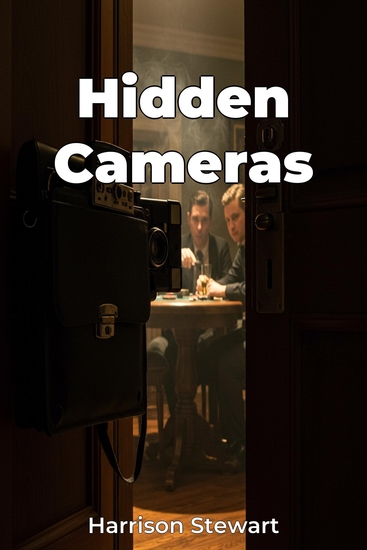
Hidden Cameras - cover

Hidden Cameras

Harrison Stewart

Translator A AI

Publisher: Publifye

  • 0
  • 0
  • 0

Summary

Hidden Cameras explores the complex world of surveillance photography and its significant impact on journalism and historical documentation. Delving into the evolution of covert photographic technology, the book argues that hidden cameras have fundamentally reshaped transparency and accountability in society. One intriguing aspect highlighted is how covert images have exposed corruption and documented injustices, sparking crucial public dialogues.

 
The text also examines the ethics surrounding the use of hidden cameras, probing the moral questions that arise when images are captured without consent, a pivotal concern for media studies. The book navigates the legal and ethical complexities, examining landmark cases and the ongoing debate about balancing privacy rights with the public's right to know. It presents compelling case studies demonstrating how covert images have influenced public opinion and driven social and political change.

 
Beginning with a historical overview, Hidden Cameras progresses to explore the ethical dilemmas inherent in covert photography before focusing on specific instances where hidden camera footage played a pivotal role. This approach provides a comprehensive understanding of the power and potential pitfalls of this tool for journalism.
Available since: 02/26/2025.
Print length: 76 pages.

Other books that might interest you

  • True Crime: Missouri - The State's Most Notorious Criminal Cases - cover

    True Crime: Missouri - The...

    David J Krajicek

    • 0
    • 1
    • 0
    Eleven stories of deadly doings in Missouri by “a standout writer of terse, staccato prose and vivid details” (The Omaha Reader).   Missouri has a bloody history dating back to frontier days—not just in St. Louis or Kansas City but in small towns and rural hamlets where one local summed up how Missourians prefer to handle conflicts: You shoot, you shovel, and you shut up. In this book, David J. Krajicek recounts eleven true tales of shocking and infamous crimes in the state, among them:     The St. Louis barroom murder that inspired the popular song “Stagger Lee”   The vigilante killing of Ken McElroy, the “town bully” of tiny Skidmore, MO   The heartless kidnapping and murder of millionaire Robert Greenlease’s son in Kansas City by a couple of St. Joseph barflies  The Kirkwood City Council massacre  The “throwaway” serial killings of over a dozen young prostitutes in Kansas City by a garbage collector  The forgotten story of “Cockeyed” Cook, a lost soul from Joplin who massacred an entire family and dumped them down a mineshaft  The “American Gothic” killers, farmer Ray Copeland and his wife, Faye, who murdered their farmhands near Chillicothe in a bizarre plot to make money—but made the mistake of planting their human crop too shallow  And more
    Show book
  • Whose Language Is English? - cover

    Whose Language Is English?

    Jieun Kiaer

    • 0
    • 0
    • 0
    Whose language is English? Although we often think of it as native to one place, today there are many Englishes. About seventy-five countries are now using English as their official or first language, and the number of people speaking it around the world continues to rise. But the makeup of the English-speaking population is changing. The proportion of speakers for whom English is a first language is decreasing, due to the explosion in popularity of English as a second language. 


    In this ambitious book, Jieun Kiaer explores the lives of English words in the twenty-first century, when the creation and use of language has become an increasingly dynamic, interactive, and diverse process in which ordinary people have taken leading roles—offering such coinages as "flexitarian," "MeToo," "glow up," and "shitizen" to "No sabo kids" and beyond. As English language grows ever more diverse, Kiaer believes, we need a paradigm shift. We must acknowledge that all varieties of English are languages in their own right when they are used by a community of speakers. English is a language that belongs to everyone. 


    Considering the effects of social media, the Covid-19 pandemic, virtual work, globalization, and artificial intelligence, Kiaer paints a compelling portrait of a rapidly evolving language characterized by creativity and democratization.
    Show book
  • A Comic History Of Rome - A Wry Journey From the Wolf-Sucking Start to the Farcical Dictator Face-Off of History's Favorite Oligarchic Republic - cover

    A Comic History Of Rome - A Wry...

    Gilbert Abbott A'Beckett

    • 0
    • 0
    • 0
    Forget dusty textbooks and noble senators. The real history of Rome is a chaotic, blood-soaked circus of power-crazed maniacs, backstabbing politicians, and enough megalomaniacs in togas to outfit a farce. 
    Behind the marble pillars and glittering triumphs lay a world of two-faced demagogues and ruthless ambition. Gilbert Abbott A Beckett’s legendary Comic History of Rome drags the Eternal City’s glorious past into the gloriously witty gutter where it belongs. 
    This is history as the finest form of satire. Witness the original sibling rivalry between Romulus and Remus, which ended—like so much in Rome—in betrayal. From the daring escape of Cloelia from the Etruscan camp to the grim reality of the gladiatorial arena, no sacred cow is left unskewered. A Beckett’s narrative, both “compendious and correct,” guides you through the chaos with dry, avuncular wit, suggesting we take the reign of Romulus with “an entire cellar of salt.” 
    Now, listen as the venerable figures of antiquity are revived in all their farcical glory: eavesdrop on the Senate’s petty squabbles, follow Hannibal’s troublesome Alpine holiday, and endure the terrible poetry and even worse governance of Emperor Nero. The original illustrations are vividly brought to life through the narrator's sharp performance, preserving the unique charm of this classic. 
    So, don your metaphorical laurel wreath and ready your laughter. This audiobook invites you to experience the hilarious rise and fall of an empire—a story far richer, and funnier, than any textbook would ever dare admit.
    Show book
  • Where Stands a Wingèd Sentry - cover

    Where Stands a Wingèd Sentry

    Margaret Kennedy

    • 0
    • 0
    • 0
    Margaret Kennedy was an acclaimed novelist and playwright best-known for The Constant Nymph. In this autobiographical account, taken from her war diaries, she conveys the tension, frustration, and bewilderment of the progression of the war, and the terror of knowing that the worst is to come, but not yet knowing what the worst will be. 


    English bravery, confusion, stubbornness, and dark humor provide the positive, more hopeful side of her experiences, in which she and her children move from Surrey to Cornwall, to sit out the war amidst a quietly efficient Home Guard and the most scandalous rumors. 


    "Most people knew in their hearts that the lid had been taken off hell, and that what had been done in Guernica would one day be done in London, Paris and Berlin." Margaret Kennedy's prophetic words, written about the pre-war mood in Europe, give the tone of this riveting 1941 wartime memoir: it is Mrs. Miniver with the gloves off. 


    Where Stands A Wingèd Sentry, the title comes from a seventeenth-century poem by Henry Vaughan, was only published in the USA in 1942, and was never published in the UK, until now.
    Show book
  • Black Soldiers in the World Wars: The History of the Most Decorated African American Units in Both Conflicts - cover

    Black Soldiers in the World...

    Charles River Editors

    • 0
    • 0
    • 0
    The United States has no shortage of famous military units, from the Civil War’s Iron Brigade to the 101st Airborne, but one would be hard pressed to find one that had to go through as many hardships off the field as the Tuskegee Airmen, a group of African American fighter pilots who overcame Jim Crow at home and official segregation in the military to serve their country in the final years of World War II. In fact, it required a concerted effort by groups such as the National Association for the Advancement of Colored People (NAACP) and the extreme circumstances brought about by World War II that the military eventually decided to establish the “Tuskegee Experiment.” In time, the Tuskegee Airmen would be romanticized and mythologized to the extent that it was erroneously claimed that some escort squadrons didn’t lose a bomber to the enemy, which led Tuskegee airman Grant Williams to note in jest, “Back then, nobody realized the significance of what we were doing. Now, they seem to think we could walk on water."  
    Between 1942 and 1949, nearly 20,000 black men trained at Montford Point. They endured tar-paper barracks that baked in summer heat and leaked in coastal storms, learned to drill to the cadence of instructors who sometimes doubted their right to wear the uniform, and mastered skills that would carry them to the beaches and supply trails of Saipan, Iwo Jima, and Okinawa. Their story illuminated the paradox of wartime America, a republic that preached freedom abroad while policing hierarchies at home. 
    One of the most overlooked African American combat units is the Harlem Hellfighters, also known as the 369th Infantry Regiment of the U.S. Army. Initially raised as the 15th New York (Colored) National Guard and later federalized for World War I, the regiment was "loaned" to the French Army, where it compiled an extraordinary combat record, with a remarkable 191 days on the line and suffering about 1,400 casualties.
    Show book
  • African Mythology: Enthralling Myths Fables and Legends from Africa - cover

    African Mythology: Enthralling...

    Billy Wellman

    • 0
    • 0
    • 0
    Africa is huge and varied, and so is its mythology. 
    African ideas of how the world began are very different from the story of Genesis. Though the creator god is repeatedly seen as having withdrawn from the world, people often have a very direct and intense relationship with demigods, ancestors, and bush spirits. The entire landscape is permeated by spiritual meanings and inhabited by gods and spirits. While many Africans today formally follow the Christian or Muslim faiths, they often blend these beliefs with traditional lore and rites. 
    This audiobook examines the central themes of African mythology—the creation, gods and goddesses, trickster tales, animals, monsters, heroes, and mythical rulers—and shows how some motifs recur throughout the corpus of myths. It also looks at how African myths are becoming better known because of writers and filmmakers, particularly from the Black diaspora, who draw on this rich heritage for inspiration. 
    This introductory guide to African myths will allow you to do the following:Learn why the original creator decided to withdraw from Earth.Find out how ancient Egypt had several different creation stories, depending on which god was in ascendancy at the time.Listen to the medieval African emperor said to have been the richest man in history.Find out where Br’er Rabbit really came from.Check out how Anansi the Spider gained ownership of all the stories in the world.Get to know Oshun, the Yoruba river goddess, and how she arrived in Latin America.Learn about Haile Selassie, the emperor who brought Ethiopia into the League of Nations, and how he became a living god to Jamaican Rastafarians.Understand how Voodoo (Vodou) grew out of traditional West African religion. 
    Scroll up and click the “add to cart” button to learn more about African mythology!
    Show book