Join us on a literary world trip!
Add this book to bookshelf
Grey
Write a new comment Default profile 50px
Grey
Subscribe to read the full book or read the first pages for free!
All characters reduced
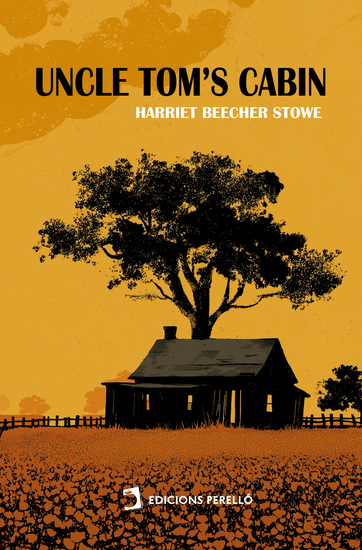
Uncle Tom's Cabin - cover

Uncle Tom's Cabin

Harriet Beecher Stowe

Publisher: Edicions Perelló

  • 0
  • 0
  • 0

Summary

Uncle Tom's Cabin (1852) is the novel that moved an entire nation and became a powerful manifesto against slavery. The story follows Tom, a kindhearted and deeply religious enslaved man whose faith and dignity remain unshaken despite oppression and suffering. Published during the intense political tensions preceding the American Civil War, this work not only marked a milestone in American literature but also inspired the abolitionist movement. A moving and courageous tale that continues to remind generation after generation of the importance of freedom and humanity.
Available since: 08/15/2025.
Print length: 470 pages.

Other books that might interest you

  • Richard III - cover

    Richard III

    E.A. Copen, Pierre Arthur Laure,...

    • 0
    • 0
    • 0
    Brilliantly manipulative and entirely amoral, the hero-villain Richard is one of Shakespeare's greatest roles. 
    The Yorkists have emerged victorious from the civil wars and Edward IV wears the English crown. But Edward's misshapen brother Richard harbors kingly ambitions and will stop at nothing to achieve the throne. In a fatal battle on Bosworth Field, Richard meets the ghosts of all whom he has murdered and the Earl of Richmond, the future King Henry VII. 
    Richard III is played by David Troughton. Saskia Wickham plays Lady Anne, Margaret Robertson plays Queen Margaret, and Philip Voss is Buckingham.
    Show book
  • Blackmail - From their pens to your ears genius in every story - cover

    Blackmail - From their pens to...

    John Galsworthy

    • 0
    • 0
    • 0
    John Galsworthy was born on the 14th August 1867 on the family estate, Parkfield, in Kingston-upon-Thames.  His family’s wealth came from the shipping industry 
    At age nine he began his education at Saugeen, a Bournemouth preparatory school, before moving to Harrow school in 1881, distinguishing himself as an athlete.  
    Galsworthy attended New College, Oxford to read law and left with a second-class degree with honours in 1889. The bar called him in 1890 but Galsworthy decided he would rather run the family’s shipping business. This also meant travelling to destinations such as Vancouver, South Africa and Australia. 
    In 1895 Galsworthy began a decade long affair with Ada Nemesis Pearson Cooper, the wife of his first cousin. It was only when, in 1905, she divorced and married Galsworthy that their affair became known. 
    His literary career began in 1897 with a short story volume, ‘From the Four Winds’, with the pseudonym John Sinjohn as were three further works. Under his own name, in 1904, came ‘The Island Pharisees’, a novel of social observation, seasoned with flashes of satire and propaganda. He also switched from small, independent publishers to the larger Heinemann and to whom he remained for the duration of his career. 
    1906 saw first major play, ‘The Silver Box’, and the novel ‘The Man of Property’. Each to considerable acclaim. The latter was the first in ‘The Forsyte Saga’ trilogy written between 1906 and 1921. It dealt with the questions of status, class and materialism through Soames Forsyte, who is acutely aware of his ‘new money’ status. Jealous of his wife, his machinations drive her into the arms of another. Soames engages in a terrible revenge with terrible consequences.  
    His social agenda was enlightened particularly in his condemnation over the use of solitary confinement in prisons, his attacks on theatrical censorship and campaigning for animal rights. 
    Galsworthy, having been passed over for active service, spent much of the First World War working as an orderly in a field hospital in France. 
    Despite his it was only in 1920 that he had his first blockbuster play ‘The Skin Game’, a melodrama dealing with ethics, property and class.  
    In 1920 ‘In Chancery’ also arrived with further discourse on the marital disharmony between Soames Forsyte and his wife.  
    The appreciation of his work gradually shifted from plays to novels, particularly through his detailing English social difference, tension and pretension with the Forsytes.  A second trilogy, ‘A Modern Comedy’, followed, examining his love for his daughter Fleur and the English commercial upper-middle class, its ideologies and Soames’ poisonous materialism.  
    Having rejected a knighthood in 1918 he was appointed, in 1929, to the Order of Merit. Galsworthy spent his last years writing a third Forsythe trilogy, ‘End of the Chapter’.   
    In 1932 he was awarded the Nobel Prize, but by now failing health meant he was too ill to attend the ceremony. 
    John Galsworthy died at his Hampstead home of a brain tumour on 31st January, 1933. He was cremated and his ashes scattered from an aeroplane over the South Downs.
    Show book
  • The Swiss Family Robinson - cover

    The Swiss Family Robinson

    Johann Wyss

    • 0
    • 0
    • 0
    "The Swiss Family Robinson" by Johann David Wyss is a classic adventure novel, following the Robinson family's thrilling tale of survival on a tropical deserted island. 
    The Robinson family battles nature's fury and discovers the true meaning of resilience. 
    How will they conquer the challenges of the untamed wilderness and forge a new life amidst its many secrets?
    Show book
  • The Imp of the Perverse - cover

    The Imp of the Perverse

    Edgar Allan Poe

    • 0
    • 0
    • 0
    "The Imp of the Perverse" is a short story by 19th-century American author and critic Edgar Allan Poe. Beginning as an essay, it discusses the narrator's self-destructive impulses, embodied as the symbolic metaphor of "the Imp of the Perverse". The narrator describes this spirit as the agent that tempts a person to do things "merely because we feel we should not."
    In the story, the narrator commits murder to inherit a man's estate. A coroner attributes the death to an act of God, and the narrator benefits from his crime. Several years later, the narrator starts obsessing about a possible confession for his crime. He acts on a self-destructive impulse, and confesses his crime in public, leading to his swift trial and execution.
    The narrator explains at length his theory on "The Imp of the Perverse", which he believes causes people to commit acts against their self-interest. This essay-like discussion is presented objectively, though the narrator admits that he is "one of the many uncounted victims of the Imp of the Perverse". He then explains how his conviction for murder was the result of this.
    Show book
  • The Loathly Opposite - From their pens to your ears genius in every story - cover

    The Loathly Opposite - From...

    John Buchan

    • 0
    • 0
    • 0
    The Scottish novelist John Buchan enjoyed a remarkable career as politician, historian and Governor General. He was born John Buchan on 26th August 1875 and later added 1st Baron Tweedsmuir PC GCMG GCVO CH to his name.  
    Buchan studied at Hutchesons’ Grammar School, Glasgow and at seventeen won a scholarship to the University of Glasgow to study classics. There he began to write poetry. In 1895 he transferred to Oxford to continue his study of Classics and in 1896 ‘Sir Quixote of the Moors’ was published followed by the non-fiction ‘Scholar-Gipsies’. His prolific literary output now hardly faltered. 
    He graduated in 1900 and became the private secretary to Alfred Milner, the High Commissioner for Southern Africa and other colonies. Buchan found the same inspiration in the African landscape as he had in the Scottish Borders, and would later set many works here. Returning to London he became a partner in a publishing house, and garnered an editorial role at The Spectator. He also completed his law studies. He was called to the bar in 1901 but never practiced.  
    On 15th July 1907 Buchan married Susan Charlotte Grosvenor, the cousin of the Duke of Westminster. In 1910 he wrote ‘Prester John’, the first of a series set in South Africa.  
    In 1911 Buchan entered politics as a Unionist candidate in the Scottish Borders advocating the support of free trade, women’s suffrage, national insurance, and reducing the power of the House of Lords.  
    The Great War saw Buchan writing for the War Propaganda Bureau and as Times correspondent in France. In 1915, he published ‘The Thirty-Nine Steps’, his most famous book and a follow-up Richard Hannay novel, ‘Greenmantle’, in 1916.  
    In 1916 Buchan enlisted in the Intelligence Corps which included writing speeches for Sir Douglas Haig. By 1917 he was Director of Information under Lord Beaverbrook. Buchan called it “the toughest job he ever took on”. He somehow found time to assist in a history of the war magazine. This was later published in 24 volumes: Nelson’s History of the War. 
    After the war his writing focused on historical studies. In 1927 Buchan became the Unionist Party Member of Parliament for the Combined Scottish Universities. In a speech to Parliament he said “I believe every Scotsman should be a Scottish nationalist. If it could be proved that a Scottish parliament were desirable… Scotsmen should support it.”  
    Over the next decade he continued to distinguish himself politically and in literature.  On the 1st June 1935 he became 1st Baron Tweedsmuir of Elsfield in the County of Oxford.  
    He was now also given the position of Governor General in Canada and resolved to travel all over Canada to gain a better insight of the country. Having crossed both length and breadth he saw the cultural shift between areas and their common ground and helped bring about a clear national Canadian identity. 
    On the 6th February 1940 he collapsed from a stroke and sustained a very serious head injury in falling. Two rounds of surgery to stabilise his condition were unsuccessful and Buchan died on the 11th February. After a state funeral in Ottawa his ashes were returned to his estate in Oxfordshire.
    Show book
  • Hadji Murat - cover

    Hadji Murat

    Leo Tolstoy

    • 0
    • 0
    • 0
    Tolstoy’s final work—a gripping novella about the struggle between the Muslim Chechens and their inept occupiers—is a powerful moral fable for our time. 
     
    Inspired by a historical figure Tolstoy heard about while serving in the Caucasus, this story brings to life the famed warrior Hadji Murat, a Chechen rebel who has fought fiercely and courageously against the Russian empire. After a feud with his commander he defects to the Russians, only to find that he is now trusted by neither side. He is first welcomed but then imprisoned by the Russians under suspicion of being a spy, and when he hears news of his wife and son held captive by the Chechens, Murat risks all to try to save his family. In the award-winning Pevear and Volokhonsky translation, Hadji Murat is a thrilling and provocative portrait of a tragic figure that has lost none of its relevance. 
     
    This audiobook is expertly read by Constantine Gregory, with audio engineering by Mike Thal. It was produced and published by Echo Point Books & Media, an independent bookseller in Brattleboro, Vermont.
    Show book