Join us on a literary world trip!
Add this book to bookshelf
Grey
Write a new comment Default profile 50px
Grey
Subscribe to read the full book or read the first pages for free!
All characters reduced
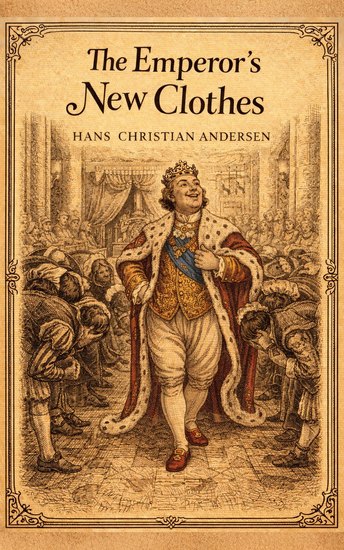
The Emperor's New Clothes - cover

The Emperor's New Clothes

Hans Christian Andersen

Publisher: CLXBX

  • 0
  • 0
  • 0

Summary

Step into a world of vanity, deception, and surprising courage in Hans Christian Andersen's timeless classic, The Emperor's New Clothes. This beloved fairy tale tells the story of a proud and fashion-obsessed emperor who cares for little beyond his extravagant wardrobe and public image. When two cunning swindlers arrive at his court claiming they can weave the most magnificent fabric ever seen—one invisible to anyone unfit for their position or hopelessly foolish—the emperor eagerly commissions a royal suit.

As the "magical" cloth is crafted, ministers and officials are sent to inspect the progress. Afraid of appearing incompetent or foolish, each one pretends to see the nonexistent fabric, praising its beauty and sophistication. The emperor himself, unwilling to admit he sees nothing, joins in the charade. Soon, the entire kingdom buzzes with admiration for a suit that does not exist.

On the day of the grand procession, the emperor proudly parades through the streets wearing his "new clothes," while his subjects, equally fearful of exposing themselves as unworthy, applaud in false admiration. It is only when a small child, innocent and unafraid of judgment, speaks the simple truth—"But he isn't wearing anything at all!"—that the illusion is shattered.

With humor, wit, and sharp social commentary, Andersen's tale explores themes of pride, conformity, honesty, and the power of truth. Beneath its playful storytelling lies a profound message about the dangers of vanity and the human tendency to follow the crowd rather than trust one's own judgment.

The Emperor's New Clothes remains a powerful and relevant story for readers of all ages, reminding us that courage often comes from the most unexpected voices—and that sometimes, the simplest truth is the hardest to admit.
Available since: 02/14/2026.
Print length: 7 pages.

Other books that might interest you

  • Avenger An - cover

    Avenger An

    Anton Chekhov

    • 0
    • 0
    • 0
    In the story, "An Avenger", Anton Chekhov, explores the themes of infidelity, trust, revenge, shame and pride. Fyodor Sigaev catches his wife being unfaithful to him red-handed. He finds himself angry and outraged at a gun shop where he has thoughts of killing his wife, her lover and himself.
    Show book
  • The Three Musketeers - cover

    The Three Musketeers

    Alexandre Dumas

    • 0
    • 0
    • 0
    "The Three Musketeers" by Alexandre Dumas is a classic adventure novel written in the early 19th century. The story follows the ambitious and courageous young man, D'Artagnan, who travels to Paris to join the King's Musketeers and prove his worth among the legendary figures Athos, Porthos, and Aramis. 
    At the beginning of the book, we are introduced to D'Artagnan as he embarks on his journey with only a horse and the wisdom of his father. He quickly finds himself caught up in conflicts that test his bravery and lead to encounters with formidable adversaries. The narrative sets the stage for D'Artagnan's character development, highlighting his boldness and fiery spirit as he faces challenges while seeking camaraderie among the renowned Musketeers. 
    The whimsical tone and swashbuckling adventures draw readers into a vibrant world filled with honor, friendship, and rivalry, ensuring an engaging start to this timeless tale.
    Show book
  • Notes from the Underground - cover

    Notes from the Underground

    Fyodor Dostoevsky

    • 0
    • 0
    • 0
    Dostoevsky's novella " Notes from the Underground" is part embittered monologue and part brief descriptions of anecdotes from the anonymous writer's life. As the author himself states: 
    "The author of the diary and the diary itself are, of course, imaginary. Nevertheless it is clear that such persons as the writer of these notes not only may, but positively must, exist in our society, when we consider the circumstances in the midst of which our society is formed." 
    The Russia of the mid 19th century was a period in which the society was awash with a myriad of philosophical ideas as it became increasingly influenced by the West. The writer instinctively reacts against Utopian ideals and sees in himself the proof that such a philosophy is doomed.   
    Head Stories Audio presents "Notes from the Underground" by Fyodor Dostoevsky, narrated by Simon Hester. With original music.
    Show book
  • Fathers and Sons - cover

    Fathers and Sons

    Ivan Turgenev

    • 0
    • 0
    • 0
    "Bazarov—a gifted, impatient, and caustic young man—has journeyed from school to the home of his friend Arkady Kirsanov. But soon Bazarov's outspoken rejection of authority and social conventions touches off quarrels, misunderstandings, and romantic entanglements that will utterly transform the Kirsanov household and reflect the changes taking place across all of nineteenth-century Russia.A timeless depiction of generational conflict during social upheaval, it vividly portrays the clash between the older Russian aristocracy and the youthful radicalism that foreshadowed the revolution to come—and offers modern-day readers much to reflect upon as they look around at their own tumultuous, ever changing world.  Support us at https://manifoldmedia.net/donate
    Show book
  • The Scarlet Plague - cover

    The Scarlet Plague

    Jack London

    • 0
    • 0
    • 0
    Step into a post-apocalyptic world of chaos and resilience in Jack London's timeless classic, 'The Scarlet Plague.' Immerse yourself in this gripping tale of a deadly pandemic that reshapes humanity, leaving behind only a few survivors. As you listen to the digital audiobook, you'll be transported to a future where civilization has crumbled, and a handful of individuals must navigate a harsh new reality.  
     
    London's masterful storytelling brings to life the struggles, triumphs, and bonds that emerge in the face of adversity. Join us on this unforgettable journey, and let the haunting narrative of 'The Scarlet Plague' keep you on the edge of your seat, reminding you of the enduring power of the human spirit. Get your digital audiobook now and experience a classic story that resonates with our world today.
    Show book
  • A Midsummer Night’s Dream - cover

    A Midsummer Night’s Dream

    Pierre Arthur Laure, William...

    • 0
    • 0
    • 0
    Shakespeare’s most imaginative and merry play is set in an enchanted wood amidst fairies and sprites. 
    When Oberon, King of the Fairies, uses his magic upon four runaway lovers in a midsummer wood outside Athens, chaos ensues. Who really loves whom? Meanwhile, a band of well-meaning but bungling local actors have their rehearsal sabotaged by the mischievous Puck, who bewitches their leader, Bottom, and Titania, the Fairy Queen. The result is a lively and anarchic comedy which can only be resolved by an elaborate disentangling of spells. 
    Hermia is played by Amanda Root, Oberon by David Harewood, and Bottom by Roy Hudd. 
    ACT IScene 1. In Athens, preparations are underway for the wedding of Duke Theseus to Hippolyta, Queen of the Amazons. An angry father, Egeus, comes to the ducal palace and accuses Lysander of bewitching his daughter Hermia, even though she is already betrothed to Demetrius. Hermia confesses her love for Lysander, and Theseus tells her that according to the law, she must either die or enter a nunnery if she refuses to marry the man chosen by her father. He gives her until the new moon to decide. Hermia and Lysander decide to run away; they agree to meet the following night in a wood outside the city. They tell Helena, Hermia’s childhood friend, of their plan; she, however, is in love with Demetrius, who has rejected her for Hermia, and she hopes to regain his favor by telling him of the lovers’ intentions.Scene 2. A group of Athenian workmen, “rude mechanicals,” are preparing an entertainment to be performed at the Duke’s wedding. They have chosen “the most lamentable comedy and most cruel death of Pyramus and Thisby.” 
    ACT IIScene 1. In a wood near Athens, Oberon and Titania, King and Queen of the Fairies, argue over a changeling boy. Titania has adopted him, but Oberon wants him for an attendant. When Titania refuses to give in, Oberon summons his servant, the mischievous sprite Puck. Oberon instructs him to find an enchanted flower, the juice of which, when laid on a sleeper’s eyelid, will cause him or her to fall in love with the first creature seen on awaking. He thus hopes to force her into giving him the boy. While Puck is gone, Oberon observes Helena and Demetrius, who have followed Hermia and Lysander into the wood. Demetrius rejects Helena peremptorily. When Puck returns with the flower, Oberon tells him to lay some of its juice on the eye of the “disdainful youth,” whom he will know by his Athenian clothes.Scene 2. Oberon squeezes the juice of the magic flower on Titania’s eyelids. Lysander and Helena fall asleep nearby. Puck mistakes Lysander for Demetrius and drops the juice on his eye. Demetrius and Helena arrive and Lysander awakes, promptly falling in love with Helena. Hermia wakes to find herself left alone. 
    ACT IIIScene 1. Near where Titania lies sleeping, the “rude mechanicals” rehearse their play. Puck, who has been watching the rehearsal with amusement, places the head of an ass on Bottom’s shoulders. His fellow actors run away terrified. Titania awakes and falls instantly in love with Bottom.Scene 2. Oberon is delighted at what has happened to Titania, but angered when he realizes that the sprite has mistaken Lysander for Demetrius. To right the error, he lays juice on the lids of the sleeping Demetrius. When the young man wakes, the first person he sees is Helena, and he duly falls in love with her. Helena, now beloved of both the youths, is certain they are teasing her cruelly. Hermia is distraught when Lysander rejects her and accuses Helena of stealing her beloved. Lysander and Demetrius leave to settle their quarrel over Helena by combat, but Oberon orders Puck to send them to sleep. Puck then lays an antidote to the love juice on Lysander’s eyelids. Meanwhile Helena and Hermia fall asleep beside their lovers. 
    ACT IVScene 1. Oberon sees Titania sleeping beside Bottom. He pities her and, on undoing the spell, they are reconciled. Puck removes Bottom’s
    Show book