Join us on a literary world trip!
Add this book to bookshelf
Grey
Write a new comment Default profile 50px
Grey
Subscribe to read the full book or read the first pages for free!
All characters reduced
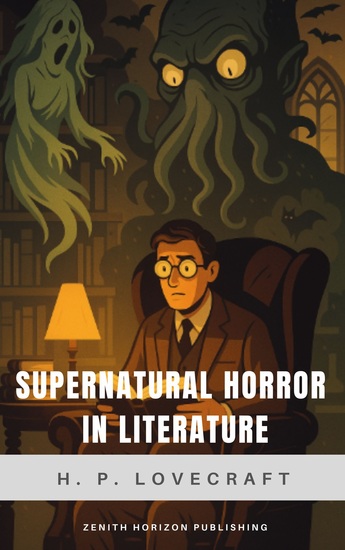
Supernatural Horror in Literature - H P Lovecraft's Critical History of the Macabre - cover

Supernatural Horror in Literature - H P Lovecraft's Critical History of the Macabre

H.P. Lovecraft, Zenith Horizon Publishing

Publisher: Zenith Horizon Publishing

  • 0
  • 0
  • 0

Summary

What lurks in the literature of fear, madness, and the unknowable?

In Supernatural Horror in Literature, H. P. Lovecraft—a master of cosmic dread—offers a profound and scholarly analysis of horror fiction throughout history. From Gothic precursors like Edgar Allan Poe to the eerie tales of Algernon Blackwood, this essay is both a literary guide and a dark meditation on fear itself.

More than just a catalog of the strange and macabre, Lovecraft explores how supernatural fiction evokes cosmic awe, psychological terror, and the fear of the unknown. This work is essential for readers, writers, and critics of horror, fantasy, and weird fiction.

📚 This edition includes:

The complete, unabridged essay

Thoughtfully selected illustrations and typography

Kindle-optimized format for academic and casual readers alike

🕯️ A must-read for fans of Gothic horror, cosmic dread, and dark literary theory.

Dive into the dark heart of horror literature.
Download this definitive edition today.
Available since: 06/11/2025.
Print length: 108 pages.

Other books that might interest you

  • Ship on Fire at Sea A (Unabridged) - cover

    Ship on Fire at Sea A (Unabridged)

    Jean Ingelow

    • 0
    • 0
    • 0
    Jean Ingelow (17 March 1820 - 20 July 1897) was an English poet and novelist, who gained sudden fame in 1863. She also wrote several stories for children. Ingelow followed this in 1851 with a story, "Allerton and Dreux", but it was the publication of her Poems in 1863 that suddenly made her popular. It ran rapidly through numerous editions and was set to music, proving popular as domestic entertainment. The collection was said to have sold 200,000 copies. Her writings often focus on religious introspection. In 1867 she edited, with Dora Greenwell, The Story of Doom and other Poems, a poetry collection for children.
    A SHIP ON FIRE AT SEA: As she spoke two strange objects came into my view. One was a great pale moon, sickly and white, hanging and seeming to brood over the horizon; the other, which looked about the same size, was red and seemed to lie close at her side. It was not round, but looked blotted and blurred in the mist. Could it be a meteor?
    Show book
  • Selected Short Stories - by F Scott Fitzgerald - cover

    Selected Short Stories - by F...

    F. Scott Fitzgerald

    • 0
    • 0
    • 0
    Selected Short Stories is a collection of some of F. Scott Fitzgerald's most memorable and thought-provoking works. Published in 1931, the collection includes several of his best-known stories, such as "The Diamond as Big as the Ritz," "Bernice Bobs Her Hair," and "The Curious Case of Benjamin Button." These stories explore themes of social class, love, loss, and the search for meaning in a rapidly changing world. Fitzgerald's writing style is characterized by its elegance, wit, and poetic language, making his stories both engaging and thought-provoking. 
     
    One of the recurring themes in Fitzgerald's stories is the tension between the individual and society. In many of his stories, the characters are struggling to find their place in a society that values wealth, status, and conformity. This is particularly evident in "Bernice Bobs Her Hair," in which the protagonist, Bernice, must decide whether to conform to the expectations of her wealthy cousin or to follow her own desires. Similarly, in "The Curious Case of Benjamin Button," the protagonist must come to terms with his unusual condition, which sets him apart from the rest of society. 
     
    Another important theme in Fitzgerald's stories is the fleeting nature of happiness and the inevitability of change. Many of his characters are searching for love, success, or fulfillment, but find that these things are elusive and ultimately fleeting. This is particularly evident in "The Diamond as Big as the Ritz," in which the protagonist discovers a hidden mountain of diamonds, only to realize that his wealth is meaningless in the face of the vastness of the universe. Fitzgerald's stories remind us that life is both beautiful and fragile and that the pursuit of happiness can be both exhilarating and heartbreaking. 
    Overall, Selected Short Stories is a testament to Fitzgerald's talent as a writer and his ability to capture the spirit of his time.
    Show book
  • Rupert of Hentzau - cover

    Rupert of Hentzau

    Anthony Hope

    • 0
    • 0
    • 0
    In the realm of classic adventure literature, few novels have achieved the enduring charm and timeless appeal of Anthony Hope's "Rupert of Hentzau." Originally published in 1898 as a sequel to "The Prisoner of Zenda," this captivating tale of political intrigue, romance, and daring escapades has cemented its place as a literary gem. 
    Head Stories Audio presents Rupert of Hentzau, narrated by Simon Hester.  With original music.
    Show book
  • D H Lawrence - A Short Story Collection - Volume 2 - A titan of English literature that challenged ideas of romance and sexuality - cover

    D H Lawrence - A Short Story...

    D H Lawrence

    • 0
    • 0
    • 0
    David Herbert Lawrence was born on the 11th September 1885 in Eastwood, Nottinghamshire, a coal mining town where the reality of a harsh life was only useful as experiences for future literary works. 
     
    He was educated at Beauvale Board School and became the first local boy to receive a scholarship to attend Nottingham High School. After 3 years he became a junior clerk in Haywood’s surgical appliances factory. He was also attempting a literary career which, in the short term, led to a teacher training position in Eastwood and later a teaching qualification from University College, Nottingham.  
     
    Lawrence’s first efforts were poems, short stories and a draft of ‘The White Peacock’. Moving to London and a teaching position in Croydon his writing attracted the attention of Ford Madox Ford, editor of The English Review, and he commissioned him to write ‘Odour of Chrysanthemums’.  
     
    Wanting to write full-time he now began work on what would become ‘Sons and Lovers.   
     
    In 1912 he met the older and married mother-of-three Frieda Weekley. They eloped to Germany and here Lawrence could see for himself the growing tensions with France.  So keen was his interest that he was arrested and accused of being a British spy.  
     
    In early 1914 Frieda obtained her divorce and they returned to Britain to be married just days before the outbreak of war. Owing to her German parentage, and his own public dislike of militarism and violence, the couple were treated with contempt and suspicion throughout the war years.  
     
    Despite this he continued to write but his reputation in England was so tarnished and, mirrored by his own disdain for the country, he and Frieda left England in November 1919, first for Europe and then America via Ceylon and Australia. 
     
    They bought a ranch in Taos, New Mexico and visited Mexico several times. The third visit in March 1925 caused a near fatal attack of malaria. To convalesce they moved to Florence. Here he continued work on ‘Lady Chatterley’s Lover’ which for many years would cause controversy. A renewed interest in oil painting resulted in an exhibition in 1929 which was raided by the police and several works were confiscated.  
     
    D H Lawrence died of complications arising from a bout of tuberculosis on the 2nd of March 1930 in Vence, France.  He was 44. 
     
    1 - D H Lawrence - A Short Story Collection - Volume 2 - An Introduction 
    2 - The Rocking Horse Winner by D H Lawrence 
    3 - The Border Line by D H Lawrence 
    4 - A Fragment of Stained Glass by D H Lawrence 
    5 - Odour of Chrysanthemums by D H Lawrence 
    6 - The Horse Dealer's Daughter by D H Lawrence
    Show book
  • Jane Eyre: A Christian Readers' Guide - cover

    Jane Eyre: A Christian Readers'...

    Rachel Kovaciny

    • 0
    • 0
    • 0
    Explore the story of Jane Eyre in a brand new light. With prompts for discussions, thought provoking questions, and a breakdown and analysis of each chapter,Rachel Kovaciny brings to the forefront the major and minor themes and valuable lessons to be learned from this classic novel. An excellent companion for the novel, this guide demonstrates a love and appreciation for the classics and elevates understanding through the author’s clear grasp of the historical context as well as Charlotte Brontë’s background. Kovaciny’s guide also approaches each analysis through the lens of a Christian worldview. Viewing the heartbreak, growth, introspection, and lessons of love and loss through a Biblical perspective allows for an even deeper understanding of the characters, plot, and even Brontë herself. A wonderful library addition for fans of classic literature, homeschool families, book clubs, or those looking to further their education on the classics, this thoughtful and thorough guide is a must have!
    Show book
  • Dream of the Red Chamber - A Tale Of Betrayal - cover

    Dream of the Red Chamber - A...

    Cao Xueqin

    • 0
    • 0
    • 0
    The Dream of the Red Chamber (also known as The Story of the Stone) is one of the Four Great Classical Novels of China, and considered the greatest of them all. Almost 40 main characters and some 500 minor characters tell the fortunes of the Chia family; the book details mainly the life of Chia Pao-yü, the heir apparent, who is described as very intelligent, but also as carefree and self-indulging. The already wealthy Chia family rises to new heights when Pao-yü's elder sister becomes an imperial consort. On her first visit home, a lush garden is built, where much of the rest of the story takes place. The intrigues surrounding Pao-yü and his cousins, especially Lin Tai-yü who he loves, and Hsüeh Pao-ch'ai who he is finally tricked into marrying, make up a large part of the story. The decline of the Chia family begins with the death of the imperial consort, and when they fall into disfavour with the emperor, their mansions and the garden are eventually destroyed. 
     
    The whole book has 120 chapters, only 80 of which were written by Cao Xueqin before his death in 1764. Cheng Weiyuan and Gao E claimed to have access to Cao's papers, and published what is now known as the Cheng-Gao version in 1791. Henry Bencraft Joly translated only part of the book written by Cao. Book I contains the first 24 chapters, Book II ends abruptly with chapter 56; a Book III was never published.
    Show book