Join us on a literary world trip!
Add this book to bookshelf
Grey
Write a new comment Default profile 50px
Grey
Subscribe to read the full book or read the first pages for free!
All characters reduced
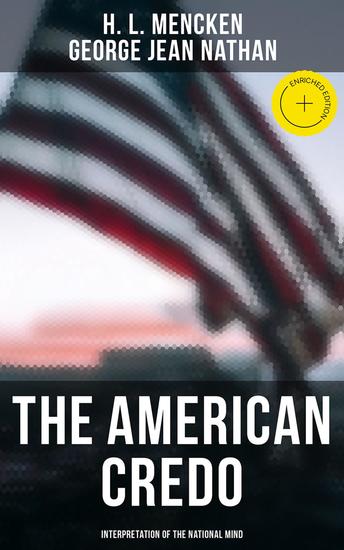
The American Credo - Interpretation of the National Mind - Enriched edition - cover

The American Credo - Interpretation of the National Mind - Enriched edition

H. L. Mencken, George Jean Nathan

Publisher: Musaicum Books

  • 0
  • 0
  • 0

Summary

In 'The American Credo - Interpretation of the National Mind,' editors H.L. Mencken and George Jean Nathan curate a probing exploration into the collective American psyche, unearthing the nuanced and often contradictory beliefs that have shaped the national identity. The anthology is characterized by its eclectic blend of satire, sharp analysis, and profound sincerity, showcasing a broad spectrum of literary styles that reflect the diversity of thought across the country. The collection serves as not only a mirror but also a critique of American sociopolitical currents, capturing the essence of the nation's spirit during its time and beyond. The contributors, Mencken and Nathan themselves, are monumental figures in American literary criticism and journalism, known for their incisive wit and enduring influence on early 20th-century intellectual circles. The anthology aligns with pivotal cultural and literary movements of the era, offering insights into the American condition through a critical, often sardonic lens. By pulling together a tapestry of views, the editors provide a rich, multifaceted perspective on American values and ideologies, presenting a cohesive narrative that speaks to the complexities of cultural identity. For scholars, students, and anyone interested in American cultural studies, 'The American Credo' presents a unique opportunity to engage with the dynamic and divergent ideologies that have shaped the nation. This collection invites readers to a deeper understanding and appreciation of the myriad forces at play in the development of American thought, encouraging an informed dialogue through its compelling dissection of the national mind. Its educational value and breadth of insights make it an indispensable addition to any thoughtful reader's library.

In this enriched edition, we have carefully created added value for your reading experience:
- A succinct Introduction situates the work's timeless appeal and themes.
- The Synopsis outlines the central plot, highlighting key developments without spoiling critical twists.
- A detailed Historical Context immerses you in the era's events and influences that shaped the writing.
- A thorough Analysis dissects symbols, motifs, and character arcs to unearth underlying meanings.
- Reflection questions prompt you to engage personally with the work's messages, connecting them to modern life.
- Hand‐picked Memorable Quotes shine a spotlight on moments of literary brilliance.
- Interactive footnotes clarify unusual references, historical allusions, and archaic phrases for an effortless, more informed read.
Available since: 01/04/2022.
Print length: 80 pages.

Other books that might interest you

  • Exurbia Now - The Battleground of American Democracy - cover

    Exurbia Now - The Battleground...

    David Masciotra

    • 0
    • 0
    • 0
    The suburbs have become too liberal and diverse for many white American conservatives, so "exurbia"—areas outside the cities and their suburbs—are becoming the staging ground for the radical right extremist insurgency . . . 


    Beyond a fanatical devotion to former president Donald Trump, one of the curious things that united the rank and file of the January 6 insurrectionist mob was that many of them were residents of one of America's fastest growing residential areas: Exurbia. In this brilliant work of political and cultural inquiry, veteran political journalist David Masciotra provides a definitive account of what exurbia is, how it came to be, and how it's transforming American life. Zooming in outside the greater metropolitan area of Chicago—where Masciotra grew up—he shows how exurbia has become a safe space to fly the MAGA flag and romanticize the mores of the pre-civil rights, pre-feminist, pre-gay rights 1950s. 


    But, as Masciotra also shows, reactionary white flight is not the whole story of small-town America. The story often lost is the power and persistence of small-town liberals—people who believe in equality, celebrate diversity, and enroll in movements for justice. Exurbia, as it turns out, is ground zero for the fight over a democracy mightily beleaguered, yet still full of promise, and still worth fighting for.
    Show book
  • Eternal capitalist trickery - cover

    Eternal capitalist trickery

    Anonymous

    • 0
    • 0
    • 0
    The concentration of power and wealth in the hands of a small predatory class, repeated crises, the inability of politicians to influence the course of events, worsening inequalities and the end of growth are the hallmarks of today's capitalism.  Since the fall of communism, capitalism has had no competitors. Will it die one day? Not in the short term: the system is stronger than governments, its worst scoundrels enjoy widespread impunity, and while economists have little or no understanding of how it works, no clear alternative is emerging. Above all, no one seems to be seriously considering a fundamental reform of modern financial capitalism. Curiously, a century earlier, this same situation had been analyzed by Nikolai Dimitrievich Kondratieff, a famous economist and committed player in the Russian Revolution of 1917. Kondratieff was executed by Stalin in 1938 for having scientifically demonstrated the eternity of capitalism. Would he have the same opinion about capitalism today?
    Show book
  • Gang Politics - Revolution Repression and Crime - cover

    Gang Politics - Revolution...

    Kristian Williams

    • 0
    • 0
    • 0
    Demystifying forces of the state, gangs, and revolutionary violence. 


    In Gang Politics, Kristian Williams examines our society's understanding of social and political violence, what gets romanticized, misunderstood, or muddled. He explores the complex intersections between "gangs" of all sorts—cops and criminals, Proud Boys and Antifa, Panthers and skinheads—arguing that government and criminality are intimately related, often sharing critical features. As society becomes more polarized and conflict more common, Williams's analysis is a crucial corrective to our usual ideas about the role violence might or should play in our social struggles.
    Show book
  • The Assault on the State - How the Global Attack on Modern Government Endangers Our Future - cover

    The Assault on the State - How...

    Stephen E. Hanson, Jeffrey S....

    • 0
    • 0
    • 0
    What if the state as we know it didn't exist? Our air would be poisonous, our votes uncounted, and our markets dysfunctional. Yet across the world, in countries as diverse as Hungary, Israel, the UK, and the US, attacks on the modern state and its workforce are intensifying. They are morphing into power grabs by self-aggrandizing politicians who attempt to seize control of the state for themselves and their cronies. What replaces the modern state once it is fatally undermined is not the free market and the flowering of personal liberty. Instead, the death of government agencies organized under the rule of law inevitably leads to the only realistic alternative: the rule of men. 


    In The Assault on the State, political scientists Stephen Hanson and Jeffrey Kopstein offer an impassioned plea to defend modern government against those who seek to destroy it. They dissect the attack on the machinery of government from its origins in post-Soviet Russia to the core powers of Western democracy. The dangers of state erosion imperil every aspect of our lives. Hanson and Kopstein outline a strategy that can reverse this destructive trend before humanity is plunged back into the pathological personalistic politics of premodern times.
    Show book
  • Simple Sabotage Field Manual - cover

    Simple Sabotage Field Manual

    United States Office of...

    • 0
    • 0
    • 0
    The *Simple Sabotage Field Manual*, created in 1944 by the U.S. Office of Strategic Services (OSS), is a unique World War II-era document that provides guidance on simple methods of sabotage. Originally intended for citizens in enemy-occupied territories, it describes easy-to-execute tactics for disrupting enemy operations without special tools or skills. The manual covers areas such as industrial sabotage, transportation interference, and general workplace disruption, encouraging small acts like misplacing tools, giving incorrect directions, or insisting on unnecessary bureaucracy to lower productivity and morale. Emphasizing the power of collective minor disruptions, this field manual offers a fascinating look at unconventional resistance strategies and reflects the ingenuity of wartime intelligence efforts. Now in the public domain, it serves as a historical document on guerrilla tactics and psychological warfare.
    Show book
  • Age of Deception - Cybersecurity as Secret Statecraft (Cornell Studies in Security Affairs) - cover

    Age of Deception - Cybersecurity...

    Jon R. Lindsay

    • 0
    • 0
    • 0
    At the heart of cybersecurity is a paradox: Cooperation enables conflict. In Age of Deception, Jon R. Lindsay shows how widespread trust in cyberspace enables espionage and subversion.  
    The dark arts have long been part of global politics, but digital systems expand their scope and scale. Yet success in secret statecraft depends on political context, not just sophisticated technology. Lindsay provides a general theory of intelligence performance—the analogue to military performance in battle—to explain why spies and hackers alike depend on clandestine organizations and vulnerable institutions. 
    Through cases spanning codebreaking at Bletchley Park during WWII to the weaponization of pagers by Israel in 2024, Lindsay reveals continuity and change in secret statecraft. Along the way he explains why popular assumptions about cyber warfare are profoundly misleading. Offense does not simply dominate defense, for example, because the same digital complexity that expands opportunities for deception also creates potential for self-deception and counter-deception. Provocative and persuasive, Age of Deception offers crucial insights into the future of secret statecraft in cyberspace and beyond.
    Show book