Join us on a literary world trip!
Add this book to bookshelf
Grey
Write a new comment Default profile 50px
Grey
Subscribe to read the full book or read the first pages for free!
All characters reduced
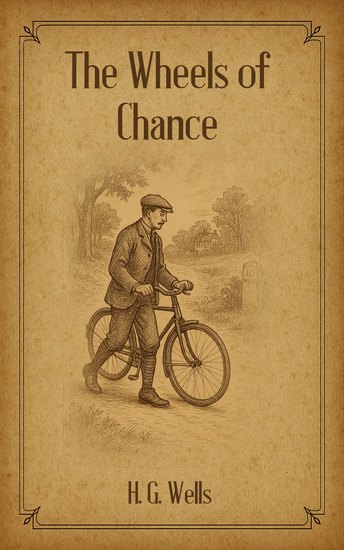
The Wheels of Chance - cover

The Wheels of Chance

H. G. Wells

Publisher: CLXBX

  • 0
  • 0
  • 0

Summary

The Wheels of Chance is a delightful and gently humorous novel by H. G. Wells that captures the spirit of adventure, romance, and self-discovery in everyday life. First published in 1896, the book departs from Wells's famous scientific romances to offer a warm, human-scale story set against the backdrop of late Victorian England.

The novel follows Mr. Hoopdriver, a timid and socially awkward draper's assistant who embarks on a bicycling holiday in hopes of escaping the monotony of his constrained existence. Along the road, he encounters Jessie Milton, a young woman fleeing an unhappy situation of her own. Their chance meeting sets in motion a journey filled with mishaps, misunderstandings, and moments of unexpected courage.

As the two travelers navigate both the English countryside and their own personal limitations, Wells explores themes of class, freedom, social convention, and the quiet heroism of ordinary people. With warmth and irony, the novel celebrates the liberating possibilities of travel and the transformative power of stepping beyond one's prescribed role.

Charming, insightful, and subtly satirical, The Wheels of Chance remains a timeless exploration of individuality and chance encounters. It stands as one of Wells's most accessible and endearing novels, offering readers humor, romance, and a compassionate view of human aspiration.
Available since: 02/10/2026.
Print length: 200 pages.

Other books that might interest you

  • Three Men in a Boat - cover

    Three Men in a Boat

    Jerome K.

    • 0
    • 0
    • 0
    "Three Men in a Boat" is a humorous account penned by Jerome K. Jerome and first published in 1889. The story chronicles the comedic misadventures of three friends - Jerome, George, and Harris - along with Montmorency, their spirited fox-terrier, as they embark on a boating holiday along the Thames River. What starts as a restorative leisure trip quickly becomes an uproarious journey filled with mishaps, misunderstandings, and memorable anecdotes. Through Jerome's witty narrative, the novel presents a delightful mix of absurdity and astute observations on human nature and the Victorian era's peculiarities.
    Show book
  • White Fang - cover

    White Fang

    Jack London

    • 0
    • 0
    • 0
    White Fang is a novel by American author Jack London  — and the name of the book's eponymous character, a wild wolfdog. First serialized in Outing magazine, it was published in 1906. 
    The story details White Fang's journey to domestication in Yukon Territory and the Northwest Territories during the 1890s Klondike Gold Rush. It is a companion novel (and a thematic mirror) to London's best-known work, The Call of the Wild, which is about a kidnapped, domesticated dog embracing his wild ancestry to survive and thrive in the wild.
    Much of White Fang is written from the viewpoint of the titular canine character, enabling London to explore how animals view their world and how they view humans. White Fang examines the violent world of wild animals and the equally violent world of humans. The book also explores complex themes including morality and redemption.
    The story begins before the wolf-dog hybrid is born, with two men and their sled dog team on a journey to deliver the coffin of Lord Alfred to a remote town named Fort McGurry in the higher area of the Yukon Territory. The men, Bill and Henry, are stalked by a large pack of starving wolves over the course of several days. Finally, after all of their dogs and Bill have been eaten, four more teams find Henry trying to escape from the wolves; the wolf pack scatters when they hear the large group of people coming...
    Show book
  • For the Blood is the Life - A renowned and influential early gothic vampire tale set in Italy - cover

    For the Blood is the Life - A...

    F. Marion Crawford

    • 0
    • 0
    • 0
    Francis Marion Crawford was born on August 2nd, 1854 at Bagni di Lucca, Italy. An only son and a nephew to Julia Ward Howe, the American poet and writer of ‘The Battle Hymn of the Republic’.  
     
    His education began at St Paul's School, Concord, New Hampshire, then to Cambridge University; University of Heidelberg; and the University of Rome.  
     
    In 1879 Crawford went to India, to study Sanskrit and then edited The Indian Herald. In 1881 he returned to America to continue his Sanskrit studies at Harvard University. 
     
    At this time in Boston he lived at his Aunt Julia house and in the company of his Uncle, Sam Ward. His family was concerned about his employment prospects.  After a singing career as a baritone was ruled out, he was encouraged to write.  
     
    In December 1882 his first novel, ‘Mr Isaacs’, was an immediate hit which was amplified by ‘Dr Claudius’ in 1883.  
     
    In October 1884 he married Elizabeth Berdan. They went on to have two sons and two daughters. 
     
    Encouraged by his excellent start to a literary career he returned to Italy with Elizabeth to make a permanent home, principally in Sant' Agnello, where he bought the Villa Renzi that then became Villa Crawford.  
     
    In the late 1890s, he began to write his historical works: ‘Ave Roma Immortalis’ (1898), ‘Rulers of the South’ (1900) and ‘Gleanings from Venetian History’ (1905). The Saracinesca series is perhaps his best work. ‘Saracinesca’ was followed by ‘Sant’ Ilario’ in 1889, ‘Don Orsino’ in 1892 and ‘Corleone’ in 1897, that being the first major treatment of the Mafia in literature.  
     
    Francis Marion Crawford died at Sorrento on Good Friday 1909 at Villa Crawford of a heart attack.  
     
    Set in Italy, ‘For Blood is the Life’ draws us into a world usually beyond our senses.  With Crawford’s pen the uneasy, horrific world of vampires is now upon us.
    Show book
  • Antony and Cleopatra - cover

    Antony and Cleopatra

    William Shakespeare

    • 0
    • 0
    • 0
    Antony and Cleopatra (First Folio title: The Tragedie of Anthonie, and Cleopatra) is a tragedy by William Shakespeare. The play was first performed, by the King's Men, at either the Blackfriars Theatre or the Globe Theatre in around 1607; its first appearance in print was in the Folio of 1623.
    The plot is based on Thomas North's 1579 English translation of Plutarch's Lives (in Ancient Greek) and follows the relationship between Cleopatra and Mark Antony from the time of the Sicilian revolt to Cleopatra's suicide during the Final War of the Roman Republic. The major antagonist is Octavius Caesar, one of Antony's fellow triumvirs of the Second Triumvirate and the first emperor of the Roman Empire. The tragedy is mainly set in the Roman Republic and Ptolemaic Egypt and is characterized by swift shifts in geographical location and linguistic register as it alternates between sensual, imaginative Alexandria and a more pragmatic, austere Rome.
    Many consider Shakespeare's Cleopatra, whom Enobarbus describes as having "infinite variety", as one of the most complex and fully developed female characters in the playwright's body of work. She is frequently vain and histrionic enough to provoke an audience almost to scorn; at the same time, Shakespeare invests her and Antony with tragic grandeur. These contradictory features have led to famously divided critical responses. It is difficult to classify Antony and Cleopatra as belonging to a single genre. It can be described as a history play (though it does not completely adhere to historical accounts), as a tragedy (though not completely in Aristotelian terms), as a comedy, as a romance, and according to some critics, such as McCarter, a problem play. All that can be said with certainty is that it is a Roman play, and perhaps even a sequel to another of Shakespeare's tragedies, Julius Caesar.
    Among the most significant works William Shakespeare: Hamlet, Othello, King Lear, Macbeth, Orpheus, Romeo and Juliet, Julius Caesar, Troilus and Cressida, The Tempest, Venus and Adonis, Antony and Cleopatra, Measure for Measure, The Winter's Tale and many more.
    Show book
  • The Pilgrim's Progress from this world to that which is to come - One Man’s Journey from Earthly Struggle to Eternal Glory - cover

    The Pilgrim's Progress from this...

    John Bunyan

    • 0
    • 0
    • 0
    "The Pilgrim's Progress from This World to That Which Is to Come," written by John Bunyan in the late 17th century, is an allegorical novel that follows the journey of a character named Christian, who represents all of humanity. Christian embarks on a spiritual quest from the "City of Destruction" to the "Celestial City," seeking salvation and enlightenment through various trials and challenges. 
    At the beginning of the story, Christian is depicted as bearing a heavy burden and grappling with existential despair. After reading a troubling book that reveals his doomed state, he becomes increasingly distressed, ultimately crying out for salvation. His path soon intersects with the character Evangelist, who directs him to the wicket gate as a way to escape his dire fate. 
    Throughout his journey, Christian faces the temptation to succumb to worldly advice and the folly of straying from his divine purpose. This underscores themes of faith, redemption, and the challenges encountered on the path to spiritual truth.
    Show book
  • The Wouldbegoods - cover

    The Wouldbegoods

    Edith Nesbit

    • 0
    • 0
    • 0
    "The Wouldbegoods" by Edith Nesbit continues the adventures of the Bastable siblings as they earnestly attempt to be good but find themselves entangled in humorous escapades. Their well-intentioned deeds lead to comical mishaps, revealing the challenges of virtue. Nesbit's charming narrative explores the complexities of childhood innocence, mischief, and the enduring warmth of family dynamics in this delightful sequel.
    Show book