Join us on a literary world trip!
Add this book to bookshelf
Grey
Write a new comment Default profile 50px
Grey
Subscribe to read the full book or read the first pages for free!
All characters reduced
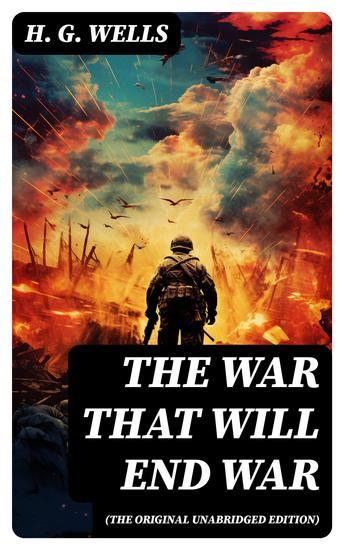
The War That Will End War (The original unabridged edition) - cover

The War That Will End War (The original unabridged edition)

H. G. Wells

Publisher: DigiCat

  • 0
  • 0
  • 0

Summary

In 'The War That Will End War,' H. G. Wells presents a prescient and incisive exploration of the global conflicts that defined the early 20th century, particularly World War I. Written in 1914, this unabridged edition retains Wells' characteristic blend of speculative fiction and social commentary, engaging readers in discussions about the futility of war and the ideal of lasting peace. Wells employs a mix of impassioned rhetoric and analytical observation, challenging his contemporaries to rethink their assumptions about militarism and the potential for a unified world order. His prophetic vision reflects the disillusionment felt by many in the face of modern warfare, encapsulating the zeitgeist of a society on the brink of transformative change. H. G. Wells, often referred to as the father of science fiction, was deeply influenced by his own experiences and the tumultuous socio-political landscape of his time. His career spanned debates about socialism, technology, and the human condition, all of which colored his vision of the world's future. Wells advocated for international cooperation and disarmament, events which shaped his narrative in this compelling and thought-provoking text. 'The War That Will End War' remains strikingly relevant today, offering insightful reflections on the nature of conflict and the enduring quest for peace. This book is essential reading for those interested in history, political science, and literature, as it not only illuminates the past but also provokes critical discussions about the future of humanity.
Available since: 12/29/2023.
Print length: 168 pages.


Other books that might interest you

  • What's Real about Race? - Untangling Science Genetics and Society - cover

    What's Real about Race? -...

    Rina Bliss

    • 0
    • 0
    • 0
    In What's Real About Race?, sociologist Rina Bliss illuminates the truth about one of the most misunderstood, controversial concepts in our society and reveals why we cannot confuse race with genetic difference. Blending energizing prose with the latest in genetics research, this paradigm-shifting tour unmasks what's truly real about race: namely, racism's impact on our bodies and lives. 


    Bliss traces the history of race, revealing how unscientific categories of identity—White, Black, Asian/Pacific Islander, and American Indian/Alaska Native—became the standard, and illuminates how the myth of biological races endures in science and society, warping our understanding of complex topics like intelligence, disease susceptibility, and behavior. Along the way, What's Real About Race? busts enduring myths about IQ, ancestry tests, behavioral racism, and more. In fascinating explorations of gene research, medicine, and social justice, Bliss argues for a new way forward. To create equity in science and society, we must disentangle our understanding of genetics from identity and see race for what it really is: a purely social category. At a time when misinformation about our bodies and identities is dangerously prevalent, What's Real About Race? is an indispensable resource and a powerful reminder that, biologically, our similarities vastly outweigh our differences.
    Show book
  • The Human Planet - How We Created the Anthropocene - cover

    The Human Planet - How We...

    Simon L. Lewis, Mark A. Maslin

    • 0
    • 0
    • 0
    An exploration of the Anthropocene and “a relentless reckoning of how we, as a species, got ourselves into the mess we’re in today” (The Wall Street Journal). 
     
    Meteorites, mega-volcanoes, and plate tectonics—the old forces of nature—have transformed Earth for millions of years. They are now joined by a new geological force—humans. Our actions have driven Earth into a new geological epoch, the Anthropocene. For the first time in our home planet's 4.5-billion-year history a single species is increasingly dictating Earth’s future. 
     
    To some the Anthropocene symbolizes a future of superlative control of our environment. To others it is the height of hubris, the illusion of our mastery over nature. Whatever your view, just below the surface of this odd-sounding scientific word—the Anthropocene—is a heady mix of science, philosophy, history, and politics linked to our deepest fears and utopian visions. 
     
    Tracing our environmental impacts through time, scientists Simon Lewis and Mark Maslin reveal a new view of human history and a new outlook for the future of humanity in the unstable world we have created.
    Show book
  • How Would You Like Your Mammoth? - 12000 Years of Culinary History in 50 Bite-Size Essays - cover

    How Would You Like Your Mammoth?...

    Uta Seeburg, Max Miller

    • 0
    • 0
    • 0
    Did you know that Egyptians mummified beef ribs for their dearly departed to enjoy in the afterlife? That Roman gladiators were relegated to a vegan diet of grains and beans? That the fast-food hamburger was a result of a postwar, high-efficiency work ethic? This is not a cookbook; instead, How Would You Like Your Mammoth? is a chronological journey through the culinary history of humankind, with fifty short, snackable essays packed to the brim with juicy tidbits and cultural insights. With author Uta Seeburg as your guide, you'll learn not only which dishes are linked to key cultural moments, but also how each represents the social hierarchy and values of the civilization that invented it. 
     
    Discover how and why: the Columbian exchange gave Indian curry its spicy kick; roasted swan became the centerpiece of choice in spectacle-loving 1650s high society; a Portuguese princess helped popularize tea in England; the first dish ever to be prepared live on television was an omelet; and much more. 
     
    Foodies and history buffs alike will savor every amusing yet educational historical snapshot, from one of the oldest recorded recipes (lamb stew with barley and onions) to out-of-this-world food fit for astronauts (dehydrated chicken soup just like mom used to make).
    Show book
  • What Happened to Make You Anxious? - How to Uncover the Little "t" Traumas that Drive Your Anxiety Worry and Fear - cover

    What Happened to Make You...

    LCSW Jaime Castillo

    • 0
    • 0
    • 0
    Let's face it: anxiety can interfere with every single aspect of your life, from work and family to relationships and finances. Left unchecked, the cycle of anxiety reinforces and perpetuates itself over time, and can leave you feeling paralyzed with fear. 


    In What Happened to Make You Anxious?, anxiety expert Jaime Castillo offers a whole new approach; one that focuses less on avoiding or extinguishing anxiety, and more toward understanding and working with it to create a fulfilling, meaningful life. You'll learn how your anxiety is connected to what Castillo refers to as "little 't' traumas"—seemingly small, unhealed traumas from your past that drive your fear and worry, so you can get to the root of your anxiety and start healing. 


    Your anxiety works overtime communicating perceived threats; this book will show you how to listen to anxiety, discern which threats are real, which don't fit the actual facts of the situation, and which are triggered by past events. 


    You've tried managing it on your own. You may have even received treatment. If you're at your wit's end when it comes to your anxiety, this book will show you a new path toward lasting relief.
    Show book
  • Gorgias - A Clash Between Rhetoric and Philosophy – Plato’s Dialogue on Power Morality and the Good Life - cover

    Gorgias - A Clash Between...

    Plato, Tim Zengerink

    • 0
    • 0
    • 0
    What if the power to persuade was more dangerous than a sword? 
    In a verbal battlefield where charisma and cunning meet truth and integrity, Socrates challenges famed rhetoricians Gorgias, Polus, and Callicles. Through riveting argument and fearless logic, Plato explores: 
    •	The Seduction of Rhetoric – Can a man skilled in words bend justice to his will? 
    •	Moral Strength vs. Political Might – Who truly has power: the tyrant or the virtuous? 
    •	The Soul at Stake – A daring argument that how we speak reveals who we are. 
    •	A Timeless Lesson – In an age of influencers and image, Plato reminds us that character still matters most. 
    Perfect for listeners hungry for wisdom in a noisy world, this audiobook delivers an unforgettable intellectual duel that remains shockingly modern.
    Show book
  • The Smut Revolution - From Taboo to Trend - cover

    The Smut Revolution - From Taboo...

    Skyler Bosse

    • 0
    • 0
    • 0
    There is a reason your pulse quickens when you turn to that one particular scene in a book – the one where tension spills over, where restraint shatters, and where characters surrender to something primal, something undeniable. That moment, the one so many readers secretly crave, is smut. 
    Once whispered about behind closed doors, hidden beneath the guise of “guilty pleasures,” smut has clawed its way into mainstream literature, proving that what was once considered taboo is now a genre in its own right. From centuries-old erotic manuscripts to today’s bestselling scorchers, smut has evolved, adapted, and seduced millions along the way. 
    But why do we read it? Why do we write it? And why does society continue to both embrace and condemn it in equal measure? 
    Each chapter in this book begins with an excerpt – an unfiltered glimpse into the heart of smut – before shifting to the forces that shape it, the way it has been challenged, censored, and celebrated. Some scenes will linger, some may provoke, but all of them exist because smut, at its core, is more than just raw lust – it is a reflection of desire, fantasy, and the ever-changing boundaries of storytelling. 
    So, turn the page. But be warned: once you indulge, there is no going back.
    Show book