¡Acompáñanos a viajar por el mundo de los libros!
Añadir este libro a la estantería
Grey
Escribe un nuevo comentario Default profile 50px
Grey
Suscríbete para leer el libro completo o lee las primeras páginas gratis.
All characters reduced
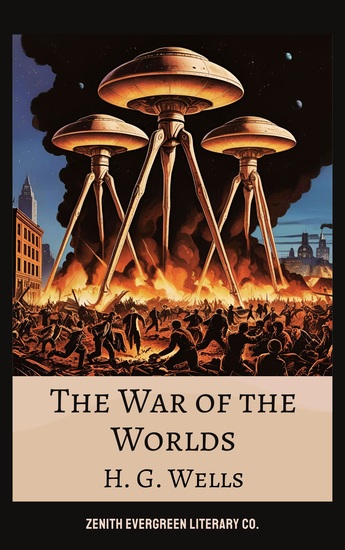
The War of the Worlds - H G Wells' Legendary Tale of Alien Invasion and Human Survival - cover

The War of the Worlds - H G Wells' Legendary Tale of Alien Invasion and Human Survival

H. G. Wells, Zenith Evergreen Literary Co.

Editorial: Zenith Evergreen Literary Co.

  • 0
  • 0
  • 0

Sinopsis

🌍 What happens when Earth is no longer the dominant force in the universe? Discover the thrilling classic that redefined science fiction — The War of the Worlds by H. G. Wells! 👽💥

Martians have landed… and they didn't come in peace. 🚀 Their tripods tower over towns, their heat-rays scorch the Earth, and humanity's very survival hangs by a thread. In this gripping narrative of invasion and resistance, Wells crafts a chilling warning about technology, imperialism, and our place in the cosmos. 🌌🔥

🧠 Written in 1898 and still astonishingly relevant, this visionary novel captures the raw emotion of fear, chaos, and the will to fight back against the unknown. Perfect for fans of alien fiction, dystopian thrillers, and classic literature, The War of the Worlds is more than a story — it's a cultural landmark. 📖⚠️

🌟 Praised as one of the earliest and most influential alien invasion novels, this is the book that inspired countless adaptations, from movies to radio dramas.

👉 Are you ready for Earth's first contact with the unknown? Download now and experience the sci-fi epic that changed everything!
Disponible desde: 15/04/2025.
Longitud de impresión: 128 páginas.

Otros libros que te pueden interesar

  • In Exile - cover

    In Exile

    Anton Chekhov

    • 0
    • 0
    • 0
    "In Exile" was first published in  May 1892 issue of the Vsemirnaya Illustratsiya magazine.
    The story was inspired by Chekhov's journey through Siberia and his stay in Sakhalin and, in particular, two episodes of this trip.
    While on Sakhalin,  Anton Chekhov met a boatman nicknamed Krasivy, a self-professed 'happy man' who struck him with his own peculiar brand of Tolstovian philosophy. It was Krasivy, apparently, who became a prototype for Semyon Tolkovy, the story's hero.
    Ver libro
  • London Models (Unabridged) - cover

    London Models (Unabridged)

    Oscar Wilde

    • 0
    • 0
    • 0
    Oscar Wilde (16 October 1854 - 30 November 1900) was an Irish poet and playwright. After writing in different forms throughout the 1880s, he became one of the most popular playwrights in London in the early 1890s.
    LONDON MODELS: Professional models are a purely modern invention. To the Greeks, for instance, they were quite unknown. Mr. Mahaffy, it is true, tells us that Pericles used to present peacocks to the great ladies of Athenian society in order to induce them to sit to his friend Phidias, and we know that Polygnotus introduced into his picture of the Trojan women the face of Elpinice, the celebrated sister of the great Conservative leader of the day.
    Ver libro
  • The Mystery of the Blue Train - cover

    The Mystery of the Blue Train

    Agatha Christie

    • 0
    • 0
    • 0
    In Agatha Christie's six installment of the Hercules Poirot series, our titular detective will once again showcase his brilliant investigative skills as he untangles the mystery of the blue train.A luxury train is headed to Nice with several well-to-do passengers on board. Most are living, breathing people with their own mysterious motivations, but the train will also deliver one silent victim. Somewhere along the route, Ruth Keeting was robbed and murdered, and it's up to Poirot to find her killer. Is it Ruth's estranged husband? Her French lover? Or someone else altogether . . . In this classic murder mystery filled with twists and turns, Poirot will stage a chilling reenactment of the fatal journey in order to expose hidden truths and bring the true culprit to justice.
    Ver libro
  • Bobok - From their pens to your ears genius in every story - cover

    Bobok - From their pens to your...

    Fyodor Dostoyevsky

    • 0
    • 0
    • 0
    Fyodor Mikhailovich Dostoyevsky was born in Moscow on 11th November, 1821 to distinguished multi-ethnic parents from a Lithuanian background.  
    His childhood years were at the family home in hospital grounds which also contained an orphanage, an insane asylum and a cemetery for criminals.  The young Fyodor often disobeyed his father by talking to the ill in the hospital gardens.   
    His health was compromised at age 9 when he experienced his first epileptic fit. By the time he was a teenager both parents had died and he was now enrolled in a military academy where he graduated and eventually became a Lieutenant in 1842.  He left military service the next year. 
    In 1846 he published his first novel ‘Poor Cow’ to great literary acclaim.  His next was unable to emulate that success but his short stories helped provide an income.  Life as an author was definitely difficult. As he began his next work he was arrested and incarcerated for treason and participation in the political and literary Petrashevsky Circle. Although the case was weak and unjustified he was sentenced to 4 years of hard labour followed by 5 years of military service in a Siberian regiment.  
    Despite the undoubted hardships and setbacks in his life, and whether they helped or hindered his writing, his talents produced many exceptional works of literature including ‘Crime and Punishment’, ‘The Idiot’ and ‘The Brothers Karamazov’.   
    Dostoevsky’s ability to get under the skin of his characters and show the inner workings of their mind was hugely influential and ahead of its time.  Interwoven with this was the influence of the broader social, spiritual and political forces at work in a person's psyche.   
    Fyodor Dostoevsky struggled financially and remained in poor health for much of his adult life.  He died from a lung haemorrhage on 9th February, 1881.
    Ver libro
  • Browdean Farm - From their pens to your ears genius in every story - cover

    Browdean Farm - From their pens...

    A M Burrage

    • 0
    • 0
    • 0
    Alfred McLelland Burrage was born in Hillingdon, Middlesex on 1st July, 1889. His father and uncle were both writers, primarily of boy’s fiction, and by age 16 AM Burrage had joined them.  The young man had ambitions to write for the adult market too.  The money was better and so was his writing. 
    From 1890 to 1914, prior to the mainstream appeal of cinema and radio the printed word, mainly in magazines, was the foremost mass entertainment.  AM Burrage quickly became a master of the market publishing his stories regularly across a number of publications. 
    By the start of the Great War Burrage was well established but in 1916 he was conscripted to fight on the Western Front. He continued to write during these years documenting his experiences in the classic book War is War by Ex-Private X. 
    For the remainder of his life Burrage was rarely printed in book form but continued to write and be published on a prodigious scale in magazines and newspapers.  In this volume we concentrate on his supernatural stories which are, by common consent, some of the best ever written.  Succinct yet full of character each reveals a twist and a flavour that is unsettling…..sometimes menacing….always disturbing.
    Ver libro
  • Chelkash by Maxim Gorky - A small time thief is caught up in a larger scheme testing his willpower and showing the dangers of greed - cover

    Chelkash by Maxim Gorky - A...

    Maxim Gorky

    • 0
    • 0
    • 0
    Alexei Maximovich Peshkov was born on 28th March 1868, in Nizhny Novgorod, Russia. 
     
    Better known as Maxim Gorky he was orphaned at 11 and ran away from home at 12.  At 19 he had already attempted suicide and thereafter travelled, by foot, across the Russian Empire for 5 years. 
     
    His first book ‘Essays & Stories’ in 1898 was a sensation and so began a long career as an author of short stories, novels and plays.  Gorky saw writing as a moral and political act that would help to change the unjust world around him.  He was an ardent early advocate of the emerging Marxist movement and publicly opposed the Tsarist regime leading several times to his arrest.  
     
    In 1904 he began his own theatre but the censor banned every play and Gorky was forced to abandon the project. 
     
    But Gorky was a financially successful author, editor, and playwright and gave monies to political parties as well as for civil rights and social reform.  The brutal shooting of workers, which set in motion the Revolution of 1905, pushed Gorky more decisively toward radical solutions.  
     
    In 1906 he went to the United States to raise funds for the Bolsheviks. Those experiences including a scandal over travelling with his lover and not his wife deepened his contempt for the ‘bourgeois soul.’ 
     
    Gorky now moved to Capri in Italy, both for health reasons and to escape the increasingly repressive times in Russia.  
     
    An amnesty for the 300th anniversary of the Romanov dynasty saw him return to Russia in 1914. His politics remained close to the Bolshevik cause.  But soon, after the 1918 revolution, his essays referred to Lenin as a tyrant for his senseless arrests and repression.  He was soon appealing to the outside world for food aid after the catastrophic crop failure. 
     
    In October 1921 Gorky returned to Italy, now in Fascist hands, and settled in Sorrento until 1932.  His health worsened with the onset of tuberculosis. 
     
    He wrote several successful books there but now decided to find an understanding with the communist regime. Stalin invited him home and his return was hailed as a major propaganda victory.  He was decorated with the Order of Lenin, and a province, a park, and various streets re-named in his honour. 
     
    But he had his faults too.  In 1933, Gorky co-edited a book on the White Sea-Baltic Canal and denied even a single prisoner died during its construction, but thousands had. As well, knowing that some Nazis were homosexual, a phrase was attributed to him that said ‘exterminate all homosexuals and fascism will vanish’.  Although he was himself was quoting another he was decidedly homophobic. 
     
    With the increase of Stalinist repression in 1935 Gorky was placed under unannounced house arrest. 
     
    Maxim Gorky died on the 18th June 1936 from pneumonia.  He was 68. 
     
    Stalin and Molotov were among those who carried Gorky's urn of ashes at his funeral.  
     
    In Gorky’s story, a thief, Chelkash, ensnares a young man into his scheme to steal silk from a ship.  When he then sells the stolen goods he is set upon by the young accomplice.  What happens then is as unexpected as it is remarkable.
    Ver libro