Join us on a literary world trip!
Add this book to bookshelf
Grey
Write a new comment Default profile 50px
Grey
Subscribe to read the full book or read the first pages for free!
All characters reduced
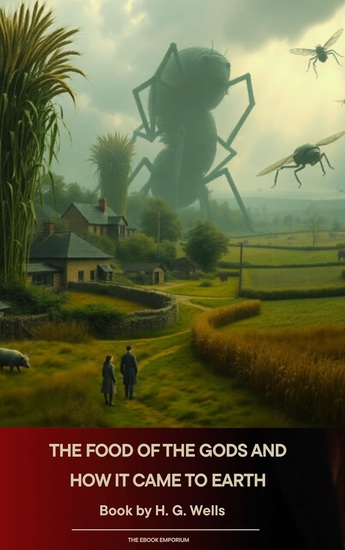
The Food of the Gods and How It Came to Earth - cover

The Food of the Gods and How It Came to Earth

H. G. Wells

Publisher: The Ebook Emporium

  • 0
  • 0
  • 0

Summary

"In the world of the small, the large is always a monster."

What happens when science outpaces morality? When two eccentric scientists, Mr. Bensington and Professor Redwood, develop "Herakleophorbia"—a substance that allows for continuous, limitless growth—they envision a world of giant livestock and abundant food. Instead, they unleash a biological revolution. From giant wasps and man-eating rats to a new generation of human "Giants" who stand forty feet tall, the world is irrevocably changed. Wells uses this fantastic premise to craft a biting satire of a society that fears progress and a moving epic about the struggle for a larger, more noble existence.

The Chaos of the Small: The first half of the novel is a brilliant dark comedy. Due to the negligence of a pair of sloppy caretakers, the "Food" leaks into the English countryside, creating a nightmare of gargantuan pests. Wells meticulously describes the terror of a world where common insects and rodents become apex predators, forcing humanity to confront the dangers of its own tinkering.

The War of the Worlds (Small vs. Large): As the human "Children of the Food" grow to adulthood, they find themselves outcasts in a world built for "little people." The novel shifts from science fiction to political allegory, as the "old" world, led by the populist politician Caterham (the "Jack the Giant-killer"), attempts to suppress and destroy the giants. It is a powerful meditation on the "growing pains" of civilization and the fear of the unknown.

A Prophecy of the Future: Wells leaves the reader with a haunting question: Can humanity evolve fast enough to inhabit the world its science has created? The Food of the Gods is an essential read for anyone interested in the ethics of biotechnology and the eternal struggle between the status quo and the future.

Witness the growth of a new world. Purchase "The Food of the Gods" today and see the world through the eyes of a giant.
Available since: 01/08/2026.
Print length: 288 pages.

Other books that might interest you

  • Cranford - cover

    Cranford

    Elizabeth Gaskell

    • 0
    • 0
    • 0
    Step into the quaint village of "Cranford" by Elizabeth Gaskell, where tradition and charm rule the day. This delightful novel chronicles the lives of the village's predominantly female inhabitants, led by the endearing and resilient Miss Matty. Through a series of vignettes, Gaskell captures their small triumphs, cherished routines, and subtle resistances to change. With gentle humor and deep empathy, "Cranford" offers a nostalgic and touching portrait of community, friendship, and the enduring strength of women in a rapidly evolving world.
    Show book
  • The Brigadier and the Golf Widow - cover

    The Brigadier and the Golf Widow

    John Cheever

    • 0
    • 0
    • 0
    Here is one of twelve magnificent stories, originally part of The John Cheever Audio Collection, in which John Cheever celebrates—with unequaled grace and tenderness—the deepest feelings we have. 
    As Cheever writes in his preface, ""These stories seem at times to be stories of a long-lost world when the city of New York was still filled with a river light, when you heard the Benny Goodman quartets from a radio in the corner stationery store, and when almost everybody wore a hat.""
    Show book
  • Lecture to Art Students (Unabridged) - cover

    Lecture to Art Students...

    Oscar Wilde

    • 0
    • 0
    • 0
    Oscar Wilde (16 October 1854 - 30 November 1900) was an Irish poet and playwright. After writing in different forms throughout the 1880s, he became one of the most popular playwrights in London in the early 1890s.
    LECTURE TO ART STUDENTS: Delivered to the Art students of the Royal Academy at their Club in Golden Square, Westminster, on June 30, 1883. The text is taken from the original manuscript. In the lecture which it is my privilege to deliver before you to-night I do not desire to give you any abstract definition of beauty at all.
    Show book
  • Strange Case of Dr Jekyll and Mr Hyde The (Unabridged) - cover

    Strange Case of Dr Jekyll and Mr...

    Robert Louis Stevenson

    • 0
    • 0
    • 0
    "The Strange Case of Dr. Jekyll and Mr. Hyde" Stevenson's famous exploration of humanity's basest capacity for evil, has become synonymous with the idea of a split personality. More than a moral tale, this dark psychological fantasy is also a product of its time, drawing on contemporary theories of class, evolution, criminality, and secret lives. Also in this volume are "The Body Snatcher," which charts the murky underside of Victorian medical practice, and "Olalla," a tale of vampirism and "The Beast Within" which features a beautiful woman at its center.
    Show book
  • Frankenstein Alive - cover

    Frankenstein Alive

    Mary Shelley

    • 0
    • 0
    • 0
    Mary Shelley ) was an English novelist who wrote the Gothic novel Frankenstein; or, The Modern Prometheus in 1818, which is considered an early example of science fiction. She also edited and promoted the works of her husband, the Romantic poet, and philosopher Percy Bysshe Shelley. Her father was the political philosopher William Godwin and her mother the philosopher and feminist activist Mary Wollstonecraft. 
     
    Shelley's mother died less than a month after giving birth to her. She was raised by her father, who provided her with a rich if informal education, encouraging her to adhere to his own anarchist political theories. When she was four, her father married a neighbor, Mary Jane Clairmont, with whom Shelley came to have a troubled relationship. 
     
    In 1814, Shelley began a romance with one of her father's political followers, Percy Bysshe Shelley, who was already married. Together with her stepsister, Claire Clairmont, she and Percy left for France and traveled through Europe. Upon their return to England, Shelley was pregnant with Percy's child. Over the next two years, she and Percy faced ostracism, constant debt, and the death of their prematurely born daughter. They married in late 1816, after the suicide of Percy Shelley's first wife, Harriet. 
     
    In 1816, the couple and her stepsister famously spent a summer with Lord Byron and John William Polidori near Geneva, Switzerland, where Shelley conceived the idea for her novel Frankenstein. The Shelleys left Britain in 1818 for Italy, where their second and third children died before Shelley gave birth to her last and only surviving child, Percy Florence Shelley. In 1822, her husband drowned when his sailing boat sank during a storm near Viareggio. A year later, Shelley returned to England and from then on devoted herself to the upbringing of her son and a career as a professional author.
    Show book
  • A Christmas Mistake - cover

    A Christmas Mistake

    Lucy Maud Montgomery

    • 0
    • 0
    • 0
    Some mistakes carve wounds. Others, however, carve paths—twisting, unexpected roads that lead straight to the heart of what truly matters. In A Christmas Mistake, Montgomery paints a holiday tale where a simple misunderstanding reshapes lives in ways neither regret nor logic could predict. The charm of this story lies in its warmth, its humanity, and the quiet wisdom that sometimes, what seems like misfortune is nothing more than fate wrapped in disguise. Witty, touching, and utterly Montgomery, this is Christmas storytelling at its finest—where mishaps become blessings and where the wrong road just might lead to the right home.
    Show book