Join us on a literary world trip!
Add this book to bookshelf
Grey
Write a new comment Default profile 50px
Grey
Subscribe to read the full book or read the first pages for free!
All characters reduced
The First Men in the Moon (translated) - cover

The First Men in the Moon (translated)

H. G. Wells

Translator Ale. Mar. Sas

Publisher: Anna Ruggieri

  • 0
  • 0
  • 0

Summary

- This edition is unique;- The translation is completely original and was carried out for the Ale. Mar. SAS;- All rights reserved.The First Men in the Moon is a book by H. G. Wells, first published in 1901. This early science fiction novel follows the journey of two unlikely companions—an eccentric scientist named Mr. Cavor and the pragmatic businessman Bedford—as they travel to the Moon using a revolutionary anti-gravity substance called Cavorite. Once there, they discover a complex subterranean civilization of insect-like beings known as Selenites, revealing a lunar world both alien and eerily reflective of human society. Wells’s novel was a bold imaginative leap for its time, offering readers a speculative look at space travel decades before it became scientifically plausible. It reflects the anxieties and ambitions of the early 20th century, including concerns about imperialism, industrialization, and the limits of human understanding. The book also contributed to shaping the genre of science fiction, influencing countless later works exploring extraterrestrial life, the ethics of exploration, and the clash of civilizations.
Available since: 09/02/2025.
Other books that might interest you

  • You Alright I'm Good Until You're Not - The Illusion of Exemption - cover

    You Alright I'm Good Until...

    Terrance McDuffie

    • 0
    • 0
    • 0
    You alright? 
    “I’m good.” 
    That’s what we say. 
    That’s what we’ve been taught to say—no matter what’s really going on beneath the surface. 
    You Alright. I’m Good. Until You’re Not. is a powerful and unfiltered look at the illusion we live under—the belief that everything is fine… until it isn’t. 
    Through raw storytelling and real-life perspective, Terrance McDuffie takes you inside the moments we often ignore—the stress, the pressure, the silent battles, and the warning signs we overlook. 
    This isn’t just about what happens when life changes. 
    It’s about what comes after. 
    The fear. 
    The questions. 
    The shift in identity. 
    And the realization that everything can change in an instant—without warning. 
    Narrated by the author himself, this audiobook delivers an intimate and deeply personal experience that resonates far beyond the moment of crisis. 
    If you’ve ever said “I’m good” when you weren’t… 
    this story is for you.
    Show book
  • Washington's Lieutenants - Major versus Brigadier Generals in the Revolutionary War - cover

    Washington's Lieutenants - Major...

    Douglas M. Branson

    • 0
    • 0
    • 0
    As commander-in-chief of the Continental Army, George Washington developed the strategy that won the Revolutionary War, but while Washington directed some battles, his strategy for the most part was carried out by his subordinates. In the spirit of the best military history and biography, Washington's Lieutenants tells the story of the generals who served under Washington from 1775 to 1781. 


    Based on extensive research, the book finds the brigadier generals a laudable group of commanders. A quarter of all brigadiers died in the service of the new nation. 


    Only three served for the war's duration, including the great Nathanael Greene and Henry Knox. Ten resigned. Benedict Arnold turned coat. At least three were involved in the so-called Conway Cabal of 1777–78 to oust General Washington. The controversial Horatio Gates, self-proclaimed victor of Saratoga, was accused of cowardice at the Battle of Camden, South Carolina. 


    At once entertaining information about some of the Revolutionary War's most colorful military commanders and an insightful analysis of how the young nation fought for its independence, Washington's Lieutenants will be essential during the wars 250th anniversary and beyond.
    Show book
  • Lucifera - From their pens to your ears genius in every story - cover

    Lucifera - From their pens to...

    Anthony Hope

    • 0
    • 0
    • 0
    Sir Anthony Hope Hawkins was born on 9th February 1863 in Clapton, London.  
    He was educated at St John's School, Leatherhead, Marlborough College and Balliol College, Oxford.  Hope trained as a lawyer and barrister and was called to the Bar by the Middle Temple in 1887. Despite what was thought to be a promising legal career he had literary ambitions and wrote in his spare time. 
    His early works appeared in various periodicals of the day but for his first book ‘A Man of Mark’ (1890), with no publisher interested, he published with his own resources.  
    More novels and short stories followed, including the mildly successful ‘Mr Witt's Widow’ in 1892. Hope even found time to run as the Liberal candidate for Wycombe in the election that same year but was unsuccessful. 
    His first major literary success came with ‘The Dolly Dialogues’, a collection of previously published magazine pieces followed very quickly by his instant classic, ‘The Prisoner of Zenda’. He now gave up the vestiges of his legal career to pursue writing full-time. 
    Despite never again reaching the same pinnacle of success he was popular and wrote prolifically across novels, plays and of course, short stories though his writing output rapidly diminished after the war. 
    In 1918 he was knighted for his contribution to propaganda efforts during World War I.  
    His short stories are delicate, mannered and often surprising with their wit, humour and interplay of characters who say one thing and usually mean another.  He was very definitely a writer of escapist rather than serious fare but they are no less enjoyable for that. 
    Anthony Hope died of throat cancer on 8th July 1933 at his country home, Heath Farm at Walton-on-the-Hill in Surrey. He was 70.
    Show book
  • Sir Walter Scott - His Life and Work - cover

    Sir Walter Scott - His Life and...

    John Buchan

    • 0
    • 0
    • 0
    To know Sir Walter Scott as a man is as delightful and fruitful an experience as to appreciate the greatness of his books.
    
    
    In the bicentenary year of the publication of Sir Walter Scott's first novel Waverley, this is a timely republication of John Buchan's biography of Scott - one great storyteller exploring the life of another.


    Buchan's sympathetic treatment of Scott is perceptive, and his enthusiasm for Scott's work is infectious. Interspersed with superb extracts exhibiting Scott's storytelling skills, John Buchan's short introduction to Scott has never been bettered. To this day, he remains the ideal advocate and guide to the great Sir Walter Scott.
    
    
    John Buchan is the very person to get us reading Scott again, abandoning the superficial media distractions for a grand rumbling rollercoaster of a read - ideal for a stage coach journey, an airport wait, or a holiday lived out of time.
    
    FROM THE INTRODUCTION BY DONALD SMITH
    
    
    The almost inspired literary criticism of Sir Walter Scott shows Buchan at his best.
    
    DICTIONARY OF NATIONAL BIOGRAPHY
    Show book
  • River Without a Cause - An Expedition through the Past Present and Future of Theodore Roosevelt's River of Doubt - cover

    River Without a Cause - An...

    Sam Moses

    • 0
    • 0
    • 0
    A riveting journey down Theodore Roosevelt's "river of doubt" with a diverse crew of adventurers, scientists, and Indigenous leaders who shine light on the past, present, and future of a natural wonder.Sam Moses took part in the adventure of a lifetime when he, along with seventeen men and two women, embarked on the Rio Roosevelt Expedition. They would follow the former president's wake down five-hundred miles of extreme whitewater into the dark heart of the Amazon. The party was guided by two chiefs from the Cinta Larga tribe—the same tribe that stalked Roosevelt's expedition in 1914—who, between rapids, tell the story of the tribe's own Trail of Tears.After the wildest whitewater is past, Moses travels with the chiefs to their village to witness the massive illegal mahogany logging from their forest, the Roosevelt Indigenous Territory. River Without a Cause puts us in the raft during those heart pounding rapid descents, as we experience the drama, dynamics, and disputes between the Bull Moose and his coleader, Brazil's most famous explorer, the rigid Colonel Candido Rondon. As the Amazon stands on the precipice of hope with the election of a new Brazilian president, River Without a Cause is a moving and galvanizing tale of adventure that is a fitting tribute to this world wonder.
    Show book
  • Chinook Crew 'Chick' - Highs and Lows of Forces Life from the Longest Serving Female RAF Chinook Force Crewmember - cover

    Chinook Crew 'Chick' - Highs and...

    Liz McConaghy

    • 0
    • 0
    • 0
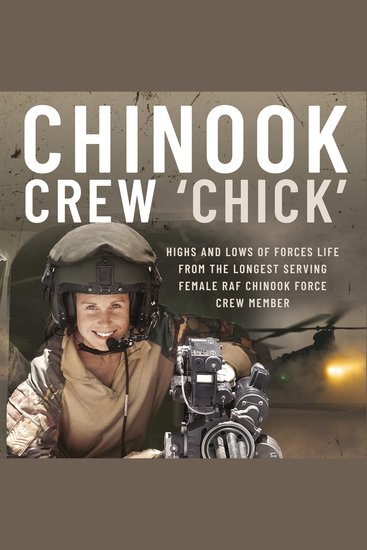
    Liz McConaghy spent a total of seventeen years flying with the RAF’s Chinook Fleet. Aged just 21, she was the youngest aircrew member to deploy to Iraq and was also the only woman on the Chinook wing for four years. In her astounding career, Liz McConaghy completed two deployments to Iraq followed by ten deployments to Helmand province in Afghanistan in support of the enduring Operation Herrick campaign. 
     
    Liz’s inspiringly honest story reveals the highs and lows that she witnessed at war, and the cost that came with that both, physically and mentally for those involved. During her deployments, she survived not only a near fatal wire strike onboard her CH47, but numerous enemy fire ‘contacts’ defending her crew by returning fire from both the M134 ‘Minigun’ and M60 weapons entrusted to her to operate. 
     
    Her biggest honor of all her duties, however, was serving on the Medical Emergency Response Team, or MERT, flying ambulance as it was more commonly known. This involved recovering wounded soldiers from the battlefield, often under fire, and witnessing them both die and indeed come back to life at her feet in the cabin of her Chinook. 
     
    Liz saw Camp Bastion grow from a barbed wire fence surrounding an area of tents in the sand to the huge Operating Base it became. She was also on the last 1310 Flight deployment there as the British forces withdrew 10 years later handing it back to the Afghan National Army. 
     
    Very few Chinook crew members, if any, spanned the length of time deployed as Liz McConaghy did. This is a genuinely unique tale that only Liz could tell, which ends with her battling the memories that haunted her, long after she had left the battlefield. Her own war within took her to the point of suicide once she had left the service. Her survival from both the battles in foreign lands and in her own head led her to begin telling her story, in the hope she can help others win their wars.
    Show book