Join us on a literary world trip!
Add this book to bookshelf
Grey
Write a new comment Default profile 50px
Grey
Subscribe to read the full book or read the first pages for free!
All characters reduced
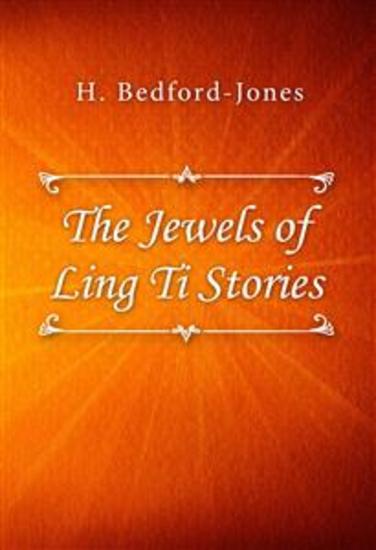
The Jewels of Ling Ti Stories - cover

The Jewels of Ling Ti Stories

H. Bedford-Jones

Publisher: Classica Libris

  • 0
  • 0
  • 0

Summary

Collection of adventure stories: “Little Tomtit,” “The Tale of the Tenth Tablet,” “The Emperor’s Amulet,” “A Tiger Hilt,” “Red Amber,” “The Ambassador’s Ring” and “The Image of Earth.”
Available since: 09/25/2022.

Other books that might interest you

  • Zen and the Art of Starship Maintenance and Other Stories - cover

    Zen and the Art of Starship...

    Tobias S. Buckell

    • 0
    • 0
    • 0
    Zen and the Art of Starship Maintenance and Other Stories is Tobias S. Buckell's seventh short fiction collection and is comprised of 15 stories, several of which are original to the collection or were previously only available through his Patreon. 
     
    This collection ranges from galactic adventures to intimate explorations of humanity—sometimes in the same story—rich with a sense of wonder and deft storytelling.
    Show book
  • The Queen of Spades - The founder of modern Russian literatures most famous piece of prose The Queen of Spades explores themes of greed and risk wrapped in the ebb and flow of an ongoing struggle between supernatural and reality - cover

    The Queen of Spades - The...

    Alexander Pushkin

    • 0
    • 0
    • 0
    Alexander Sergeyevich Pushkin was born on 26th May 1799 in Moscow into a family of Russian nobility. 
     
    Raised by nursemaids and French tutors in French he learnt Russian only via the household staff. 
     
    He graduated from the prestigious Imperial Lyceum, near St Petersburg and plunged into the vibrant and raucous intellectual youth culture of what was then the capital of the Russian Empire.  
     
    In 1820, he published his first long poem, ‘Ruslan and Ludmila’, with much controversy about both subject and style.  Pushkin was heavily influenced by the French Enlightenment and gravitated, with other literary radicals, towards social reform angering the Government. 
     
    His early literary work and reputation was poetic and written as he travelled around the Empire or engaged himself in various rebellions against the Ottoman Empire.  A clash with his own government after his poem, ‘Ode to Liberty’, was found among the belongings of the Decembrist Uprising rebels meant two years of internal exile at his mother's rural estate.  His friends and family continually petitioned for his release, sending letters and meeting with Tsar Alexander I and then Tsar Nicholas I.   
     
    In 1825, whilst at his Mother’s estate, Pushkin wrote his most famous play, the drama ‘Boris Godunov’.  
     
    Upon meeting with Tsar Nicholas I, Pushkin obtained his release and began work as the Tsar's Titular Counsel of the National Archives.  However, because of the earlier problems the tsar retained control of everything Pushkin published, and he was banned from travelling at will. 
     
    Around 1828, Pushkin met the 16-year-old Natalia Goncharova, one of the most talked-about beauties of Moscow.  After much hesitation, Natalia accepted his marriage proposal after she received assurances that the government had no intentions to persecute the libertarian poet.  When the Tsar gave Pushkin the lowest court title, Gentleman of the Chamber, he became enraged, feeling that the Tsar intended to humiliate him. 
     
    In the year 1831, during Pushkin's growing literary influence, he met Nikolai Gogol.  Recognising his gifts Pushkin supported him and published his short stories in his own magazine ‘The Contemporary’. 
     
    By the autumn of 1836, Pushkin was falling into greater and greater debt and facing scandalous rumours that his wife was having an affair.  
     
    In January 1837, Pushkin sent a ‘highly insulting letter’ to his wife’s pursuer, Georges-Charles de Heeckeren d'Anthès.  The only answer could be a challenge to a duel. 
     
    It took place on 27th January.  D'Anthès fired first, critically wounding Pushkin; the bullet entered at his hip and penetrated his abdomen.  Two days later Alexander Pushkin died of peritonitis.  He was 37. 
     
    One of Pushkin’s most lauded stories ‘The Queen of Spades’ takes on gambling and the need for just a tiny piece of information that will turn the game in his favour and take life to a level that is sure to be both deserved and his by right.
    Show book
  • Abnormal Statistics - cover

    Abnormal Statistics

    Max Booth III

    • 0
    • 0
    • 0
    "Abnormal Statistics takes us on a desolate walking tour of the everyday American nightmare. Come see what’s happening behind the closed doors and shuttered windows of your neighbors, your best friends, the people you trust most. Bleak and bloody horror that’s as raw and immediate as a pile of yellowed teeth, roots and all." 
    —​Trevor Henderson, creator of Siren Head 
    "A tightly written and devastating collection. Abnormal Statistics grabs the reader by the throat with each tale, from the stellar opener 'Indiana Death Song' to the harrowing 'Video Nasties.' Throughout the collection, Booth performs a sort of emotional autopsy that's impossible to look away from, even as we're handed our own viscera to hold. Horror, sorrow, fury and dark humor are woven throughout with an expert hand, and by the end, it hurt more of my feelings than I ever knew I possessed."  
    —​Laurel Hightower, author of Crossroads and Below 
    Suburban decay, familial horror, bleak lullabies. Abnormal Statistics is the debut story collection from Max Booth III.  
    Bad times are waiting for you.  
    Featuring 10 reprints and 3 stories original to this collection (including a brand-new novella called "Indiana Death Song").
    Show book
  • Adolf - cover

    Adolf

    D H Lawrence

    • 0
    • 0
    • 0
    'Adolf' is a charming story of a wild rabbit introduced by the father into a miner's home to the delight of the children and the despair of the mother. Larger questions of life and death and nature and civilisation are touched on with a light hand.
    Show book
  • Edna Ferber: Long Distance - Romance is often closer than we think - cover

    Edna Ferber: Long Distance -...

    Edna Ferber

    • 0
    • 0
    • 0
    Telephone lineman in the early 1900s were known for their very vocal appreciation of any and all female beauty as it walked below on the street. From their lofty perch they felt safe to whistle and shout their thanks to the lovely ladies who passed anywhere within their visual range. The women thus admired often expressed distain and dislike of this outward expression by the men but they usually walked away with their complexions a bit rosier than before. This, as we now know of course, was very inappropriate and something to be sternly discouraged but at the time all parties involved somehow to managed survive and even thrive. This story is about such an encounter. But the lady involved did not just blush and walk away, she stopped and invited the man on the pole to come down and get his face slapped for his impudence. She was of Irish descent and did not put up with uppity and distasteful men. 
    Well, the man did come down and did indeed get a resounding slap from her. What happened after this I will let the listener discover in this delightful tale of men and women and their mysterious doings.
    Show book
  • The Devil in the Belfry - From their pens to your ears genius in every story - cover

    The Devil in the Belfry - From...

    Edgar Allan Poe

    • 0
    • 0
    • 0
    Edgar Poe was born in Boston Massachusetts on 19th January 1809. His father abandoned his family the following year and within a year his mother had died leaving him an orphan.   
    He was taken in by the Allan family but never formally adopted although he now referred to himself as Edgar Allan Poe.  His father alternatively spoiled or chastised him and tension was frequent over gambling debts and monies for his education.  His university years to study ancient and modern languages was cut short by lack of money and he enlisted as a private in the army claiming he was 22, it is more probable he was 18. After 2 years he obtained a discharge in order to take up an appointment at the military academy, West Point, where he failed to become an officer. 
    Poe had released his 1st poetry volume in 1827 and after his 3rd turned to prose and placing short stories in several magazines and journals.  At age 26 he obtained a licence to marry his cousin.  She was a mere 13 but they stayed together until her death from tuberculosis 11 years after. 
    In January 1845 ‘The Raven’ was published and became an instant classic.  Thereafter followed the prose works for which he is now so rightly famed as a master of the mysterious and the macabre. 
    Edgar Allan Poe died at the tragically early age of 40 on 7th October 1849 in Baltimore, Maryland. Newspapers at the time reported Poe's death as ‘congestion of the brain’ or ‘cerebral inflammation’, common euphemisms for death from disreputable causes such as alcoholism but the actual cause of death remains a mystery. 
    Poe is also one of a number of authors credited with inventing the detective genre with his Parisian sleuth C. Auguste Dupin.  He featured in three stories including the legendary ‘Murders in the Rue Morgue’ and by sheer deduction, logic and a touch of Gallic arrogance revealed what was hidden to the rest of us.
    Show book