Join us on a literary world trip!
Add this book to bookshelf
Grey
Write a new comment Default profile 50px
Grey
Subscribe to read the full book or read the first pages for free!
All characters reduced
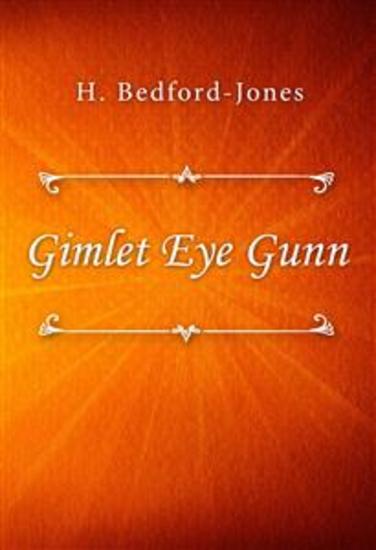
Gimlet Eye Gunn - cover

Gimlet Eye Gunn

H. Bedford-Jones

Publisher: Classica Libris

  • 0
  • 0
  • 0

Summary

Peter Larsen knew well enough that air personnel had often been forced to land on remote tropical islands. But he hadn’t thought of any of them as being haunted islands.
How can a 300 year-old ghost know so much, from the past, to the present – even the future? Larsen had no idea, but he had to find out. It would mean knowing whether Gimlet Eye Gunn was for real, or he was the one going crazy.
A classic that once appeared in Weird Tales.
Available since: 09/25/2022.

Other books that might interest you

  • A Lantern in Her Hand - cover

    A Lantern in Her Hand

    Bess Streeter Aldrich

    • 0
    • 0
    • 0
    The classic story of Abbie and Will Deal—pioneers who left everything behind for a new life on America's frontier.Abbie Mackenzie dreamed of becoming a fine lady like her aristocratic grandmother, devoting herself to music and art. But at eighteen Abbie found a different dream, turning away from the promise of a comfortable life as a doctor's wife to marry handsome, quiet Will Deal. Together, they eagerly accepted the challenge of homesteading in Nebraska territory, where the prairies stretched as far as the eye could see, and only the strongest survived for long.For over 90 years, people have cherished Abbie's story—an inspiring story of struggle against unexpected perils, of love, of the land she helped nurture, and the family she raised.
    Show book
  • Anathema - From their pens to your ears genius in every story - cover

    Anathema - From their pens to...

    Alexander Kuprin

    • 0
    • 0
    • 0
    Alexander Kuprin was born in Narovchat, Penza in Russia on 7th September 1870. 
    At 3 his Father died and he and mother moved to Moscow. By 10 he was enrolled at the Second Moscow Military High School and there his interest in literature began. The Alexander Military Academy followed and two years later he was a sub-lieutenant and posted to an Infantry Regiment for a further four years. 
    Despite his duties he was a now a keen writer and published his first short story at this time. His military duties also garnered him experiences for his breakthrough work ‘The Duel’.  Leaving the military he left for Kiev to work for local newspapers.  He continued to publish both stories and novels and by 1901 he was in St Petersburg becoming part of a group that included Chekhov, Ivan Bunin, Maxim Gorky and Leonid Andreyev.  
    In the years that followed further controversial works and acclaim followed.  His comments on the regime meant he was also put under secret police surveillance.   
    As World War I erupted, Kuprin opened a military hospital but was then given command of an infantry company in Finland. He was soon discharged on grounds of ill health.  
    The October Revolution saw him praise Lenin, but he warned that the Bolsheviks threatened Russian culture and might cause further widespread suffering to the peasants.  As Civil War raged he took his family to Helsinki and then on to Paris. 
    Exile saw his talents decline further and his succumbing to alcoholism. He became lonely and withdrawn. The family's poverty increased his malaise.   
    In May 1937, the Kuprin’s returned to Moscow.  He now saw his work published but wrote almost nothing new.  In 1938 his health rapidly deteriorated.  Already suffering from a kidney problems and sclerosis, he had now developed cancer of the oesophagus.  
    Alexander Kuprin died on 25th August 1938.
    Show book
  • The Twins and a Wedding - cover

    The Twins and a Wedding

    Lucy Maud Montgomery

    • 0
    • 0
    • 0
    Lucy Maud Montgomery (November 30, 1874 – April 24, 1942), published as L. M. Montgomery, was a Canadian author best known for a series of novels beginning in 1908 with Anne of Green Gables. The book was an immediate success. The title character, orphan Anne Shirley, made Montgomery famous in her lifetime and gave her an international following.
    The Twins and a Wedding: Sometimes Johnny and I wonder what would really have happened if we had never started for Cousin Pamelia's wedding. I think that Ted would have come back some time; but Johnny says he doesn't believe he ever would, and Johnny ought to know, because Johnny's a boy. Anyhow, he couldn't have come back for four years. However, we did start for the wedding and so things came out all right, and Ted said we were a pair of twin special Providences.
    Show book
  • Far from the Madding Crowd - cover

    Far from the Madding Crowd

    Thomas Hardy

    • 0
    • 0
    • 0
    "Far from the Madding Crowd," published in 1874, is one of Thomas Hardy's most celebrated novels and the first to introduce readers to the fictional county of Wessex. The story follows the independent and headstrong Bathsheba Everdene, who inherits her uncle's farm and decides to manage it herself, which was unusual for a woman of her time. Throughout the narrative, Bathsheba attracts three very different suitors: the loyal shepherd Gabriel Oak, the mature and prosperous farmer Mr. Boldwood, and the dashing but reckless Sergeant Troy. As the story unfolds, it delves deep into themes of love, honor, and betrayal against the backdrop of the pastoral English countryside.
    Show book
  • Life and Adventures of Jack Engle An Autobiography - cover

    Life and Adventures of Jack...

    Walt Whitman

    • 0
    • 0
    • 0
    Walter Whitman was an American poet, essayist and journalist. A humanist, he was a part of the transition between transcendentalism and realism, incorporating both views in his works. Whitman is among the most influential poets in the American canon, often called the father of free verse. His work was controversial in its time, particularly his 1855 poetry collection Leaves of Grass, which was described as obscene for its overt sensuality. Whitman's own life came under scrutiny for his presumed homosexuality.Born in Huntington on Long Island, as a child and through much of his career, he resided in Brooklyn. At age 11, he left formal schooling to go to work. Later, Whitman worked as a journalist, a teacher, and a government clerk. Whitman's major poetry collection, Leaves of Grass, was first published in 1855 with his own money and became well known. The work was an attempt at reaching out to the common person with an American epic. He continued expanding and revising it until his death in 1892. During the American Civil War, he went to Washington, D.C. and worked in hospitals caring for the wounded. His poetry often focused on both loss and healing. On the death of Abraham Lincoln, whom Whitman greatly admired, he wrote his well-known poems, "O Captain! My Captain!" and "When Lilacs Last in the Dooryard Bloom'd", and gave a series of lectures. After a stroke towards the end of his life, Whitman moved to Camden, New Jersey, where his health further declined. When he died at age 72, his funeral was a public event.Whitman's influence on poetry remains strong. Mary Whitall Smith Costelloe argued: "You cannot really understand America without Walt Whitman, without Leaves of Grass ... He has expressed that civilization, 'up to date,' as he would say, and no student of the philosophy of history can do without him." Modernist poet Ezra Pound called Whitman "America's poet ... He is America.
    Show book
  • Hand and Heart - From their pens to your ears genius in every story - cover

    Hand and Heart - From their pens...

    Elizabeth Gaskell

    • 0
    • 0
    • 0
    Elizabeth Stevenson was born in Chelsea in London on 29th September 1810.  
    Both parents embedded their strong Unitarian beliefs into Elizabeth who rebelliously was often reluctant to display these religious convictions.  
    The early death of Elizabeth’s mother saw her sent away to be brought up by her maternal aunt in Knutsford, Cheshire.  
    Her father now remarried but Elizabeth spent most of her childhood in Cheshire away from her father and his new family but was supportive towards her half-siblings.  
    Elizabeth’s aunt encouraged her education and particularly to read and express herself through writing.   
    In 1828, her brother John, who worked in the merchant navy, disappeared on a journey to India. This disastrous loss depressed her father, and she went to his household to nurse him for the next year before he died.  
    In 1832, she fell in love with William Gaskell, a Unitarian minister like her father, and married him.  They settled in Manchester. This booming industrial city had a great impact on Elizabeth who felt the need to speak up for poor workers and their exploitation by large industrial companies. A collection of poems and short stories, ‘Sketches among the Poor’ appeared in 1837, co-authored by her husband.  Her first major work, under a pseudonym, was ‘Mary Barton: A Tale of Manchester Life’ published in 1848. 
    During her career she worked continually with Charles Dickens and published much in his various magazines. With him she published ‘Lizzie Leigh’ in 1850 which dealt with the taboo subject of prostitution.  She was an excellent writer and impressed her many Victorian literary peers. Much of her writing reflects her work as a social critic highlighting the exploitation of the working class and the situation of women in society.  
    On 12th November 1865, Elizabeth Gaskell died in Holybourne, Hampshire, after suffering from a heart attack a month earlier.
    Show book