Join us on a literary world trip!
Add this book to bookshelf
Grey
Write a new comment Default profile 50px
Grey
Subscribe to read the full book or read the first pages for free!
All characters reduced
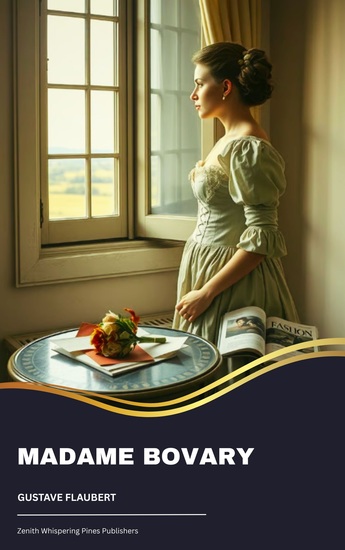
Madame Bovary - cover

Madame Bovary

Gustave Flaubert

Translator Eleanor Marx-Aveling

Publisher: Zenith Whispering Pines Publishers

  • 0
  • 0
  • 0

Summary

A woman longing for passion. A life that feels too small. A dream that leads her where she never meant to go.
Emma Bovary marries a kind but ordinary doctor, hoping for romance, beauty, and excitement. Instead, she finds herself trapped in routine and aching for more. As she pursues love, luxury, and escape, her desires turn into dangerous illusions—drawing her deeper into secrets, debt, and heartbreak she cannot control.

Praised as "one of the greatest novels ever written," Flaubert's masterpiece is renowned for its exquisite prose, psychological depth, and fearless portrayal of desire and disillusionment. Emma's struggle to reconcile fantasy with reality remains as gripping today as when the book first shocked the world.

If you love emotionally intense storytelling, rich character exploration, and classics that linger long after the last page, this novel is essential reading.

Open the book—and step into the life of a woman whose dreams burn brighter than the world around her.
Available since: 12/08/2025.
Print length: 397 pages.

Other books that might interest you

  • Lord Jim - cover

    Lord Jim

    Joseph Conrad

    • 0
    • 0
    • 0
    "He is one of us." — Marlow
    
    Young Jim is a promising officer in the British merchant marine, a dreamer fueled by romantic visions of heroism. But when the pilgrim ship SS Patna strikes an underwater object and begins to sink, Jim commits an act of cowardice that will haunt him forever: he jumps. Abandoning hundreds of passengers to their fate, he survives only to face a court of inquiry and a lifetime of self-loathing. The story follows Jim as he drifts through the ports of the East, shadowed by his secret shame, until the narrator Marlow helps him find a final chance for "greatness" in the remote jungle territory of Patusan. There, among the warring factions of the archipelago, Jim seeks to become the hero he once failed to be.
    
    A Masterpiece of Moral Ambiguity: Conrad's novel is a pioneering work of modernism, using a fractured timeline and multiple viewpoints to ask a difficult question: Can a single moment of weakness define a man's entire soul? Jim's struggle is not with the law, but with his own internal "ideal" of who he should be.
    
    The "One of Us" Philosophy: Through Marlow's eyes, we see Jim as a representative of the human condition—flawed, idealistic, and deeply vulnerable. The novel explores the "misty" nature of truth and the fragility of the codes we live by, whether they be the rules of the sea or the expectations of society.
    
    The Final Stand in Patusan: In the second half of the novel, the scale shifts from a maritime drama to a colonial epic. Jim rises to become "Tuan Jim" (Lord Jim) to the local people, but the arrival of the villainous Gentleman Brown forces a final, tragic reckoning. It is a climax that challenges the possibility of ever truly escaping one's past.
    
    Explore the depths of the human heart. Purchase "Lord Jim" today.
    Show book
  • Oliver Twist - cover

    Oliver Twist

    Charles Dickens

    • 0
    • 0
    • 0
    "Oliver Twist; or, The Parish Boy's Progress" is a novel by Charles Dickens, first published as a serialized work between 1837 and 1839. The story follows Oliver Twist, an orphan who escapes from a workhouse to seek his fortune in London. Oliver is naive and innocent, contrasting sharply with the corrupt and exploitative adults he encounters. He becomes involved with a group of juvenile criminals led by the cunning Fagin. The book explores social inequality and is an early example of the social-protest novel.
    Show book
  • The Velveteen Rabbit - cover

    The Velveteen Rabbit

    Margery Williams

    • 0
    • 0
    • 0
    The Velveteen Rabbit (or How Toys Become Real) is a British children's book written by Margery Williams (also known as Margery Williams Bianco) and illustrated by William Nicholson. It chronicles the story of a stuffed rabbit's desire to become real through the love of his owner. The story was first published in Harper's Bazaar in 1921 featuring illustrations from Williams' daughter Pamela Bianco. It was published as a book in 1922 and has been republished many times since.
    The Velveteen Rabbit was Williams' first children's book. It has been awarded the IRA/CBC Children's Choice award. Based on a 2007 online poll, the National Education Association voted the book #28 on the "Teachers' Top 100 Books for Children".
    Show book
  • Clouds of Witness - The Lord Peter Wimsey Mysteries Vol: 2 - cover

    Clouds of Witness - The Lord...

    Dorothy L. Sayers

    • 0
    • 0
    • 0
    Clouds of Witness: A Murder Mystery Novel by Dorothy L. SayersDelve into the captivating world of Lord Peter Wimsey with Clouds of Witness, the second installment in Dorothy L. Sayers' iconic mystery series. This timeless classic offers a gripping tale of murder, family secrets, and aristocratic intrigue.When the Duke of Denver, Lord Peter's own brother, is accused of murder, the stakes couldn't be higher. Armed with his razor-sharp intellect and unyielding determination, Lord Peter uncovers a web of secrets, lies, and political entanglements. As the truth unfolds, readers are treated to Sayers' signature blend of wit, suspense, and literary charm.Perfect for fans of classic detective fiction, Clouds of Witness showcases Dorothy L. Sayers' masterful storytelling and the enduring appeal of her brilliant and charismatic sleuth, Lord Peter Wimsey.
    Show book
  • The Railway Children - cover

    The Railway Children

    E. Nesbit

    • 0
    • 0
    • 0
    "The Railway Children" follows the lives of three siblings - Roberta, Peter, and Phyllis - who, along with their mother, move to the countryside after their father is wrongfully imprisoned. The children find solace in their adventures near the railway line, making friends with the stationmaster and a kind stranger. E. Nesbit's heartwarming tale of resilience, family bonds, and the simple joys of childhood has captivated readers since its publication. With its timeless portrayal of innocence and the enduring spirit of youth, "The Railway Children" remains a beloved classic in children's literature. 
     
    Edith Nesbit, commonly known as E. Nesbit, was an English author and poet, celebrated for her children's literature. She co-founded the Fabian Society, a socialist organization, and her progressive beliefs often found expression in her stories. Her most popular works, including "The Railway Children" and "Five Children and It," continue to delight young readers with their imaginative and adventurous themes, making her one of the pioneers of modern children's literature.
    Show book
  • The Timeless Classic Persuasion - cover

    The Timeless Classic Persuasion

    Jane Austen

    • 0
    • 0
    • 0
    Persuasion is a novel by Jane Austen that follows the story of Anne Elliot, an unmarried woman struggling to reconcile her feelings for a man she met and fell in love with eight years earlier, Captain Frederick Wentworth. The fast-paced novel explores themes of love, class, and social expectations in 19th-century England. Austen uses Anne's character to highlight the societal limitations placed upon women during this time. Women were expected to marry for financial security and status, rather than for love. Anne's struggle to navigate her desires and the expectations of her family and society highlights the conflict that many women faced during this period. In addition to exploring themes of love and societal expectations, the novel also delves into the class system of England at that time. Austen uses the characters of the landed gentry and the navy officers to comment on the societal changes that were occurring during this time period. Through these characters, Austen highlights the shifting power dynamics and changing social structures of the time.
    Show book