Join us on a literary world trip!
Add this book to bookshelf
Grey
Write a new comment Default profile 50px
Grey
Subscribe to read the full book or read the first pages for free!
All characters reduced
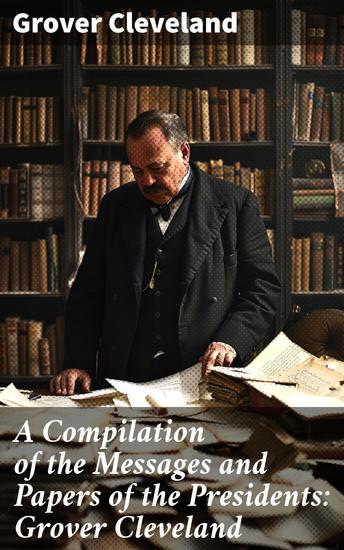
A Compilation of the Messages and Papers of the Presidents: Grover Cleveland - A Comprehensive Compilation of Presidential Messages and Policies - cover

A Compilation of the Messages and Papers of the Presidents: Grover Cleveland - A Comprehensive Compilation of Presidential Messages and Policies

Grover Cleveland

Publisher: Good Press

  • 0
  • 0
  • 0

Summary

In "A Compilation of the Messages and Papers of the Presidents: Grover Cleveland," the reader is invited into the rich tapestry of American political history through the lens of one of its most complex figures. Cleveland's literary style is characterized by clarity and directness, reflective of his pragmatic approach to governance. This compilation meticulously organizes his messages, speeches, and writings, providing a comprehensive overview of his presidency during a time of great economic and social upheaval in the late 19th century. It serves not just as a historical artifact, but also as a critical scholarly resource, illuminating themes of economic reform, civil service, and the evolving role of the federal government amid burgeoning industrialization. Grover Cleveland, the only U.S. President to serve two non-consecutive terms, approached the presidency with a commitment to integrity and a desire to combat corruption. His experiences as a reform-minded politician, along with his legal background, informed his leadership style and policy initiatives. This compilation emerges as a natural extension of his legacy, as it intricately weaves together his thoughts and reflections during a transformative era in American history. This book is essential for scholars, students, and anyone interested in understanding the nuances of presidential leadership and the foundational issues that shaped modern America. By engaging with Cleveland'Äôs writings, readers gain insights into the principles of governance and the moral dilemmas faced by leaders in a democratic society.
Available since: 08/12/2023.
Print length: 530 pages.
Other books that might interest you

  • Who Really Owns Ireland - How we became tenants in our own land - and what we can do about it - cover

    Who Really Owns Ireland - How we...

    Matt Cooper

    • 0
    • 0
    • 0
    Through centuries of oppression, we were tenants in our own land.
    Today, despite our independence and new-found affluence, we are in the midst of a crisis.
    The question of who owns Ireland is once again taking on a sense of urgency. Is the land of Ireland still for the people of Ireland?
    In a deep and far-reaching investigation, journalist, broadcaster and No. 1 bestselling author Matt Cooper examines the power wielded by those who control the land where we live, work and play. Who are they, how did they acquire so much and what does it mean for ordinary citizens when the ownership of key resources like shopping centres, wind farms, forestry and data centres comes from outside?
    This is a story about how power and money influence and control the present and the future of Ireland … sometimes for good and sometimes for bad. Filled with riveting detail, this compelling story of who really owns Ireland is an essential account of the issues that affect every single one of us living on this island.
    Show book
  • Kill Caesar! - Assassination in the Early Roman Empire - cover

    Kill Caesar! - Assassination in...

    Rose Mary Sheldon

    • 0
    • 0
    • 0
    “Why were Rome’s first emperors—the good, the bad, and the ugly—so vulnerable to conspiracies and assassination? . . . an expert analysis . . . compelling.” —Adrienne Mayor, author of The Poison King: The Life and Legend of Mithradates and Rome’s Deadliest Enemy Exploring the history of internal security under the first Roman dynasty, this groundbreaking book answers the enduring question: If there were 9,000 men guarding the emperor, how were three-quarters of Rome’s leaders assassinated? Rose Mary Sheldon traces the evolution of internal security mechanisms under the Julio-Claudians, evaluating the system that Augustus first developed to protect the imperial family and the stability of his dynasty. Yet in spite of the intensive precautions taken, there were multiple attempts on his life.    Like all emperors, Augustus had a number of competing constituencies—the senate, the army, his extended family, the provincials, and the populace of Rome—but were they all equally threatening? Indeed, the biggest threat would come from those closest to the emperor—his family and the aristocracy. Even Roman imperial women were deeply involved in instigating regime change. By the fourth emperor, Caligula, the Praetorian Guards were already participating in assassinations, and the army too was becoming more politicized.    Sheldon weighs the accuracy of ancient sources: Does the image of the emperor presented to us represent reality or what the people who killed him wanted us to think? Were Caligula and Nero really crazy, or did senatorial historians portray them that way to justify their murder? Was Claudius really the fool found drooling behind a curtain and made emperor, or was he in on the plot from the beginning? These and other fascinating questions are answered as Sheldon concludes that the repeated problem of “killing Caesar” reflected the empire’s larger dynamics and turmoil.
    Show book
  • Pain as a Portal - A Philosophy to Explore Your Potential - cover

    Pain as a Portal - A Philosophy...

    April Simone

    • 0
    • 0
    • 0
    Discover how Mettāmorphosis-an essential new philosophy-offers a pathway to alleviate suffering and connects you with your own inherent wisdom to make sense of it all. 
    The book is divided into three parts: 
        * Part One explores The PAIN Process model, introducing the philosophy behind it and a step-by-step guide to frame, process and morph your pain into gifts. 
        * Part Two includes case studies to provide clear examples of how this model has been applied in real-life scenarios. 
        * Part Three offers deeply personal and vulnerable narratives from April Simone's own life, serving as sustenance of hope for your mind and heart. 
    Pain as a Portal is a transmission that serves as a guide, travelling alongside you on your journey to uncover the many gifts your pain has to offer.
    Show book
  • Christianity and Critical Race Theory - A Faithful and Constructive Conversation - cover

    Christianity and Critical Race...

    Robert Chao Romero, Jeff M. Liou

    • 0
    • 0
    • 0
    Critical Race Theory (CRT) has become a lightning rod in American politics and evangelical Christianity. This book offers a critical but constructive and sympathetic introduction to CRT written from a perspective rooted in Scripture and Christian theology. The authors take us beyond caricatures and misinformation to consider how CRT can be an analytical tool to help us understand persistent inequality and injustice—and to see how Christians and churches working for racial justice can engage CRT in faithful and constructive ways. 


    The authors explore aspects of CRT that resonate with well-trod Christian doctrine but also that challenge or are corrected by Christian theology. They also address the controversial connection that critics see between CRT and Marxism. Their aim is to offer objective analysis and critique that go beyond the debates about social identity and the culture wars and aid those who are engaging the issues in Christian life and ministry. Reflection/discussion questions, exercises, a glossary of key CRT terms, and suggested readings make the book helpful for students or small groups.
    Show book
  • Battle of White Mountain The: The History and Legacy of the First Major Battle of the Thirty Years’ War - cover

    Battle of White Mountain The:...

    Editors Charles River

    • 0
    • 0
    • 0
    It has been famously pointed out that the Holy Roman Empire was neither holy, nor Roman, but it was also not an empire in the sense people expect when hearing the term. In theory, the emperor was the highest prince in Christendom, and his dominion extended the length and breadth of Western Europe. The tensions between the Holy Roman Empire and Church over the power to invest bishops with authority led to decades of civil war in Germany on the way to establishing the relationship between Church and State, elevating the status of the papacy and weakening the Holy Roman Empire. 
    	The Thirty Years' War was one of the most horrific conflicts in history, resulting in the deaths of nearly two-thirds of Germany's population, and the Battle of White Mountain in 1620 was the first major battle of that war. The battle was fought mainly due to Holy Roman Emperor Ferdinand II’s dealings with the Bohemians and their new king, Frederick of the Palatinate, who Ferdinand regarded as illegitimate. It was also partly a struggle between the centralizing attempts of the Habsburg dynasty conflicting with the traditional regional autonomy that existed within the legislative institutions called the Estates. What gave it an emotional element was the enmity between Bohemian Protestantism and Ferdinand II’s zealous Catholicism, and that would help draw in several European powers. At the Battle of White Mountain, the armies of the Bohemian Confederation and the Habsburgs met each other near Prague, and the combatants included officers and soldiers from nearly every nation in Europe, including the Netherlands, Germany, Italy, Poland, Bohemia, Moravia, Bavaria, Italy, Spain, Hungary, Transylvania, England, Scotland, and Ireland. The decisive result would permanently affect the course of the conflict over the coming decades, and with it the fate of modern Europe. 
    Show book
  • Happy Mind Miracles - cover

    Happy Mind Miracles

    Dr. Suresh Jain

    • 0
    • 0
    • 0
    Are you suffering from negativity like stress, anxiety, worry, anger, fear, sin, guilt, irritability, jealousy, overthinking, procrastination, and many others? or having limited belief systems, emotional patterns, or behavior patterns, and because of that, you are not able to achieve the big goals to live your dream life. If your answer is yes, this book “Happy Mind Miracles” is to help you to resolve all these problems, by Harmonizing happy hormones, rewiring your mind, and creating an abundance Mindset. This book is like a powerful toolbox crafted with a holistic approach, combining neuroscience, positive psychology, Modern Medicine, and the wisdom of ancient yoga and meditation to help people to overcome the above problems, and achieve ambitious life goals, enduring Happiness and Unstoppable Success.
    Show book