Join us on a literary world trip!
Add this book to bookshelf
Grey
Write a new comment Default profile 50px
Grey
Subscribe to read the full book or read the first pages for free!
All characters reduced
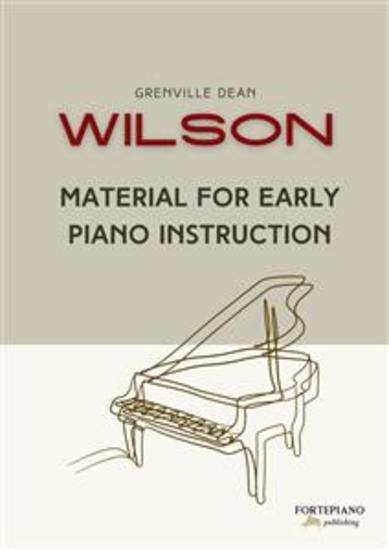
Material for Early Piano Instruction - in 3 books - cover

Material for Early Piano Instruction - in 3 books

Grenville Dean Wilson

Publisher: Fortepiano Publishing

  • 0
  • 0
  • 0

Summary

Grenville Dean Wilson, an American pianist and composer born in 1833, is best remembered for his contributions to piano education and composition, particularly his work "Material for Early Piano Instruction." This work, first published in the years 1876 and 1877, is a significant contribution to piano pedagogy, reflecting the Romantic style prevalent in that era. The material is carefully crafted to cater to early piano learners, demonstrating Wilson's deep understanding of the piano as both a performer and an educator.
Wilson's dedication to music education extended beyond his compositions. He was a prominent figure in Nyack, New York, where he worked as a piano teacher from about 1870 until his death in 1897. His influence in Nyack was profound, as he was instrumental in founding both the Nyack Choral Society and the Nyack Philharmonic Orchestra, in addition to founding the Nyack Library. These contributions illustrate his commitment to fostering a rich musical culture and education in his community.
"Material for Early Piano Instruction" stands as a testament to Wilson's expertise and his dedication to nurturing the musical talents of younger students. The work is structured to provide a comprehensive and accessible introduction to piano playing, reflecting the pedagogical methods of the time while also showcasing Wilson's unique compositional style.

- Piano book, Easy piano, beginner , Piano method, Piano practice, Piano exercises, Piano teaching, Piano course, Piano technique, Piano teacher, Piano studies, Piano pedagogy,  Classical piano, Piano skills, Piano playing.
Available since: 01/16/2024.
Other books that might interest you

  • Beauty and Imitation - A Philosophical Reflection on the Arts - cover

    Beauty and Imitation - A...

    Daniel McInerny

    • 0
    • 0
    • 0
    The human person is a truth seeker, and one of the most compelling ways human beings pursue truth is through the arts. In Beauty and Imitation: A Philosophical Reflection on the Arts, Daniel McInerny argues for an understanding of art as a form of inquiry into truth that proceeds by way of sensible beauty.  Drawing upon the thought of Aristotle and St. Thomas Aquinas, McInerny argues for the unfashionable yet philosophically compelling view that art is essentially “mimetic,” imitative of human action. But what does it mean for art to imitate human action? It means that art imitates the way human beings by nature quest for fulfillment, or happiness. In questing for fulfillment, human life takes the form of a story, and so the arts—all the arts, from painting to music, from fiction to film—are storytelling arts whose beauty reveals the truth about human happiness.  The first part of the book features a renewed defense of the ancient Aristotelian claim that art is mimetic and that its imitation of the human story takes the form of a moral argument. The second part shows how audiences are transformed by the moral arguments the mimetic arts make, and the third concludes with a guided tour of the mimetic arts, where specific arts are considered in light of the Aristotelian and Thomistic principles advanced earlier.
    Show book
  • Me And My Friends At The Musical Party - Come Join Our Musical Journey - cover

    Me And My Friends At The Musical...

    Julie Kirchhubel

    • 0
    • 0
    • 0
    Me And My Friends  At the Musical PartyParties are always exciting, and especially when they aremusical parties! The news of this special party is rapidly spreading around the neighbourhood –but whose party is it?
    Show book
  • The Inner Game of Music - cover

    The Inner Game of Music

    Barry Green, W. Timothy Gallwey

    • 0
    • 0
    • 0
    The Inner Game of music is that which takes place in the mind, played against such elusive opponents as nervousness, self doubt, and fear of failure. Using the same principles of "natural learning" W. Timothy Gallwey developed so successfully for tennis, golf, and skiing and applying them to his own field, noted musician Barry Green shows how to acknowledge and overcome these internal obstacles in order to bring a new quality to the experience and learning of music. It is also ideal for those who don't play an instrument but who feel their appreciation of music will be enhanced if they understand more about the process of playing. 


    In precise, easy to understand language, Green and Gallwey explain how natural skills can be nurtured and enhanced, and through a series of special exercises they demonstrate the ways in which musicians can achieve exact intonation, artistic phrasing, and improved technique. 


    Ensemble playing, improvisation, composition and creativity, and listening skills are discussed throughout. 


    A methodology with a proven track record, this will be invaluable to anyone seriously interested in music, professional or amateur, composer, performer, or an appreciative listener.
    Show book
  • Exploring Christian History - cover

    Exploring Christian History

    Taurai Makadho

    • 0
    • 0
    • 0
    This audiobook is narrated by an AI Voice.   
    In 'Exploring Christian History', I aim to present a comprehensive and accurate account of the events, figures, and movements that have shaped Christianity throughout the centuries. While my own personal faith informs my interest in this subject, the contents of this book are not intended to proselytize or illustrate my own statement of faith. Rather, this work is a demonstration of a statement of facts, grounded in historical research and evidence-based scholarship. 
    My goal is to provide readers with a nuanced understanding of the complex and multifaceted nature of Christian history, highlighting both the triumphs and challenges that have characterized this faith tradition. Through this exploration, I hope to shed light on the ways in which Christianity has evolved over time, influenced cultures, and impacted individuals and societies. 
    I believe that history is best understood when presented in an objective and impartial manner, allowing readers to draw their own conclusions and insights. To that end, I have strived to approach this subject with rigor, respect, and a commitment to accuracy, drawing on a wide range of primary and secondary sources. 
    It is my hope that 'Exploring Christian History' will serve as a valuable resource for anyone seeking to understand the rich and complex heritage of Christianity, regardless of their own faith background or perspective."
    Show book
  • Modal Guitar Licks - 80 Original Guitar Licks from the Major scale and its Modes - cover

    Modal Guitar Licks - 80 Original...

    Gareth Evans

    • 0
    • 0
    • 0
    80 original & creative guitar licks in tablature and notation, featuring the major scale & all of its modes.
    
    - All guitar tablatures include picking directions & fretboard finger guide numbers
    - 432 bars of music (average lick length 5.4 bars)
    - Video demonstrations for all licks at full speed
    - Audio demonstrations for all licks at full & half speed
    - Backing tracks at full and slower practice speeds
    - Introduction to the theory of modes
    - 5 CAGED scale diagrams for every scale type (45 scale diagrams)
    - Theory and technique tips for every lick
    - Licks from the Major, Dorian, Phrygian, Lydian, Mixolydian, Aeolian & Locrian modes
    - Styles include Brit Pop, Smooth Hip Hop Jazz, Half-time Thrash, Progressive Metal, Funk Rock, Funky Blues & Pop Rock
    - Dynamics and techniques include slides, hybrid picking, sweep picking, hammer-ons, pull-offs, palm muting, trills, displaced rhythms, pedal notes, double stops, finger rolls, string bends, double-handed tapping, pinched harmonics, tapped harmonics, tremolo bar and partial chords
    Grab a copy today!
    Show book
  • Nadja - cover

    Nadja

    André Breton

    • 0
    • 0
    • 0
    In Paris, during the fall of 1926, André Breton met a young woman from the provinces who called herself Nadja because, she said, "in Russian it's the beginning of the word for hope, and because it's only the beginning." Their love affair was brief, intense, and intensely self-conscious. They both talked exuberantly of the book that Breton would make out of their days and nights. And indeed a year later (after Nadja was institutionalized and Breton had moved on to other love affairs) he began to write Nadja—a book of memory and analysis taking its cue in part from Freud's case studies, but also a book of ingeniously intercut images, drawing on Surrealist ideas to portray a soul whose very way of being approaches, in Breton's words, "the extreme limit of the Surrealist aspiration."In this, the first new translation of Nadja in more than sixty years, Mark Polizzotti captures the youthful excitement, the abiding strangeness, and above all the freshness of Breton's prose. He also provides an illuminating introduction about the fate of the real Nadja, whose identity remained jealously guarded until the twenty-first century. A gripping tale of infatuation and a meditation on the surrealism of everyday life, Nadja is still a thing of convulsive beauty, impossible to pin or put down, a precursor to works of Julien Gracq, Julio Cortázar, and W. G. Sebald.
    Show book