Join us on a literary world trip!
Add this book to bookshelf
Grey
Write a new comment Default profile 50px
Grey
Subscribe to read the full book or read the first pages for free!
All characters reduced
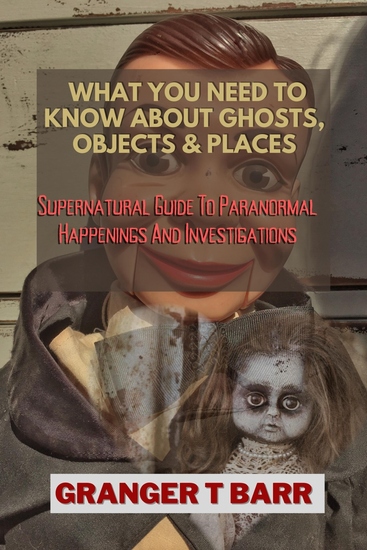
What You Should Know About Ghosts Objects And Places - Supernatural Guide To Paranormal Happenings And Investigations - cover

What You Should Know About Ghosts Objects And Places - Supernatural Guide To Paranormal Happenings And Investigations

Granger T Barr

Publisher: Publishdrive

  • 0
  • 0
  • 0

Summary

What You Should Know About Ghosts, Objects And Places: Supernatural Guide To Paranormal Happenings And Investigations
 
In conjunction with the Ghostly Encounters Series, this book will provide more paranormal facts.This includes:
 
haunted toys and artefacts, 
 
fourteen well-known film and television scary locations, 
 
paranormal, creepy investigations and hauntings, 
 
one-of-a-kind questions, answers, tips and recommendations, 
 
eight true ghost stories from real individuals.
 
Find out something new and different each time.
 
GET THIS BOOK NOW!
Available since: 09/15/2022.
Print length: 203 pages.

Other books that might interest you

  • Running on Empty - 18000 Miles down Africa with Parkinson's - cover

    Running on Empty - 18000 Miles...

    Guy Deacon

    • 0
    • 0
    • 0
    'An immense feat of endurance, a remarkable achievement, and a truly inspirational adventure filled with courage and hope' – Sir Ranulph Fiennes 
    At the age of sixty, and having lived with Parkinson’s disease for over ten years, Guy Deacon CBE set out on one last adventure: to drive solo from his home in the UK 18,000 miles and through twenty-five countries to Cape Town on the southern tip of Africa. This incredible journey, across Europe and down the full length of Africa, took the former British Army officer over twelve months. Along the way, he broke down five times, underwent one emergency evacuation, and took 3,650 prescription pills. 
    There are only a handful of vehicles each year which attempt this difficult journey; many never complete it. Ongoing conflicts in Libya, South Sudan, Mozambique and many other countries make any journey exceptionally dangerous. In central Africa, road conditions, particularly in the rainy season, often make the going treacherous. Further hazards include illegal checkpoints, extortion, contaminated fuel and a lack of services. 
    Guy drove, lived and slept in his VW Transporter, often in remote spots, hundreds of miles from the nearest village or town. Reliant on patchy GPS, he often got lost. His journey was, quite simply, an incredible feat by a man travelling alone with Stage 3 Parkinson’s disease, when simply putting on a pair of shoes can take half an hour. 
    But not only did Guy’s journey fulfil a childhood dream to drive the length of Africa, his mission was also to raise global awareness of Parkinson’s disease, for which there is currently still no cure.
    Show book
  • Aboriginal Australia - A Cultural and Historical Overview - cover

    Aboriginal Australia - A...

    Lillian Brooks

    • 0
    • 0
    • 0
    Aboriginal Australia represents one of the world’s oldest continuous cultures, with a history that spans over 65,000 years. The Aboriginal peoples of Australia have a deep connection to the land, having lived across the continent for millennia, developing diverse societies, languages, and spiritual beliefs. This rich cultural heritage reflects an extraordinary resilience, as Aboriginal communities have adapted to a wide range of environments, from the arid deserts to lush rainforests. 
    The term "Aboriginal" refers to the diverse Indigenous groups that inhabit Australia, each with their own unique customs, languages, and traditions. There are over 250 distinct language groups, with their own dialects and systems of social organization. These communities have historically been hunter-gatherers, using sophisticated methods of land management, such as controlled fire-stick farming, to ensure the sustainability of their environment. The interconnectedness of land, culture, and spirituality is central to Aboriginal identity, where the landscape itself holds profound cultural significance. The concept of “Country” goes beyond mere geography—it is a living, breathing entity with deep spiritual meaning.
    Show book
  • Celebrity Shopper - A feel-good romantic comedy - cover

    Celebrity Shopper - A feel-good...

    Carmen Reid

    • 0
    • 0
    • 0
    A laugh-out-loud, feel-good novel from Top 100 bestelling author of Worn Out Wife Seeks New Life! 
    She's hit the big time... hasn't she? 
    Personal shopper, Annie Valentine, is presenting her own popular TV fashion series. But despite this being Annie’s dream job, success isn’t all it’s cracked up to be and suddenly Annie is feeling the pressure! 
    Especially as boyfriend Ed is left at home looking after their brand-new twin babies, whilst Annie comes to terms with fame. 
    And as Annie gets more and more sucked into the celebrity showbiz world, she feels like she’s losing more and more of who she really is. 
    Could the big break she’s always wanted, actually be a big mistake? 
    Fans of Sophie Kinsella, Lindsey Kelk and Paige Toon will love this laugh-out-loud romantic comedy from bestselling author Carmen Reid. 
    Praise for Carmen Reid: 
    'If you love shopping as much as you love a great read, try this. Wonderful' Katie Fforde 
    'Annie Valentine is a wonderful character - I want her to burst into my life and sort out my wardrobe for me!' Jill Mansell 
    'I loved her then, I love her now. Annie's back and she's better than ever! Fun, feel good and feisty - Annie Valentine is the woman you want to share a cocktail with!' Portia MacIntosh 
    'You will enjoy getting to know Annie Valentine; laughing with her and crying with her. You may even fall in love with her . . . I have! A fantastic read!'⭐ ⭐ ⭐ ⭐ ⭐ Reader Review 
    'Fantastic read, couldn't put it down' ⭐ ⭐ ⭐ ⭐ ⭐ Reader Review 
    'Can't wait to read the next one!'⭐ ⭐ ⭐ ⭐ ⭐ Reader Review
    Show book
  • Mapuche Empire - The Defenders of Chile and Unconquered Warriors of South America - cover

    Mapuche Empire - The Defenders...

    Rolf Hedger

    • 0
    • 0
    • 0
    The origins of the Mapuche people trace back thousands of years, long before the arrival of Europeans in South America. They are one of the most resilient and enduring indigenous groups in the region, with a deep-rooted history in present-day Chile and Argentina. Archaeological evidence suggests that their ancestors inhabited these lands for at least 2,000 years, developing a distinct culture shaped by the diverse landscapes of the Andean foothills, valleys, and coastal regions. 
    The name "Mapuche" itself reflects their strong connection to the land, as it derives from "mapu" (earth) and "che" (people), meaning "people of the land." This bond influenced their way of life, from agriculture to spiritual beliefs. They cultivated maize, potatoes, quinoa, and beans while also engaging in hunting, fishing, and gathering. Unlike some of the great civilizations of South America, such as the Inca or the Maya, the Mapuche did not build massive stone cities. Instead, they lived in small, scattered settlements made up of rucas, traditional thatched-roof houses constructed from wood and straw, designed to withstand the varied climate of their territories. 
    Language played a crucial role in shaping the Mapuche identity. They spoke Mapudungun, a unique language that remains central to their culture today. Unlike the Quechua language of the Andes, which spread widely due to the influence of the Inca Empire, Mapudungun remained relatively isolated, preserving its distinct linguistic structure. Oral tradition was the primary means of passing down knowledge, with elders recounting stories, myths, and historical events that shaped the collective memory of the Mapuche people.
    Show book
  • Enlightened Adventures The Art Of Slow Travel - cover

    Enlightened Adventures The Art...

    Niina Niskanen

    • 0
    • 0
    • 0
    Take a transformative journey with Enlightened Adventures: The Art Of Slow Travel, an audiobook that delves into the beauty of slowing down and savoring every moment while exploring the world. Through captivating stories and practical insights, this audiobook encourages listeners to embrace a mindful approach to travel, immersing themselves fully in new cultures and experiences. 
    Why You’ll Love It:🌱 Mindful Travel Philosophy: Encourages listeners to appreciate the journey, fostering deeper cultural connections and personal growth.🌏 Cultural Immersion: Offers stories and experiences from various destinations, helping listeners gain a richer understanding of the world.🎧 Relaxing Narration: The soothing voice of the narrator enhances the reflective nature of slow travel, making for a peaceful listening experience.🛤️ Practical Advice: Provides tips on how to travel mindfully, allowing listeners to bring balance and intentionality to their adventures. 
    Rediscover the joy of travel with Enlightened Adventures: The Art Of Slow Travel, and let the journey begin.  
    Slow travel is a mindset and approach to travel that focuses on immersing oneself in the local culture and environment, rather than just ticking off tourist attractions. It involves taking time to explore a destination at a leisurely pace, savoring the moments and experiences along the way. Slow travel often involves traveling by train, bike, or on foot, and staying in local accommodations or homes instead of hotels.
    Show book
  • The Cultural Revolution - China's Radical Change - cover

    The Cultural Revolution -...

    Nova Ashford

    • 0
    • 0
    • 0
    The Cultural Revolution, which took place in China from 1966 to 1976, was one of the most tumultuous and transformative periods in the country’s history. Initiated by Mao Zedong, the founding father of the People’s Republic of China, the movement sought to preserve Chinese communism by removing capitalist, traditional, and cultural elements from Chinese society. At its core, the Cultural Revolution aimed to enforce Maoist ideology, reaffirm his leadership, and transform the cultural, social, and political fabric of China. It was a radical attempt to reshape Chinese society by addressing perceived corruption and ideological impurity within the Communist Party and broader society. 
    Mao’s motivations for launching the Cultural Revolution were multifaceted. After the failure of the Great Leap Forward (1958-1962), which had resulted in widespread famine and economic chaos, Mao’s position within the Communist Party had been weakened. The Cultural Revolution provided Mao with an opportunity to reassert his control over the party and eliminate rivals, many of whom were seen as too moderate or resistant to his vision of a truly communist society. It also reflected Mao’s concern that China was veering away from the revolutionary ideals that had initially driven the Communist Party. 
    The movement was largely propelled by the Red Guards, a youth-based movement that encouraged the younger generation to challenge authority and remove perceived counter-revolutionary influences. Under the banner of Maoism, the Red Guards sought to destroy the "Four Olds"—old customs, old culture, old habits, and old ideas. This led to widespread destruction of cultural heritage, including temples, books, and artworks. Intellectuals, teachers, and perceived enemies of the revolution were subjected to violent persecution, public humiliation, and forced labor, with many being sent to the countryside for "re-education."
    Show book