Join us on a literary world trip!
Add this book to bookshelf
Grey
Write a new comment Default profile 50px
Grey
Subscribe to read the full book or read the first pages for free!
All characters reduced
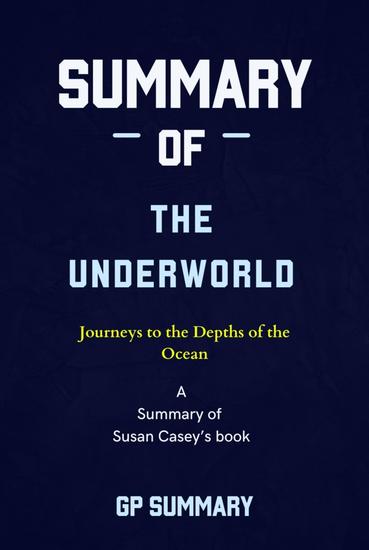
Summary of The Underworld by Susan Casey: Journeys to the Depths of the Ocean - cover

Summary of The Underworld by Susan Casey: Journeys to the Depths of the Ocean

GP SUMMARY

Publisher: BookRix

  • 0
  • 0
  • 0

Summary

DISCLAIMER
 
This book does not in any capacity mean to replace the original book but to serve as a vast summary of the original book.
 
Summary of The Underworld by Susan Casey: Journeys to the Depths of the Ocean
 
IN THIS SUMMARIZED BOOK, YOU WILL GET:

- Chapter astute outline of the main contents.
- Fast & simple understanding of the content analysis.
- Exceptionally summarized content that you may skip in the original book 
The Underworld is a captivating book by Susan Casey, a bestselling author of The Soul of an Octopus. The book explores the mysterious world beneath the waves and the men and women who seek to uncover its secrets. The deep ocean has been a source of wonder and terror for centuries, but cutting-edge technologies have allowed scientists and explorers to dive miles beneath the surface. The underwater world is home to pink gelatinous predators, shimmering creatures, ancient animals with glass skeletons, and sharks that live for half a millennium. Casey's journey takes readers on a fascinating journey through the history of deep-sea exploration, from myths and legends to storied shipwrecks and the first intrepid bathysphere pilots. The book emphasizes the importance of understanding the deep ocean's complexity and ecological importance in a time of increasing threats from climate change, industrial fishing, pollution, and mining companies.
Available since: 08/13/2023.
Print length: 73 pages.
Other books that might interest you

  • Hebrews - The World English Bible Book 58 (Unabridged) - cover

    Hebrews - The World English...

    Various Authors

    • 0
    • 0
    • 0
    Hebrews is one of the books of the New Testament. The text does not mention the name of its author, but was traditionally attributed to Paul the Apostle. Most of the Ancient Greek manuscripts, the Old Syriac Peshitto and some of the Old Latin manuscripts have the epistle to the Hebrews among Paul's letters.
    Show book
  • Fewer Rules Better People - The Case for Discretion - cover

    Fewer Rules Better People - The...

    Barry Lam

    • 0
    • 0
    • 0
    A philosopher argues that the proliferation of rules and mandates is making us dumber, less moral, more deceptive, and less able to govern important institutions. 


    Wherever there's a rule, there is someone with the power to apply or ignore it—or add to it, in the interest of justice. From enforcing chores to issuing life sentences, decision-makers deliver flawed and sometimes arbitrary outcomes. But is their use of discretion good or bad overall? As a society, should we seek to minimize or maximize discretion, with all its potential for bias and other kinds of human error? 


    Reframing our understanding of justice and ethics, philosopher Barry Lam argues that while use of discretion—whether by a sports referee, a parent, a police officer, or a judge—can never be perfect, removing it has even more problematic effects. Mandatory arrests and sentencing laws have not eliminated bias, but have corrupted the courtroom, institutionalized lying, and brought about even more unjust and arbitrary results. Fewer Rules, Better People is a bold, riveting treatise that sheds new light on political debates about law and justice while aiming to prepare us for the imminent threat of more "perfect," discretion-less rule enforcement by AI.
    Show book
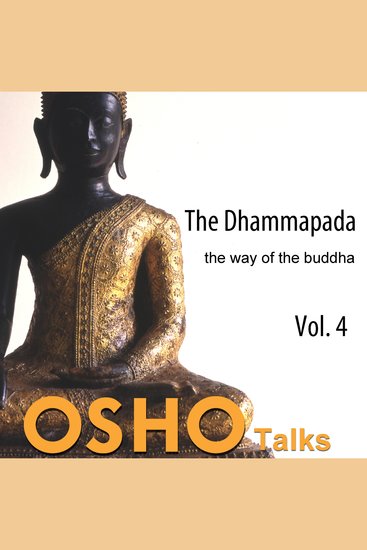
  • The Dhammapada Vol 4 - The Way of the Buddha - cover

    The Dhammapada Vol 4 - The Way...

    Osho

    • 0
    • 0
    • 0
    The Dhammapada is a collection of sayings of the Gautama the Buddha in verse form and one of the most widely read and best known Buddhist scriptures. This is volume four of a 12-volume series of Osho Talks, where Osho brings Buddha's Dhammapada into the 21st century, opening them for a new understanding for contemporary mankind.
    In alternating chapters, Osho comments on specific sutras of Buddha and responds to questions from his audience, deepening the understanding of these timeless works. "My talking on Buddha is not just a commentary: It is creating a bridge. Buddha is one of the most important masters who has ever existed on the Earth - incomparable, unique."
    The setting of these talks is an open-air auditorium at the Osho International Meditation Resort in Pune, India. Osho and his audience sit surrounded by trees, and the elements of nature - the chirping of birds, wind, and the cracking bamboos as well as the distant sound of the local Pune-Mumbai morning train - are all parts of these recordings and give them a truly existential flavor.
    Osho employs his penetrating insight and wonderful humor to remove the dust of many misunderstandings gathered on Buddha's teachings and again emphasizes meditation over dogma, meditation being Buddha's greatest contribution to the development of human consciousness.
    "Buddha transformed the word meditation. Meditation had always been something of the mind, and Buddha brought a new quality, so totally new, diametrically opposite to the old meaning: He said meditation means a state of no mind. It is not concentration; it is not contemplation. It is not thinking; it is not thinking about God. It is not even prayer, because thinking is of the head, intellectual; prayer is emotional. That is another side of the head, not very far away from it - a different language used by another part of the head."
    Osho Talks are "meditating talks", allowing the listener an experience of meditation. "These words of Buddha come from eternal silence. They can reach you only if you receive them in silence."
    Chapters:
    
    - Better than a Hundred Years
    - The Highest Flower of Creativity
    - There Is No Hell
    - Truth Is Always Very Simple
    - Dust Thrown against the Wind
    - The Great Gift of Life
    - See Yourself in Others
    - The Ultimate Luxury
    - Awake to the Law
    - Aes Dhammo Sanantano
    © & ℗ 1979 OSHO International Foundation
    Show book
  • The russian art of war How the West led Ukraine to defeat - cover

    The russian art of war How the...

    Jacques Baud

    • 0
    • 0
    • 0
    Why did Ukraine lose the war against Russia? How do the two sides think and conduct their operations? What mistakes were made on both sides? How did the West contribute to Ukraine's defeat? 
    To answer these questions and many others, Jacques Baud draws on official information, American, Western and Russian documents that analyse Russian (and Soviet) strategies and tactics over the last 50 years. He explains how Russia understands and conducts war, and shows how our ignorance of this reality has pushed Ukraine towards defeat. 
    This audiobook is read by a synthesized voice.
    
    Jacques Baud was a member of Swiss strategic intelligence, a specialist in Eastern Europe and former head of doctrine for UN peacekeeping operations. During the Cold War, he worked on Soviet military art and the war in Afghanistan. Within NATO, he was involved in programs in Ukraine, notably after the 2014 Maïdan revolution. In addition to his major works on the conflict in Ukraine, he is the author of several books on intelligence, war and terrorism, including Governing by Fake News, Defeating Jihadist Terrorism and The Navalny Case, all published by Max Milo.
    Show book
  • Summary of Beyond Order - 12 More Rules for Life by Jordan B Peterson: Key Takeaways Summary & Analysis - cover

    Summary of Beyond Order - 12...

    Brooks Bryant

    • 0
    • 0
    • 0
    DISCLAIMER: THIS IS NOT THE OFFICIAL BOOK. 
    This is a summary, & it does not accompany the official 
    In "Beyond Order" by Jordan B. Peterson, the acclaimed clinical psychologist and professor follows up on the success of his previous book, "12 Rules for Life," by presenting an additional 12 principles aimed at helping readers navigate the complexities of life. Peterson addresses the growing tendency of the human will to exert control over every aspect of existence, warning against the dangers of excessive security. He offers strategies to counteract cultural, scientific, and psychological forces pushing society toward tyranny. Instead, he encourages readers to tap into their instinctual capacity to find meaning and purpose, particularly in moments of powerlessness. 
    While an overabundance of chaos can lead to instability and anxiety, unchecked order can stifle individuality and submission. "Beyond Order" serves as a guide to striking a balance between these two fundamental aspects of reality, providing a path toward a more meaningful and fulfilling life. Jordan B. Peterson's book invites readers to explore the delicate equilibrium between order and chaos in the pursuit of personal growth and well-being.
    Show book
  • Today's Authors Series: Author and Entrepreneur Bo Peabody - Today's Authors Series - cover

    Today's Authors Series: Author...

    Bo Peabody

    • 0
    • 0
    • 0
    Listen as Bo Peabody, author of "Lucky or Smart?" and entrepreneur extraordinaire, discuss the businesses he started, how he was able to make them successful, and the place that intelligence, hard work and a little bit of good fortune have in the process. As Bo explains: “My formula for getting lucky in business is reasonably simple: Start a company that fundamentally innovative, morally compelling, and philosophically positive. Create and aura of authenticity around your start-up by carefully crafting your mission and communicating it with charisma and passion. Our company will quickly attract smart, inspired people who will work very hard. Treat all these people fairly. Provide them with a clear action plan and give them the latitude to exercise their creativity. The result: serendipity, luck, success, and, ultimately, money. And the only smart thing about this formula is that I understand that on a day-to-day basis my brain has very little to do with any of it.”
    Show book