Join us on a literary world trip!
Add this book to bookshelf
Grey
Write a new comment Default profile 50px
Grey
Subscribe to read the full book or read the first pages for free!
All characters reduced
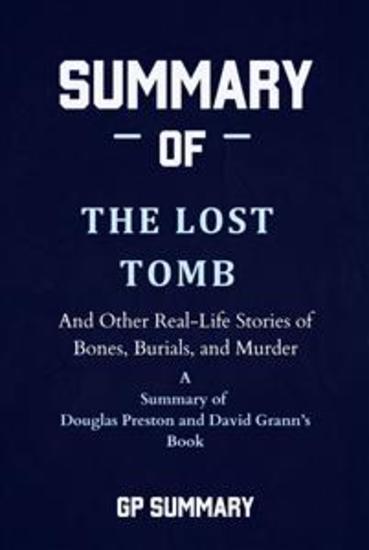
Summary of The Lost Tomb by Douglas Preston and David Grann - And Other Real-Life Stories of Bones Burials and Murder - cover

Summary of The Lost Tomb by Douglas Preston and David Grann - And Other Real-Life Stories of Bones Burials and Murder

GP SUMMARY

Publisher: BookRix

  • 0
  • 1
  • 0

Summary

DISCLAIMERThis book does not in any capacity mean to replace the original book but to serve as a vast summary of the original book. 
Summary of The Lost Tomb by Douglas Preston and David Grann: And Other Real-Life Stories of Bones, Burials, and Murder 
  
IN THIS SUMMARIZED BOOK, YOU WILL GET:- Chapter astute outline of the main contents.- Fast & simple understanding of the content analysis.- Exceptionally summarized content that you may skip in the original book 
Douglas Preston, the #1 bestselling author of The Lost City of the Monkey God, shares the discovery of an Egyptian tomb with dozens of sealed burial chambers. The tomb reveals tales of pirate treasure, mysterious deaths, and archaeological mysteries. Preston's journalistic explorations have taken him to Honduran jungles, American Southwest archaeological sites, and Italy's haunted hills. The Lost Tomb offers a compelling collection of true stories about buried treasure, enigmatic murders, lost tombs, and other fascinating stories.
Available since: 12/21/2023.
Print length: 79 pages.
Other books that might interest you

  • Brazilian History - From Colonization to Independence - Understanding the History of Brazil - cover

    Brazilian History - From...

    Will Forrest

    • 0
    • 0
    • 0
    In the hot, steamy world of Brazil's history, secrets lurk around every corner, and the ghosts of the past still haunt the present. Our latest book is an exploration of Brazil's rich and complex history, a story of love and loss, triumph and tragedy. 
    Through the pages of this gripping narrative, you will discover:A rich and layered portrait of Brazil's history and culture. This book captures the essence of Brazil and its people.A nuanced and detailed analysis of the political and social forces that shaped Brazil's history. From the struggles of the indigenous peoples to the rise and fall of the Portuguese empire, this book offers a comprehensive and detailed account of the events that shaped Brazil's unique identity. 
    So enter the world of Brazil's history, and discover a story that will linger with you long after the final page has been turned. 
    Buy this audiobook!
    Show book
  • Urban Poverty and Inequality - Analysis and Solutions - cover

    Urban Poverty and Inequality -...

    Lyric Vale

    • 0
    • 0
    • 0
    Urban poverty is a pervasive issue that affects millions of people living in cities worldwide. As cities continue to grow at an unprecedented rate, the number of urban poor continues to rise, with large portions of the population living in conditions of extreme deprivation. The term "urban poverty" refers to the situation where individuals and families in urban areas experience a lack of access to basic resources, such as adequate housing, healthcare, education, and employment opportunities. Despite being situated in areas of economic activity and growth, urban poor populations face numerous challenges that contribute to their ongoing struggle for survival and upward mobility. 
    The growth of cities and urban centers has been accompanied by an increasing divide between the wealthy and the poor. While urban areas are often seen as hubs of opportunity, economic growth, and development, they also tend to highlight social and economic inequalities. Rapid urbanization, coupled with limited resources, leads to overcrowded slums, informal settlements, and a lack of infrastructure in many parts of cities. In such environments, the poor face challenges such as high unemployment rates, limited access to education, and poor healthcare services. These conditions create a cycle of poverty that is difficult to escape. 
    In addition, the urban poor are often excluded from key economic and social systems that would help alleviate their poverty. The concentration of wealth in urban centers disproportionately benefits the middle and upper classes, while marginalized communities remain on the periphery, unable to fully participate in the economic, political, and social life of the city. This growing inequality between different social classes exacerbates poverty and leaves the urban poor trapped in a cycle of disadvantage.
    Show book
  • The American Revolution and French Revolution - The History of the Revolutions that Reshaped the West in the 18th Century - cover

    The American Revolution and...

    Charles River Editors

    • 0
    • 0
    • 0
    The American Revolution is replete with seminal moments that every American learns in school, from the “shot heard ‘round the world” to the Declaration of Independence, but the events that led up to the fighting at Lexington & Concord were borne out of 10 years of division between the British and their American colonies over everything from colonial representation in governments to taxation, the nature of searches, and the quartering of British regulars in private houses. From 1764-1775, a chain of events that included lightning rods like the Townshend Acts led to bloodshed in the form of the Boston Massacre, while the Boston Tea Party became a symbol of nonviolent protest.  
    	The political and military nature of the Revolutionary War was just as full of intrigue. While disorganized militias fought the Battles of Lexington & Concord, George Washington would lead the Continental Army in the field while men like Thomas Jefferson drafted the Declaration of Independence in Philadelphia and Benjamin Franklin negotiated overseas in France. Benedict Arnold would become one of his nation’s most vital war heroes and its most notorious traitor, French forces would play a crucial role at the end of the war, and the Treaty of Paris would conclude the Revolution with one last great surprise.  
    	The early years of the French Revolution were fueled by Enlightenment ideals, seeking the social overthrow of the caste system that gave the royalty and aristocracy decisive advantages over the lower classes. But history remembers the French Revolution in a starkly different way, as the same leaders who sought a more democratic system while out of power devolved into establishing an incredibly repressive tyranny of their own once they acquired it.  
    The height of Republican France’s tyranny came during a 10-month period forever known as the Reign of Terror, the most notorious and arguably most memorable part of the French Revolution.
    Show book
  • The Seventh Sense - The Secrets of Remote Viewing as Told by a "Psychic Spy" for the US Military - cover

    The Seventh Sense - The Secrets...

    Lyn Buchanan, Jim Marrs

    • 0
    • 0
    • 0
    For the past thirty years, the United States government has secretly trained a select corps of military personnel in the art of "remote viewing"—the psychic ability to perceive the thoughts and experiences of others through the power of the human mind . . . 


    Now, for the first time, Lyn Buchanan—a world-renowned expert on remote viewing and its potential—tells the complete, candid story of his experiences. Assigned for nearly a decade to a clandestine US Army intelligence group, Buchanan trained military personnel who utilized their inherent psychic abilities as a data-collection tool during the Iran hostage crisis, the Chernobyl disaster, and the Gulf War. 


    In this incredible account, Buchanan tells how he was selected for his unique psychic abilities, and how he was transformed from an ordinary soldier into one of our nation's leading psychic spies. Working on top-secret government and military projects using "mental espionage" created permanent, life-altering changes within Buchanan. Now, after many years of analysis and interpretation, he reveals the techniques and mental exercises used to train remote viewers, and demonstrates that each of us carries a dormant psychic ability that we can explore and use ourselves.
    Show book
  • The Extinction of Experience - Being Human in a Disembodied World - cover

    The Extinction of Experience -...

    Christine Rosen

    • 0
    • 0
    • 0
    A reflective, original invitation to recover and cultivate the human experiences that have atrophied in our virtual world. 


    We embraced the mediated life—from Facetune and Venmo to meme culture and the Metaverse—because these technologies offer novelty and convenience. But they also transform our sense of self and warp the boundaries between virtual and real. What are the costs? Who are we in a disembodied world? 


    In The Extinction of Experience, Christine Rosen investigates the cultural and emotional shifts that accompany our embrace of technology. In warm, philosophical prose, Rosen reveals key human experiences at risk of going extinct, including face-to-face communication, sense of place, authentic emotion, and even boredom. Considering cultural trends, like TikTok challenges and mukbang, and politically unsettling phenomena, like sociometric trackers and online conspiracy culture, Rosen exposes an unprecedented shift in the human condition, one that habituates us to alienation and control. To recover our humanity and come back to the real world, we must reclaim serendipity, community, patience, and risk.
    Show book
  • Anaxagoras - Mind and Cosmos in Ancient Greece - cover

    Anaxagoras - Mind and Cosmos in...

    Hector Davidson

    • 0
    • 0
    • 0
    Anaxagoras of Clazomenae, born around 500 BCE, was a pre-Socratic philosopher whose ideas bridged the gap between the earlier Milesian school and the more developed metaphysical and scientific theories of later Greek philosophy. His life and work significantly influenced subsequent thinkers, including Socrates, Plato, and Aristotle. 
    Early Life and Education: 
    Anaxagoras was born in Clazomenae, a city in Ionia, an area known for its vibrant intellectual culture. His early education exposed him to the philosophies of Thales, Anaximander, and Anaximenes, laying the groundwork for his own philosophical inquiries. He later moved to Athens, where he became a prominent figure in the intellectual circles of the time. 
    Philosophical Innovations: 
    Anaxagoras is best known for his introduction of the concept of Nous (Mind or Intellect), which he posited as the organizing principle of the cosmos. Unlike his predecessors who sought a single material principle as the origin of all things, Anaxagoras argued that the universe is governed by a rational, intelligent principle, Nous, which imparts order and structure to the chaotic flux of matter.
    Show book