Join us on a literary world trip!
Add this book to bookshelf
Grey
Write a new comment Default profile 50px
Grey
Subscribe to read the full book or read the first pages for free!
All characters reduced
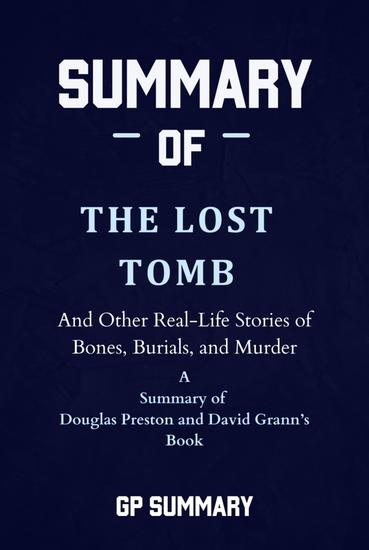
Summary of The Lost Tomb by Douglas Preston and David Grann - And Other Real-Life Stories of Bones Burials and Murder - cover

Summary of The Lost Tomb by Douglas Preston and David Grann - And Other Real-Life Stories of Bones Burials and Murder

GP SUMMARY

Publisher: BookRix

  • 0
  • 0
  • 0

Summary

DISCLAIMER
This book does not in any capacity mean to replace the original book but to serve as a vast summary of the original book.

Summary of The Lost Tomb by Douglas Preston and David Grann: And Other Real-Life Stories of Bones, Burials, and Murder
 
IN THIS SUMMARIZED BOOK, YOU WILL GET:


- - Chapter astute outline of the main contents.
- - Fast & simple understanding of the content analysis.
- - Exceptionally summarized content that you may skip in the original bookDouglas Preston, the #1 bestselling author of The Lost City of the Monkey God, shares the discovery of an Egyptian tomb with dozens of sealed burial chambers. The tomb reveals tales of pirate treasure, mysterious deaths, and archaeological mysteries. Preston's journalistic explorations have taken him to Honduran jungles, American Southwest archaeological sites, and Italy's haunted hills. The Lost Tomb offers a compelling collection of true stories about buried treasure, enigmatic murders, lost tombs, and other fascinating stories.
Available since: 12/08/2023.
Print length: 79 pages.

Other books that might interest you

  • The Women's March on Versailles - Power of the People in the French Revolution - cover

    The Women's March on Versailles...

    Amara Blackwood

    • 0
    • 0
    • 0
    In the years leading up to the French Revolution, tensions across France were steadily rising. The burdens of the common people, particularly those of the Third Estate, had reached unbearable levels. While the nobility and clergy enjoyed privileges and wealth, the vast majority of the population struggled under the weight of excessive taxation and economic instability. The inequalities in French society were stark, fueling resentment that would ultimately ignite revolutionary fervor. 
    One of the most pressing concerns for the people of France was the relentless increase in bread prices. As the primary staple of the French diet, bread was essential for survival, yet by 1789, its cost had soared beyond what many could afford. A series of poor harvests, combined with inflation and a flawed taxation system, meant that working-class families were spending nearly all their income just to feed themselves. Women, who were responsible for feeding their households, were particularly affected. Their desperation grew as they saw their children go hungry, pushing them toward direct action against those they held responsible for their suffering. 
    At the same time, the ideas of the Enlightenment had begun to take hold among the people. Thinkers like Rousseau, Voltaire, and Montesquieu had challenged the foundations of monarchy, divine rule, and social inequality. The belief that sovereignty should rest with the people rather than the king inspired many to question the legitimacy of their rulers. These ideas were not confined to intellectual circles; they spread through pamphlets, newspapers, and public gatherings, reaching even the market women and working-class citizens of Paris. For many, the Enlightenment provided not just a critique of the monarchy, but a vision for a new society built on justice and equality.
    Show book
  • Greatest Indigenous Empires in the Americas The: The History of the Groups that Dominated the Western Hemisphere Before Columbus - cover

    Greatest Indigenous Empires in...

    Editors Charles River

    • 0
    • 0
    • 0
    The Olmec people are widely recognized as the first major civilization of Mexico and are thus generally regarded as the mother civilization of Mesoamerica, making them the people from which all subsequent Mesoamerican cultures derived. In fact, the term Olmec is thought to have originated with the Aztec people, as Olmec in their Nahuatl language means “the rubber people”, a reference to the inhabitants of the land from which they accessed rubber. By and large, the Olmec culture is perhaps best identifiable by their so-called colossal heads, mammoth basalt head-statues wearing helmet-like headdresses found throughout Olmec habitation sites. 
    	From the moment Spanish conquistador Hernan Cortes first found and confronted them, the Aztecs have fascinated the world, and they continue to hold a unique place both culturally and in pop culture. Nearly 500 years after the Spanish conquered their mighty empire, the Aztecs are often remembered today for their major capital, Tenochtitlan, as well as being fierce conquerors of the Valley of Mexico who often engaged in human sacrifice rituals. Ironically, and unlike the Mayans, the Aztecs are not widely viewed or remembered with nuance, in part because their own leader burned extant Aztec writings and rewrote a mythologized history explaining his empire’s dominance less than a century before the Spanish arrived.  
    	While scholars continue to debate whether the Toltec were an actual historical group, there is an added layer of mystery to the fact that the settlement at Tula has a lot in common with the famous Mayan settlement at Chichén Itzá. The architecture and art at both sites are so similar that archaeologists and anthropologists have assumed they had the same cultural influences, even as historians struggle to determine the historical timelines, and thus whether Tula influenced Chichén Itzá or vice versa. 
    Show book
  • Kiss You Love Goodbye - a poetic journey through life - cover

    Kiss You Love Goodbye - a poetic...

    Wendy Haller

    • 0
    • 0
    • 0
    We evolve. As human beings, through the different stages of our lives, we evolve into different versions of ourselves until we get to an age, where we know who we are meant to be. Kiss you love, goodbye the author explores the complexities of adulthood and all of the inner thoughts we have about ourselves and our experiences. Themes of self-discovery, family dynamics, love, loss, trauma, grief, anxiety, depression, healing, and personal growth. The poems in this book span over 30 years of the author's life from her early college years of "Who am I?" to her late 40's of "This is who I am".
    Show book
  • Ending Human Trafficking - A Handbook of Strategies for the Church Today - cover

    Ending Human Trafficking - A...

    Shayne Moore, Sandra Morgan,...

    • 0
    • 0
    • 0
    Author Sandra Morgan awarded Wilberforce Award
    Human trafficking is one of the most pressing social justice issues of our time, and in recent years there has been renewed interest among Christians, as many have been stirred up to take their part in the ongoing battle.
    This is a wonderful thing—and yet misinformed and misguided efforts can do more harm than good. Ending Human Trafficking is a handbook designed to educate churches and parachurch organizations for truly effective work.
    In collaboration with The Global Center for Women and Justice at Vanguard University, Ending Human Trafficking is an accessible and compelling resource for Christian leaders, written by seasoned leaders in the struggle against modern slavery. Grounded in a theological response to the issue and filled with stories, up-to-date data, and practical tools and tips, it promises to be an invaluable resource for years to come.
    Show book
  • Aura Reading: How to Read Auras Perform Cleansing Rituals and Safeguard Your and Other People’s Energy - cover

    Aura Reading: How to Read Auras...

    Silvia Hill

    • 0
    • 0
    • 0
    Unlock the Power of Aura Reading – Discover Energy Fields and Protect Your Peace 
    Are you curious about reading auras and using them to transform your energy and protect yourself? Imagine knowing the energy around you and understanding how it affects your life every day. This audiobook is your guide to uncovering what auras reveal about people, animals, plants – and even yourself. 
    Does This Sound Like You?You feel drained after being around certain people and wish you knew how to protect yourself.You’re curious about why some people give off “good vibes” while others make you uneasy.You want to start a healing journey and use auras for spiritual growth and emotional health. 
    Here’s the problem: Without a guide, it’s tough to learn how to read and interpret auras accurately. And without protection techniques, harmful energies can linger and drain your peace. 
    The Solution is Here: This audiobook breaks down every step – from seeing auras to understanding their colors, shapes, and meanings. You’ll learn how to see your own aura, read others’, and keep your energy safe. 
    Inside You’ll Find:The Basics of Auras: Discover what an aura is, why it matters, and how it influences daily life.See Your Own Aura: Easy techniques to help you see and feel your energy field.Read Auras of People, Plants, and Animals: Learn to see the energy fields of loved ones, pets, and even plants.Aura Meanings & Colors: Find out what aura shapes, textures, and colors reveal about feelings, health, and personality. 
    Begin your journey into aura reading and energy protection – click “Add to Cart” now to get started!
    Show book
  • The Ending of Psychological Knowledge - Brockwood Park 1980 - Dialogue 9 - cover

    The Ending of Psychological...

    Jiddu Krishnamurti

    • 0
    • 0
    • 0
    The roots of psychological conflict. 1 April 1980. Has humanity taken a wrong turn?What is the root of this tremendous inward conflict of humanity?When I am trying to become something, it is a constant battle.Can the brain itself see that it is caught in time and as long as it is moving in that direction conflict is eternal, endless?Can the mind realise, resolve a psychological problem immediately?
    Show book