Join us on a literary world trip!
Add this book to bookshelf
Grey
Write a new comment Default profile 50px
Grey
Subscribe to read the full book or read the first pages for free!
All characters reduced
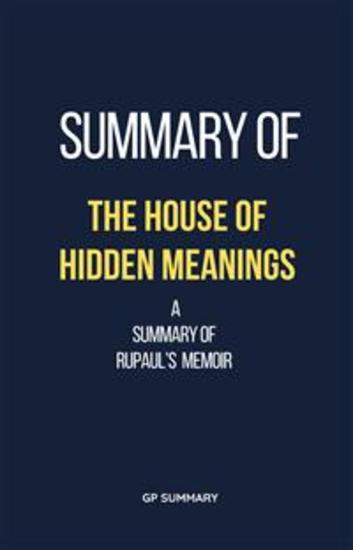
Summary of The House of Hidden Meanings a Summary of RuPaul’s memoir - cover

Summary of The House of Hidden Meanings a Summary of RuPaul’s memoir

GP SUMMARY

Publisher: BookRix

  • 0
  • 0
  • 0

Summary

DISCLAIMER

This book does not in any capacity mean to replace the original book but to serve as a vast summary of the original book.

Summary of Burn Book by Kara Swisher: A Tech Love Story

IN THIS SUMMARIZED BOOK, YOU WILL GET:

	Chapter provides an astute outline of the main contents.
	Fast & simple understanding of the content analysis.
	Exceptionally summarized content that you may skip in the original book

RuPaul Andre Charles' memoir, The House of Hidden Meanings, is a deeply personal and honest exploration of his life, relationships, and identity. The memoir, which is his most intimate work yet, is a self-portrait of the legendary drag icon, who has become a global icon and changed the way the world thinks about drag. RuPaul's adaptability has made him enigmatic to the public, but in The House of Hidden Meanings, he strips away all artifice and recounts his life with clarity and tenderness. The memoir serves as a manual for living, testifying to the value of chosen family, harnessing what makes you different, and the transformational power of facing yourself fearlessly.
Available since: 03/06/2024.
Print length: 50 pages.
Other books that might interest you

  • Dangerous Jokes - How Racism and Sexism Weaponize Humor - cover

    Dangerous Jokes - How Racism and...

    Claire Horisk

    • 0
    • 0
    • 0
    People often get away with belittling others if they frame their speech as jokes—speech that would be condemned if stated seriously. "It's just a joke," they say. But what is different or special about joking? And if jokes about lawyers and politicians are morally acceptable, then what is wrong with joking about race or gender? Furthermore, if we may joke about a politician's shirts, may we joke about his weight? People who are targeted by demeaning jokes feel their impact but may not be able to pinpoint where the harm lies. 


    Dangerous Jokes develops a novel, well-researched, and compelling argument that lays bare the power of demeaning jokes in ordinary conversations. Claire Horisk draws on her expertise in philosophy of language and on evidence from sociology, law, and cognitive science to explain how the element of humor—so often used as a defense—makes jokes more potent than regular speech in communicating prejudice and reinforcing social hierarchies. She addresses the morality of telling, being amused by, and laughing at, derogatory jokes, and she gives a new account of listening that addresses the morality of listening to demeaning speech. She leaves us with no illusions about whether "it's just a joke" is an excuse for demeaning humor.
    Show book
  • OCME - Life in America's Top Forensic Medical Center - cover

    OCME - Life in America's Top...

    Bruce Goldfarb

    • 0
    • 0
    • 0
    Bruce Goldfarb spent ten years with Maryland's Office of the Chief Medical Examiner, where every sudden or unattended death in the state is scrutinized. 


    Touching on numerous scandals, including Derek Chauvin's trial for the murder of George Floyd and the tragic killing in police custody of Freddie Gray, Goldfarb pulls back the curtain on a pioneer institution in crisis. 


    Medical examiners and the investigators and technicians who support them play vital roles in the justice and public health systems of every American community. During Goldfarb's time with the Maryland OCME, opioid-related deaths contributed to a significant increase in their workload. Faced with a chronic shortage of qualified experts and inadequate funding, their important and fascinating work has become more challenging than most people could ever imagine. 


    The public gets a skewed view of the relationship between police and medical examiners from procedural crime dramas, Bruce Goldfarb writes of his work inside one of America's most storied forensic centers. We aren't on the same team . . . We aren't on any team. The medical examiner’s sole duty is to the deceased person. We speak for the dead.
    Show book
  • Conspiracy - History’s Greatest Plots Collusions and Cover-Ups - cover

    Conspiracy - History’s Greatest...

    Charlotte Greig

    • 0
    • 0
    • 0
    22 November 1963: Dallas, Texas. US President John F Kennedy is assassinated as his motorcade passes through the city's streets. The assassin is soon captured, and revealed to be disaffected Communist sympathizer Lee Harvey Oswald. Did Oswald act alone, or did he have help? Is the Bilderberg Group simply a group of international financiers concerned with promoting democracy throughout the world, or is there a more sinister power at work? And what really happened to Princess Diana's Mercedes one warm August night in a Paris underpass? 
     
    Conspiracy looks at a range of the most interesting theories of this nature, from the risibly far-fetched, such as the belief that the world is run by the lizard people, to the only-too-true and tragic such as the overthrow and murder of Chilean President Salvador Allende.
    Show book
  • Neuropsychology - cover

    Neuropsychology

    Miguel Vaquero

    • 0
    • 0
    • 0
    This book contains two topics, which are the following:1 - Memory Improvement: The ability for the brain to encode, store, and recall information is known as memory. Experience serves as a roadmap for future action.Memory includes both consciously recalled facts and experienced details as well as deeply embedded knowledge that pops up without thought or even awareness. It serves as both a temporary information storage space and a more lasting record of what has been learned.2 - The study of the anatomy and operation of the nervous system and the brain is known as neuroscience. To map the brain mechanistically, neuroscientists draw on cellular and molecular biology, anatomy and physiology, human behavior and cognition, and other fields.Each neuron, or brain cell, in an adult human has an estimated 100 billion connections to other neurons. The mapping of all the cell-to-cell communication networks—the brain circuits that process all ideas, feelings, and behaviors—remains one of the major difficulties of contemporary neuroscience. The resulting image that gradually forms is referred described as "the connectome." All learning is based on the brain's capacity to build new neural circuits and connections, or neuroplasticity.
    Show book
  • Ancient Mesopotamia: A Captivating Introduction to the Rise and Fall of Mesopotamian Civilizations and Empires - cover

    Ancient Mesopotamia: A...

    Captivating History

    • 0
    • 0
    • 0
    Did you know that the first early battery and diving apparatus were invented in ancient Mesopotamia?  
    The land between the Tigris and Euphrates Rivers is called the “cradle of civilization,” and for good reason! Although Mesopotamia’s first civilization, Sumer, developed parallel with those of Egypt and nearby Elam, it was a place of many firsts for humanity. Some of them are well known, such as the wheel and the writing script. But it was the ancient Mesopotamians who first came up with the concept of time, the mathematical sexagesimal system, and a calendar with twelve months. It is all these inventions and ideas that set Mesopotamia apart from other civilizations that developed at approximately the same time.  
    There are so many interesting facts about the history and life of the people in Mesopotamia. By listening to this audiobook, you will find out:How agriculture and the domestication of animals led to the development of the world’s earliest civilizationWho were the peoples that occupied the region of Mesopotamia and came up with epics such as Gilgamesh?Who was Sargon of Akkad, and how did he rise to power to unite the cities and form one of the world’s first empires?How the first cuneiform script was invented and how it changed over time to fit the many languages spoken in the Akkadian EmpireWhy a new local ruler was needed to found the Third Dynasty of UrWho was Hammurabi, and why was he so important for the history of humankind?Why was Babylon obscured by Assyria?What role the Chaldeans played in the Assyrian EmpireAnd so much more! 
    Scroll up and click the “add to cart” button today to learn more about this incredible time in history!
    Show book
  • The Radical Mind - The Origins of Right-Wing Catholic and Protestant Coalition Building - cover

    The Radical Mind - The Origins...

    Chelsea Ebin

    • 0
    • 0
    • 0
    The Radical Mind is a groundbreaking analysis of the origins of the Christian Right, whose political victories are radically reshaping the landscape of American society. Scholars and the public alike have traditionally regarded the New Right and the Christian Right as separate movements. Insofar as both are conservative efforts, most people view them as reactionary and driven by a culture-war backlash against liberal changes to society. 


    Chelsea Ebin's The Radical Mind aims to overturn this consensus. Through a close analysis of New Right architects Connaught Marshner and Paul Weyrich (who is often seen as secular but was a committed Catholic), this book explores the way conservative Catholics and Protestants overcame their long-standing antipathy to form a political coalition—what Ebin calls the New Christian Right. Drawing on extensive archival research, Ebin shows how the movement’s key architects infused right-wing activism with religion. 


    The radical aims of the New Christian Right have been obscured by the way they cultivated a shared identity of victimhood and manipulated the discourse about backlash to create a nostalgic idea of the past that they then leveraged to justify their right-wing policy goals. The Catholic-Protestant alliance constructed an imagined past that they projected into the future as their ideal vision of society. Ebin calls this strategy "prefigurative traditionalism"—a paradoxical prefiguring of a manufactured past. Using this tactic, the New Christian Right coalition disguised the radicality of its politics by framing their aims as reactionary and defensive rather than proactive and offensive.
    Show book