Join us on a literary world trip!
Add this book to bookshelf
Grey
Write a new comment Default profile 50px
Grey
Subscribe to read the full book or read the first pages for free!
All characters reduced
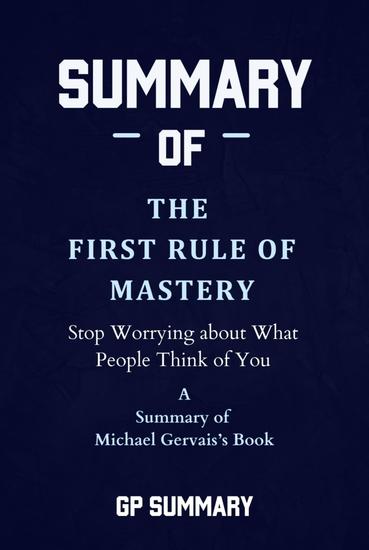
Summary of The First Rule of Mastery by Michael Gervais - Stop Worrying about What People Think of You - cover

Summary of The First Rule of Mastery by Michael Gervais - Stop Worrying about What People Think of You

GP SUMMARY

Publisher: BookRix

  • 0
  • 0
  • 0

Summary

DISCLAIMER
 
This book does not in any capacity mean to replace the original book but to serve as a vast summary of the original book.
 
Summary of The First Rule of Mastery by Michael Gervais: Stop Worrying about What People Think of You
 
IN THIS SUMMARIZED BOOK, YOU WILL GET:
 

- Chapter astute outline of the main contents.
- Fast & simple understanding of the content analysis.
- Exceptionally summarized content that you may skip in the original book 
 
Michael Gervais' The First Rule of Mastery offers a guide to overcome fear of people's opinions (FOPO), which can limit human potential. Gervais teaches mental skills and practices to top performers, including sports MVPs, artists, and Fortune 100 leaders. He warns that when we prioritize FOPO over our own, we live life on their terms, not our own. The book is filled with stories from sports, business, science, and human performance.
Available since: 11/08/2023.
Print length: 43 pages.

Other books that might interest you

  • How Reason Can Lead to God - A Philosopher's Bridge to Faith - cover

    How Reason Can Lead to God - A...

    Joshua Rasmussen

    • 0
    • 0
    • 0
    Do you seek the truth? 


    Do you value reason, science, and independent thinking? Are you skeptical of beliefs that people maintain merely "on faith," yet you remain interested in the big questions of life? Do you hope there could be a greater purpose to the universe, if only that were realistic? 


    If so, then philosopher Joshua Rasmussen can encourage you in your journey. Beginning with his own story of losing faith and the belief in any ultimate purpose in life, he then builds a bridge to a series of universal truths about ultimate reality. Using only the instruments of reason and common experience, Rasmussen constructs a pathway—step by step, brick by brick—that he argues can lead to meaning and, ultimately, a vision of God.
    Show book
  • Battle of White Mountain The: The History and Legacy of the First Major Battle of the Thirty Years’ War - cover

    Battle of White Mountain The:...

    Editors Charles River

    • 0
    • 0
    • 0
    It has been famously pointed out that the Holy Roman Empire was neither holy, nor Roman, but it was also not an empire in the sense people expect when hearing the term. In theory, the emperor was the highest prince in Christendom, and his dominion extended the length and breadth of Western Europe. The tensions between the Holy Roman Empire and Church over the power to invest bishops with authority led to decades of civil war in Germany on the way to establishing the relationship between Church and State, elevating the status of the papacy and weakening the Holy Roman Empire. 
    	The Thirty Years' War was one of the most horrific conflicts in history, resulting in the deaths of nearly two-thirds of Germany's population, and the Battle of White Mountain in 1620 was the first major battle of that war. The battle was fought mainly due to Holy Roman Emperor Ferdinand II’s dealings with the Bohemians and their new king, Frederick of the Palatinate, who Ferdinand regarded as illegitimate. It was also partly a struggle between the centralizing attempts of the Habsburg dynasty conflicting with the traditional regional autonomy that existed within the legislative institutions called the Estates. What gave it an emotional element was the enmity between Bohemian Protestantism and Ferdinand II’s zealous Catholicism, and that would help draw in several European powers. At the Battle of White Mountain, the armies of the Bohemian Confederation and the Habsburgs met each other near Prague, and the combatants included officers and soldiers from nearly every nation in Europe, including the Netherlands, Germany, Italy, Poland, Bohemia, Moravia, Bavaria, Italy, Spain, Hungary, Transylvania, England, Scotland, and Ireland. The decisive result would permanently affect the course of the conflict over the coming decades, and with it the fate of modern Europe. 
    Show book
  • A History of the Modern World - From 1950 to the Present Day - cover

    A History of the Modern World -...

    Jeremy Black

    • 0
    • 0
    • 0
    In this masterful account, Jeremy Black explores the key themes that have shaped the history of the modern world since 1950. Eschewing a simple political narrative, he instead explores the roles of the environment, demographics, the economy and technology in driving change in the world. 
     
    The story begins in 1950, by which time a new world order had come into place, with Communism firmly established in Russia, Eastern Europe and China, decolonisation well underway in the old European empires, and the American monopoly on nuclear weaponry at an end, setting the stage for the Cold War. 
     
    Over the course of the next 75 years, the world changed immeasurably - the population nearly tripled; climate change became ever more pronounced; new liberal values regarding gender, sexuality and age took hold; television and then the internet became the primary drivers of culture; and a new frontier of exploration opened up in space. At the same time tensions continued in politics, with alternative models of democracy and authoritarianism coming into fierce conflict and a range of new countries emerging through decolonization. 
     
    Ranging widely across the globe, A History of the World  sheds new light on this fascinating era.
    Show book
  • Jihad and Genocide - cover

    Jihad and Genocide

    Richard L. Rubenstein

    • 0
    • 0
    • 0
    A study of Islamic fundamentalism, its violent and deadly history, and the questions it raises today. This book examines the relationship between jihad and genocide, past and present. Richard L. Rubenstein takes a close look at the violent interpretations of jihad and how they have played out in the past hundred years, from the Armenian genocide through current threats to Israel. Rubenstein’s unflinching study of the potential for fundamentalist jihad to initiate targeted violence raises pressing questions in a time when questions of religious co-existence, particularly in the Middle East, are discussed urgently each day. Praise for Jihad and Genocide“Provocative, important reading for all interested in Arab-Israeli peace and religious coexistence worldwide. Highly recommended.” —Choice Reviews“Rubenstein’s analysis stands the test of time. Thus, attention must be paid to Rubenstein's new work, Jihad and Genocide, which offers a searing analysis of Islamic thought and bleak predictions of its impact. Even those of us who do not share his pessimism, his sense of the inevitability of the path to genocide and war, or his predilection for the political right, must confront the issues he raises.” —Foreword Reviews
    Show book
  • Muhammad: A short biography - 5 Minutes: Short on time – long on info! - cover

    Muhammad: A short biography - 5...

    5 Minutes, 5 Minute Biographies,...

    • 0
    • 0
    • 0
    Muhammad, warrior, prophet, and founder of a religion: Life and work in a short biography! Everything you need to know, brief and concise. Infotainment, education and entertainment at its best!
    Show book
  • Determinism - Fate Coincidence and the Question of Free Will - cover

    Determinism - Fate Coincidence...

    Hector Davidson

    • 0
    • 0
    • 0
    The question of whether humans possess free will has intrigued philosophers, scientists, and thinkers for centuries. At the heart of this debate lies the concept of determinism—the idea that every event or action is the result of preceding causes, governed by laws of nature and logic. If everything that happens is the result of a cause, can we truly say we have control over our decisions? Is free will simply an illusion? These questions challenge our sense of autonomy and personal responsibility, and they invite us to explore the complex relationship between fate, coincidence, and choice. 
    Determinism suggests that all events, including human actions, are preordained by prior causes. From a deterministic standpoint, the universe is a vast, interconnected web of cause and effect, where each moment flows seamlessly from the one before it. This view raises profound questions about the nature of human agency. If every decision we make, every thought we have, and every action we take is determined by a series of preceding events—genetic, environmental, and even cosmic—where does the space for free will lie? Are we merely puppets of fate, our strings pulled by forces beyond our control? 
    However, this deterministic view is not universally accepted. Many philosophers argue that humans can exercise free will—that we have the capacity to make choices independent of the deterministic forces at play. This belief in free will asserts that while factors such as genetics, upbringing, and circumstances may influence our decisions, we retain the ability to act in ways that transcend these influences. The challenge, then, is reconciling the possibility of free will with the idea that many of our actions may be shaped or even constrained by forces outside our conscious control.
    Show book