Join us on a literary world trip!
Add this book to bookshelf
Grey
Write a new comment Default profile 50px
Grey
Subscribe to read the full book or read the first pages for free!
All characters reduced
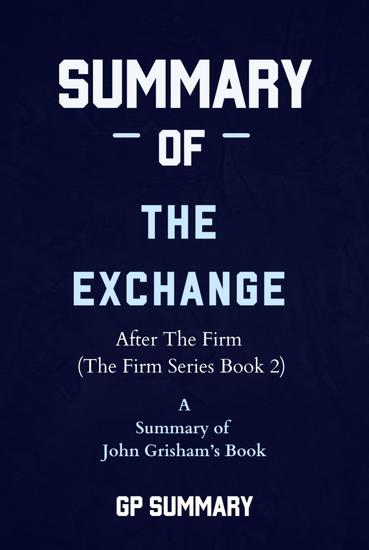
Summary of The Exchange by John Grisham: After The Firm (The Firm Series) - cover

Summary of The Exchange by John Grisham: After The Firm (The Firm Series)

GP SUMMARY

Publisher: BookRix

  • 0
  • 0
  • 0

Summary

DISCLAIMER
 
This book does not in any capacity mean to replace the original book but to serve as a vast summary of the original book.
 
Summary of The Exchange by John Grisham: After The Firm (The Firm Series)
 
IN THIS SUMMARIZED BOOK, YOU WILL GET:
 

- Chapter astute outline of the main contents.
- Fast & simple understanding of the content analysis.
- Exceptionally summarized content that you may skip in the original book 
John Grisham's The Exchange is a thrilling legal thriller that follows Mitch McDeere, the hero of The Firm, and his wife Abby, who fled after exposing Memphis law firm crimes. The sequel follows Mitch and Abby's life in Manhattan, where he becomes the center of a sinister plot with worldwide implications, revealing his mastery of staying ahead of his adversaries.
 
Available since: 10/22/2023.
Print length: 91 pages.

Other books that might interest you

  • Thinking Fast and Slow: How Your Brain Makes Decisions - The Groundbreaking Science of How We Think and Make Choices - cover

    Thinking Fast and Slow: How Your...

    Hoang Nguyen

    • 0
    • 0
    • 0
    🧠 **Nobel Prize winner Daniel Kahneman revolutionized our understanding of human psychology** with his research on how we think and make decisions. 🎯 **Discover the two systems that drive your thoughts:** the fast, intuitive System 1, and the slow, deliberate System 2. Learn how cognitive biases affect your judgment, why overconfidence leads to mistakes, and how to make better decisions in your personal and professional life. 
    💡 **You'll explore fascinating concepts like:** 
    • The lazy controller and why your brain takes shortcuts 
    • The anchoring effect and how first impressions distort judgment 
    • Loss aversion and why losses hurt more than gains feel good 
    • **The confidence myth and why experts are often wrong** 
    🌟 **Perfect for:** Business leaders, investors, marketers, psychologists, and anyone who wants to understand why they make the choices they do—and how to make better ones. 
    🚀 **Based on decades of research** that earned the author a Nobel Prize in Economics. Transform how you think about thinking forever.
    Show book
  • The Legacy of the Roman Empire - cover

    The Legacy of the Roman Empire

    Rogan Fish

    • 0
    • 0
    • 0
    The rise of Rome is one of the most remarkable stories in world history, transforming from a small settlement on the banks of the Tiber River into one of the most powerful empires the world has ever seen. The foundation of Rome is traditionally dated to 753 BCE, attributed to the legendary figure Romulus. Over time, Rome evolved through three major phases: the monarchy, the republic, and the empire, each contributing to its dominance. The city's location played a crucial role in its growth, offering natural protection, fertile land, and access to trade routes that facilitated economic and military expansion. 
    During the period of the Roman Kingdom, Rome was ruled by a series of kings, who laid the groundwork for its legal and social structures. However, dissatisfaction with monarchical rule led to the establishment of the Roman Republic in 509 BCE. This new form of government introduced a complex system of checks and balances, with power divided among elected officials, including consuls, senators, and popular assemblies. The republic was built on the idea of civic duty and military service, which helped unify its citizens under a shared sense of identity. It was during this time that Rome expanded its influence, conquering neighboring territories through strategic military campaigns. The Roman legions, known for their discipline and tactical superiority, played a key role in these conquests. 
    Rome’s transition from a republic to an empire was marked by internal conflicts and power struggles. As Rome’s territories expanded, so did the challenges of governance. The late republic saw growing economic inequality, political corruption, and civil wars between powerful leaders. Figures like Julius Caesar, Pompey, and Crassus sought control, leading to the eventual downfall of the republic. The assassination of Caesar in 44 BCE created further instability, but it ultimately paved the way for the rise of Augustus, who became the first emperor in 27 BCE.
    Show book

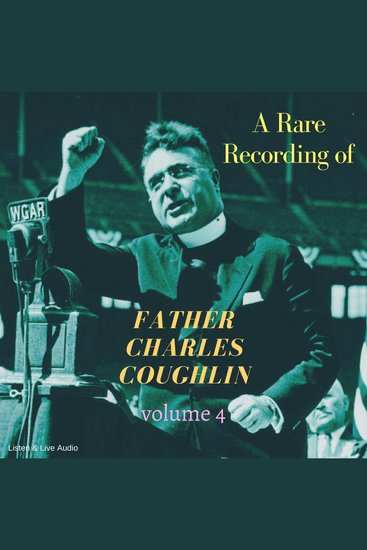
  • Rare Recording of Father Charles Coughlin A - Vol 4 - cover

    Rare Recording of Father Charles...

    Father Charles Coughlin

    • 0
    • 0
    • 0
    Father Charles Coughlin (October 25, 1891 - October 27, 1979), was a controversial Canadian-American Catholic priest based in Michigan. Calling for monetary reforms, the nationalization of major industries and railroads, and protection of the rights of labor, Coughlin used weekly radio broadcasts to reach a mass audience of up to thirty million listeners during the 1930s. An early supporter of Franklin D. Roosevelt and his New Deal, Coughlin later became a harsh critic. Coughlin’s commentary also became more anti-semitic, and he supported some of the fascist policies of Hitler, Mussolini, and Hirohito. As a result, many American Catholic leaders, as well as the Vatican, wanted Coughlin silenced. After the outbreak of World War II in 1939, the Roosevelt administration finally forced the cancellation of his radio program and forbade the dissemination of his newspaper, Social Justice. In this recording, Coughlin discusses the concept of "unjust aggressors" both within the United States and abroad.
    Show book
  • Geopolitics and Democracy - The Western Liberal Order from Foundation to Fracture - cover

    Geopolitics and Democracy - The...

    Brian Burgoon, Peter Trubowitz

    • 0
    • 0
    • 0
    A large, widening gap has opened between Western democracies' international ambitions and their domestic political capacity to support them. On issues ranging from immigration and international trade to national security, new political parties on the left and the right are rejecting the core foreign policy principles that Western governments have championed for over half a century. In Geopolitics and Democracy, Peter Trubowitz and Brian Burgoon provide a powerful new explanation for the rise of anti-globalism in the West. 


    Trubowitz and Burgoon show that support for globalism has been receding for thirty years in Western parties and legislatures. They trace the anti-globalist backlash to foreign policy decisions that mainstream parties and party elites made after the end of the Cold War. These decisions sought to globalize markets and pool sovereignty at the supranational level while applying neoliberal reforms to social protections and guarantees at home. 


    Geopolitics and Democracy reveals how domestic support for international engagement during the long East-West geopolitical contest was contingent upon social protections within Western democracies. In the absence of a renewed commitment to those social purposes, Western democracies will struggle to find a collective grand strategy that their domestic publics will support.
    Show book
  • The Book of Shadows Vol 1 - cover

    The Book of Shadows Vol 1

    D. H. Lawrence, Edith Nesbit, E....

    • 0
    • 0
    • 0
    What knowledge was never meant to be forgotten?
    
    The Book of Shadows Vol. 1 is a compelling anthology of occult writings, mystical traditions, and esoteric teachings drawn from ancient, medieval, and early modern sources. Compiled from various authors, this volume explores humanity's hidden relationship with nature, ritual, symbolism, and unseen forces.
    
    Within these pages, readers encounter spells, folklore, philosophical reflections, and spiritual practices rooted in pagan traditions, ceremonial magic, and mystical thought. Rather than sensationalism, this collection emphasizes historical depth, symbolic meaning, and the human desire to understand the invisible world.
    
    Mysterious, atmospheric, and intellectually intriguing, this volume serves as both a gateway and a foundation for readers drawn to the occult and the arcane.
    
    Inside this eBook, you'll explore:
    
    A curated collection of occult and esoteric writings
    
    Ancient rituals, symbolic traditions, and mystical philosophy
    
    Early sources of magical and spiritual thought
    
    A foundational anthology for occult literature enthusiasts
    
    Whether read for study, curiosity, or inspiration, The Book of Shadows Vol. 1 opens a door to humanity's oldest spiritual questions.
    
    Enter the circle. Begin the journey. Buy now and explore The Book of Shadows Vol. 1.
    Show book
  • A Rare Recording of Gertrude Stein Reading Her Own Writing - cover

    A Rare Recording of Gertrude...

    Gertrude Stein

    • 0
    • 0
    • 0
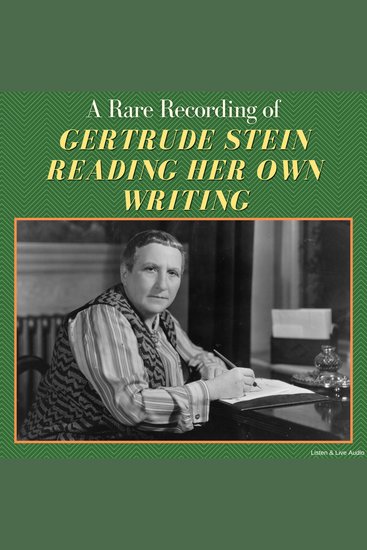
    Gertrude Stein (February 3, 1874 - July 27, 1946) was an American novelist, poet, playwright, and art collector. Born in Allegheny, Pennsylvania, and raised in Oakland, California, Stein moved to Paris in 1903, and made France her home for the remainder of her life. She hosted a Paris salon, where the leading figures of modernism in literature and art, such as Pablo Picasso, Ernest Hemingway, F. Scott Fitzgerald, Sinclair Lewis, Ezra Pound, Sherwood Anderson and Henri Matisse, would meet. The following three recordings are from Stein's novel, The Making of Americans (1925), and her poems, How She Bowed to her Brother (1931) and If I Told Him - A Completed Portrait of Picasso (1923)
    Show book