Junte-se a nós em uma viagem ao mundo dos livros!
Adicionar este livro à prateleira
Grey
Deixe um novo comentário Default profile 50px
Grey
Assine para ler o livro completo ou leia as primeiras páginas de graça!
All characters reduced
Summary of Necessary Trouble by Drew Gilpin Faust: Growing Up at Midcentury - cover
LER

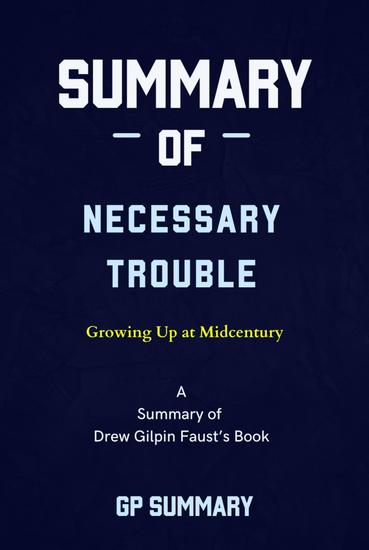
Summary of Necessary Trouble by Drew Gilpin Faust: Growing Up at Midcentury

GP SUMMARY

Editora: BookRix

  • 0
  • 0
  • 0

Sinopse

DISCLAIMER
 
This book does not in any capacity mean to replace the original book but to serve as a vast summary of the original book.
 
Summary of Necessary Trouble by Drew Gilpin Faust: Growing Up at Midcentury
 
IN THIS SUMMARIZED BOOK, YOU WILL GET:
 

- Chapter astute outline of the main contents.
- Fast & simple understanding of the content analysis.
- Exceptionally summarized content that you may skip in the original book 
Necessary Trouble is a memoir about growing up in a conservative Southern family in postwar America during the 1950s. The author, a white girl from Virginia, faced polarized national alliances, nuclear threat, and destabilized social hierarchies. Despite her upbringing's expectations, she found resistance necessary for survival. Through her love of learning and involvement in civil rights, student, and antiwar movements, she forged a path that would eventually lead her to become a historian.
Disponível desde: 26/08/2023.
Comprimento de impressão: 81 páginas.

Outros livros que poderiam interessá-lo

  • The Rory's Stories Guide to Parenting - cover

    The Rory's Stories Guide to...

    Rory O'Conor

    • 0
    • 1
    • 0
    THE PARENTING 'GUIDE' YOU'VE BEEN WAITING FOR!
    Sleep deprivation, stray Lego underfoot, mashed potato on the walls, missing spoons and the unmatched pride that comes with being a father!
    From the social media sensation, this is a hilarious and painfully accurate look at what parenting really entails – in all its messy glory.
    Ver livro
  • Dark Psychology & Mind Control - The Definitive Guide to Recognizing and Exposing Mental Manipulation Techniques Defending Yourself from Narcissists and Toxic People and Reclaiming Your Freedom - cover

    Dark Psychology & Mind Control -...

    Ethan Shepherd

    • 0
    • 0
    • 0
    Do you ever feel controlled, confused, or pushed into making choices that aren't truly yours?Do you have the feeling that someone—a partner, a boss, a family member—is playing with your mind, leaving you drained and insecure? 
    You are not alone, and you are not going crazy. 
    "Dark Psychology and Mind Control" is the definitive guide that tears through the veil of deception and gives you the tools to defend yourself. Author Ethan Shepherd doesn't teach you how to manipulate, but how to recognize and neutralize the subtle techniques others use against you.This isn't just an audiobook; it's armor for your mind. 
    You will discover:The 10 most powerful mental manipulation techniques (gaslighting, love bombing, and more) and how to unmask them instantly.How to defend yourself from narcissists, toxic people, and emotional manipulators in your daily life.Practical strategies to set healthy boundaries, say "no" without guilt, and rebuild your self-esteem.How mind control works in relationships, at work, and in society, so you never fall victim to it again. 
    Stop being a pawn in someone else's game. Reclaim your freedom, protect your mind, and start living the life you truly deserve. This audiobook is the first, essential step to breaking the invisible chains and taking back control. Your freedom starts now.
    Ver livro
  • Kyshtym Disaster The: The Controversial History of the Nuclear Meltdown Hidden by the Soviet Union - cover

    Kyshtym Disaster The: The...

    Charles River Editors

    • 0
    • 0
    • 0
    For decades, it was believed that the first major accident at a nuclear power plant took place at Three Mile Island in Pennsylvania in 1979, which took nearly 15 years and $1 billion to fully clean up after that disaster. However, Three Mile Island paled in comparison to Chernobyl, which to this day remains the most notorious nuclear accident in history. Located in the Ukraine, the Chernobyl power plant was undergoing experiments in the early morning hours of April 26, 1986 when it suffered a series of explosions in one of its nuclear reactors, killing over 30 people at the plant and spread radioactive fallout across a wide swath of the Soviet Union. Although the Soviets would try to cover up just how disastrous the accident at Chernobyl was, it was impossible to hide the full extent of the damage given that radioactive material was affecting Western Europe as well. All told, the accident caused an estimated $18 billion in damages, forced the evacuation of everybody nearby, and continues to produce adverse health effects that are still being felt in the region.  
    	The disasters emphatically demonstrated the dangers of nuclear power plants, and it brought about new regulations across the world in an effort to make the use of nuclear energy safer. Meanwhile, scientists and scholars are still studying the effects of the radiation on people exposed to the disasters and continue to come up with estimates of just how deadly they were. 
    	As it turned out, however, Chernobyl was not the first major nuclear disaster that the Soviets tried to hide. In 1957, a nuclear disaster occurred in an area near the Ural Mountains, far to the east of Moscow and to the north of the border with Kazakhstan, and to this day, it is a disaster few have heard of, even though it was the world’s worst nuclear disaster until Chernobyl. For those aware of it, it is now known as the Kyshtym disaster. 
    Ver livro
  • Rethinking Intelligence - A Radical New Understanding of Our Human Potential - cover

    Rethinking Intelligence - A...

    Rina Bliss

    • 0
    • 0
    • 0
    A genetics expert and professor challenges our understanding of intelligence, explaining what it truly means to be “smart,” why conventional assessments are misleading, and what everyone can do to optimize their potential. 
    Growing up in middle-class suburban Los Angeles in the 1980s, Rina Bliss saw intelligence as her ticket out. Like height and stature, intelligence was said to run in families. The prevailing idea was that mental capacity was determined by our DNA and could be measured; a simple IQ test could predict a child’s future. 
    Yet, once Dr. Bliss looked closer, first as a student, then as a scientist, and later as a mom of identical twins who share a genome, she began to challenge conventional wisdom about innate intelligence. In Rethinking Intelligence, she shares her findings, drawing on cutting-edge scientific research to offer a new model for how we understand, define, and assess intelligence, using a measurement that is far more flexible and expansive. 
    Intelligence has little to do with standardized test results or other conventional measures of intellect, Dr. Bliss argues. Intelligence is a process, a journey defined by change that cannot be scored or taken away. Intelligence is influenced by our surroundings in ways that are often overlooked—more than Baby Mozart or flash cards or superfoods, factors like stress, connection, and play actually sculpt young minds. 
    In Rethinking Intelligence, Dr. Bliss shares insights from the burgeoning science of epigenetics to help us harness our environments to empower our minds. If we truly want to nurture potential, we must eliminate toxic stress so that our genes can work optimally, in harmony with our environment. Dr. Bliss offers successful strategies we can use as individuals and a society, including embracing a growth mindset, prioritizing connection, becoming more mindful, and reforming systemic issues—poverty, racism, the lack of quality early childhood education—that have a negative and lasting neurobiological impact. 
    Joining acclaimed works by Carol Dweck, Amy Cuddy, and James Clear, Rethinking Intelligence reframes human behavior and intellect, offering a new perspective for understanding ourselves and our children, and the practical tools necessary to thrive.
    Ver livro
  • Pepper - A History of the World's Most Influential Spice - cover

    Pepper - A History of the...

    Marjorie Shaffer

    • 0
    • 0
    • 0
    “This is more than the story of a spice . . . Get ready for a sweeping ride through history.” ―David Oshinsky, Pulitzer Prize–winning authorThe perfect companion to Mark Kurlansky's Salt: A World History, Pepper illuminates the rich history of pepper for a popular audience. Vivid and entertaining, it describes the part pepper played in bringing the Europeans, and later the Americans, to Asia and details the fascinating encounters they had there. As Mark Pendergrast, author of Uncommon Grounds, said, “After reading Marjorie Shaffer's Pepper, you'll reconsider the significance of that grinder or shaker on your dining room table. The pursuit of this wizened berry with the bite changed history in ways you've never dreamed, involving extraordinary voyages, international trade, exotic locales, exploitation, brutality, disease, extinctions, and rebellions, and featuring a set of remarkable characters.”From the abundance of wildlife on the islands of the Indian Ocean, which the Europeans used as stepping stones to India and the East Indies, to colorful accounts of the sultan of Banda Aceh entertaining his European visitors with great banquets and elephant fights, this fascinating book reveals the often surprising story behind one of mankind's most common spices.“Using first-person accounts from journals and ships' logs, Shaffer crafts a textured story of exploration, danger, wealth and greed. Readers will find adventures on the high seas, pirates, ambitious Jesuits, sultans living in opulence and the plunder of what was once considered a ‘Garden of Eden’ . . . A vividly told story of a common spice’s uncommon history.” —Kirkus Reviews“A delightful history of the Indian Ocean and the South Seas.” ―Robert D. Kaplan, New York Times–bestselling author
    Ver livro
  • The Hiramic Legend - cover

    The Hiramic Legend

    Manly Palmer Hall

    • 0
    • 0
    • 0
    The Masonic legend of the building of Solomon's Temple does not in every particular parallel the Scriptural version, especially in those portions relating to CHiram Abiff. According to the Biblical account, this Master workman returned to his own country; in the Masonic allegory he is foully murdered. On this point A. E. Waite, in his New Encyclopædia of Freemasonry, makes the following explanatory comment: 
    "The legend of the Master-Builder is the great allegory of Masonry. It happens that his figurative story is grounded on the fact of a personality mentioned in Holy Scripture, but this historical background is of the accidents and not the essence; the significance is in the allegory and not in any point of history which may lie behind it."
    Ver livro