Join us on a literary world trip!
Add this book to bookshelf
Grey
Write a new comment Default profile 50px
Grey
Subscribe to read the full book or read the first pages for free!
All characters reduced
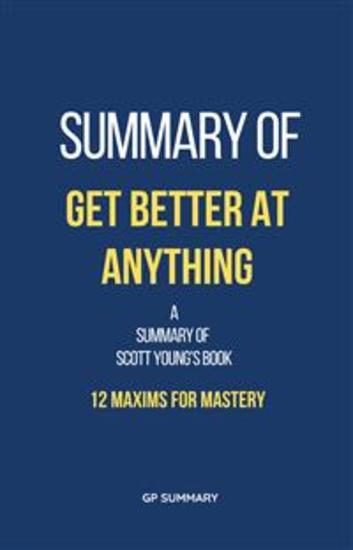
Summary of Get Better at Anything by Scott Young: 12 Maxims for Mastery - cover

Summary of Get Better at Anything by Scott Young: 12 Maxims for Mastery

GP SUMMARY

Publisher: BookRix

  • 0
  • 0
  • 0

Summary

DISCLAIMER

Please note that this book contains a summary of the original content, which is a condensation of the key ideas and information found in the original book.

Therefore, it is recommended to read the original book for a comprehensive and detailed understanding of the topics discussed.

This summary is provided for informational purposes only and is not intended to infringe upon the intellectual property rights of the original book.

Summary of Get Better at Anything by Scott Young: 12 Maxims for Mastery

IN THIS SUMMARIZED BOOK, YOU WILL GET:

	Chapter provides an astute outline of the main contents.
	Fast & simple understanding of the content analysis.
	Exceptionally summarized content that you may skip in the original book

Scott Young's book, Get Better At Anything, explains why learning new skills is difficult. He identifies three key factors that help us learn: see, do, and feedback. See is the ease of learning from others, while do is the practice required for mastery. Feedback is the results of hands-on experience. Rapid progress results when we learn from others, practice extensively, and receive reliable feedback. However, when these factors are inhibited, improvement becomes impossible. Young breaks down these elements into twelve maxims, providing insights for students, employees, and anyone interested in improving their skills.
Available since: 05/09/2024.
Print length: 61 pages.
Other books that might interest you

  • History of Arizona: A Captivating Guide to Historical Events and Facts You Should Know About the Grand Canyon State - cover

    History of Arizona: A...

    Captivating History

    • 0
    • 0
    • 0
    Did you know that Arizona was the last of the contiguous states to be admitted into the Union? 
    Even being the last, Arizona’s rich history predates its statehood by centuries, and that can be hard to digest in one sitting. What happened in Arizona before it became the forty-eighth state of the United States? 
    Step back in time with us, and witness the legacy of the Native American tribes that once thrived in this desert landscape. Uncover the tales of resilience, ingenuity, and cultural richness that continue to thrive throughout the canyons and mesas of Arizona. 
    Learn how the early settlers and Spanish missionaries molded the territory in ways that can still be seen today. 
    Here’s a taste of what you’re about to discover:Unveil the captivating tales of the ancient civilizations of ArizonaDiscover the architectural wonders that still remain todayWhat challenges the settlers enduredHow the economic foundation has affected the modern eraHow two world wars, a pandemic, and the Great Depression molded the region into what we know todayAnd so much more! 
    Scroll up and click on the “add to cart” button today to learn about the Grand Canyon State!
    Show book
  • What Is It Like to Be an Addict? - Understanding Substance Abuse - cover

    What Is It Like to Be an Addict?...

    Owen Flanagan

    • 0
    • 0
    • 0
    Owen Flanagan, an acclaimed philosopher of mind and ethics, offers a state-of-the-art assessment of addiction science and proposes a new ecumenical model for understanding and explaining substance addiction. 


    Flanagan has firsthand knowledge of what it is like to be an addict. That experience informs this important and novel work. He pairs the sciences that study addiction with a sophisticated view of the consciousness-brain/body relation to make his core argument: that substance addictions comprise a heterogeneous set of "psychobiosocial" behavioral disorders. He explains that substance addictions do not have one set of causes, such as self-medication or social dislocation, and they do not have one neural profile, such as a dysfunction in dopamine system. 


    Flanagan explores the ways addicts sensibly insist on their own responsibility to undo addiction, as well as ways in which shame for addiction can be leveraged into healing. He insists on the collective shame we all bear for our indifference to many of the psychological and social causes of addiction and explores the implications of this new integrated paradigm for practices of harm reduction and treatment. Flanagan's powerful new book upends longstanding conventional thinking and points the way to new ways of understanding and treating addiction.
    Show book
  • Summary - The Guest - Based On The Book By Emma Cline - cover

    Summary - The Guest - Based On...

    Library Of Stories

    • 0
    • 0
    • 0
    SUMMARY 
      
    THE GUEST 
    BASED ON THE BOOK BY EMMA CLINE 
      
    SUMMARY WRITTEN BY: LIBRARY OF STORIES 
      
    CONTENT 
    Arrival and Deception 
    The Struggle for Belonging 
    The Summer Routine 
    Tensions in the Relationship 
    The Social Climb 
    Encounters with the Past 
    The Party and the Fallout 
    Simon’s Growing Doubts 
    Escalation and Escape 
    General Analysis 
      
    ABOUT THE ORIGINAL BOOK 
    “The Guest” by Emma Cline follows Alex, a young woman who finds herself staying at Simon’s luxurious Hamptons estate. Running from a troubled past and a controlling relationship with Dom, Alex desperately tries to fit into Simon's wealthy world, using deception to maintain her place. As she navigates the glamorous yet superficial social circles of the elite, she grapples with her own insecurities and growing paranoia. The novel explores themes of identity, class disparity, and the consequences of living in a world built on illusions, focusing on Alex’s internal struggle to survive and belong in a world that feels increasingly out of reach.
    Show book
  • The Audacity of Relevance - Critical Conversations on the Future of Arts and Culture - cover

    The Audacity of Relevance -...

    Alex Sarian

    • 0
    • 0
    • 0
    A manifesto on the state of the non-profit arts sector and the once-in-a-lifetime opportunity leaders have to redefine the business as an investment in our shared social purpose.
    		 
    “The Audacity of Relevance isn’t just for arts leaders but for artists, philanthropists, and arts-loving audiences. It provides a modern look at our organizations and invites us to break the echo chambers we operate in. By forcing us to see the world differently, Alex Sarian asks us to rethink our purpose by leaning into our shared humanity.” — Sarah Arison, Trustee, MoMA
    		 
    The arts and culture sector is in crisis—a crisis of relevance. Whether it’s grappling with dwindling audience sizes, shifting trends in philanthropy, or addressing social challenges, experts have been documenting this slow decline for decades.
    		 
    At the core of Alex Sarian’s international career is the conviction that cultural organizations must embrace a greater civic purpose and build a new business model—one based on the social impact of the arts.
    		 
    Throughout The Audacity of Relevance, Sarian engages in conversations with leaders from across industries to paint a potential future for arts organizations—a future built on measuring our sector’s success by how positively we can influence the many local communities that surround us.
    		 
    It doesn’t matter if you’re a seasoned executive or are just beginning in your career—the principles and anecdotes in this book will inspire you to see the world of arts and culture for what it truly is: filled with endless possibilities for reinvention.
    Show book
  • Egg - A Dozen Ovatures - cover

    Egg - A Dozen Ovatures

    Lizzie Stark

    • 0
    • 0
    • 0
    An unconventional history of the world’s largest cellular workhorse, from chickens to penguins, from art to crime, and more. 
    The egg is a paradox―both alive and not alive―and a symbol as old as culture itself. In this wide-ranging and delightful journey through its natural and cultural history, Lizzie Stark explores the egg’s deep meanings, innumerable uses, and metabolic importance through a dozen dazzling specimens. 
    From Mali to Finland, mythologies around the globe have invested the egg with powers of regeneration and fecundity, often ascribing the origin of the world to a cosmic egg. An oracle to Romans, fought over by Gold Rush gangs, used as the foundation of the Clown Egg Registry, and blasted into space, the egg has taken on larger proportions than, say, the ovum of an ostrich. 
    It has starred in global dishes from the Korean comfort food ttukbaegi gyeranjjim to the less regaled yet iconic soft-boiled egg. Stark writes a biography of French-born chef Jacques Pépin through his egg creations, and weaves in her personal experiences, like attempting to make the perfect omelet or trying her hand at pysanky―the Ukrainian art of egg decoration. She also explores her fraught relationship to the eggs in her body due to a familial link to cancer, and shares her delight in becoming a mother. 
    Filled with colorful characters and fascinating morsels, Egg is playful, informative, and guarantees that you’ll never take this delicate ovoid for granted again.
    Show book
  • Psychedelics and mental health - Therapeutic applications and neuroscience of psilocybin LSD DMT and MDMA - cover

    Psychedelics and mental health -...

    Irene de Caso

    • 0
    • 0
    • 0
     
    Irene de Caso explains in an understandable and entertaining way the current neuroscientific advances related to psychedelic drugs, as well as their clinical and experiential applications.
    José Carlos Bouso, PhD, Scientific Director, ICEERS.
    
    Learn about the therapeutic uses of classical psychedelics and empathogens as revolutionary tools for neuroplasticity and mental health. Discover how they promote profoundly revealing mental states capable of restructuring our internal models of the world, reconsolidate traumatic memories and improve our social relationships. How do they affect the brain? What characteristics make these substances powerful catalysts for the psychotherapeutic process?
    Learn how they can help to improve severe symptoms: addictions, treatment-resistant depression, anxiety or post-traumatic stress.
    This illustrated guide describes the most important clinical studies and will be of great interest to all medical and mental health professionals seeking to understand the cutting edge clinical applications of these molecules, as well as to individuals interested in learning about the potential of psychedelic-assisted therapies.
    Show book