Join us on a literary world trip!
Add this book to bookshelf
Grey
Write a new comment Default profile 50px
Grey
Subscribe to read the full book or read the first pages for free!
All characters reduced
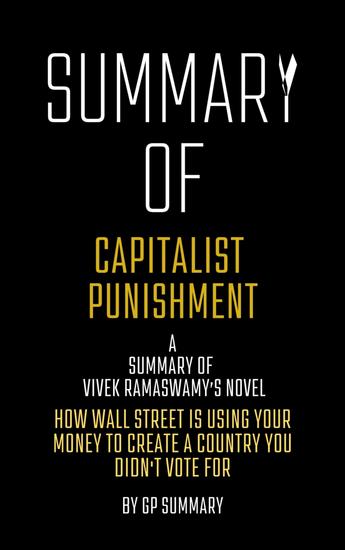
Summary of Capitalist Punishment by Vivek Ramaswamy - How Wall Street Is Using Your Money to Create a Country You Didn't Vote For - cover

Summary of Capitalist Punishment by Vivek Ramaswamy - How Wall Street Is Using Your Money to Create a Country You Didn't Vote For

GP SUMMARY

Publisher: BookRix

  • 0
  • 0
  • 0

Summary

DISCLAIMER
 
This book does not in any capacity mean to replace the original book but to serve as a vast summary of the original book.
Summary of Capitalist Punishment by Vivek Ramaswamy: How Wall Street Is Using Your Money to Create a Country You Didn't Vote For
 
IN THIS SUMMARIZED BOOK, YOU WILL GET:
 

- Chapter astute outline of the main contents.
- Fast & simple understanding of the content analysis.
- Exceptionally summarized content that you may skip in the original book 
 
The Wall Street cartel has seized control of the American economy, using your money to do so. Three Wall Street firms have amassed more money than Jeff Bezos, Elon Musk, Andrew Carnegie, and John Rockefeller combined. They have forced US companies to adopt "racial equity audits" and "emissions caps" while supporting human rights atrocities in China, coerce Western companies to produce less oil while shifting production to dirtier places, and charge high fees to mom-and-pop investors for sustainable funds. Capitalist Punishment is an easy-to-follow educational tour de force for all participants in financial markets.
Available since: 04/26/2023.
Print length: 58 pages.

Other books that might interest you

  • Somatic Experiencing - Healing Trauma through the Body's Wisdom - cover

    Somatic Experiencing - Healing...

    Vivian Westlake

    • 0
    • 0
    • 0
    Trauma is a deeply impactful event that can leave lasting scars on the body and mind. While traditionally associated with physical injury or life-threatening events, trauma also encompasses psychological and emotional experiences that overwhelm the body's ability to cope. These experiences can range from major events, such as accidents, abuse, or natural disasters, to more subtle forms of chronic stress and neglect. Regardless of the cause, trauma has profound effects on the nervous system and the way individuals experience the world around them. 
    When a person faces a traumatic event, their body enters a state of heightened alertness, preparing to respond with fight, flight, or freeze reactions. These responses are governed by the autonomic nervous system (ANS), which is responsible for managing involuntary bodily functions like heart rate, respiration, and digestion. In a traumatic situation, the ANS activates the sympathetic nervous system (SNS), triggering the fight or flight response to protect the individual. If neither response is possible, the freeze response takes over, which can lead to feelings of paralysis or disassociation. These instinctual reactions are designed to protect, but when the trauma is unresolved, the nervous system may remain stuck in a heightened state of alertness. 
    The effects of trauma are not just psychological but are also deeply physiological. When the body remains in this heightened state of arousal, it can disrupt the normal functioning of various bodily systems, leading to symptoms such as chronic pain, tension, digestive issues, or sleep disturbances. This state of dysregulation can also affect the brain, impairing areas responsible for memory, emotional regulation, and decision-making. The longer this state persists, the more difficult it becomes for the individual to return to a sense of normalcy, and the trauma can become entrenched in both the body and mind.
    Show book
  • Prussia - History of the Prominent German State - cover

    Prussia - History of the...

    Kelly Mass

    • 0
    • 0
    • 0
    Prussia, once a powerful and influential German state, traces its origins back to 1525, when it began as a duchy focused on the region near the southeast coast of the Baltic Sea. Over the centuries, it would grow to play a pivotal role in European history, especially through its military and political influence. Prussia was formally dissolved in 1947 by a decision from the Allies, though its disbandment began much earlier in 1932 when German Chancellor Franz von Papen issued an emergency order transferring the powers of the Prussian government to the central state. The state had been slowly losing its autonomy for years before that, following the turbulent events of the early 20th century. 
    At the height of its power, Prussia was ruled by the House of Hohenzollern, a royal family that presided over its expansive territories and built a military machine renowned for its discipline and effectiveness. Prussia's capital was initially Königsberg, but in 1701, it became Berlin when Prussia elevated itself to the status of a kingdom. Over the years, the Kingdom of Prussia became a major player in European affairs, with its well-organized army enabling it to extend its borders and influence across the continent.
    Show book
  • Summary: The Big Short - Inside the Doomsday Machine by Michael Lewis: Key Takeaways Summary & Analysis - cover

    Summary: The Big Short - Inside...

    Brooks Bryant

    • 0
    • 0
    • 0
    Disclaimer: This is not the official book, but a summary & it does not accompany the official. 
    Ever wondered how a handful of Wall Street outsiders saw what everyone else missed and made a fortune from the financial meltdown of 2008? 'The Big Short' plunges you deep into the twisted world of subprime mortgages, credit default swaps, and financial mayhem. 
    In our succinct summary, you'll meet the eccentric characters who bet against the housing market and learn how they unraveled the complex web of financial deceit. Get ready for a riveting, behind-the-scenes look at the most audacious gamble of the 21st century! 
    Navigate the intricate maze of Wall Street with the rebels who dared to defy the system. Learn how greed, ignorance, and systemic corruption led to a crisis—and how the smart money cashed in. If you're intrigued by finance, fascinated by human folly, or just love a story of underdogs triumphing against the odds, this is the book for you. 
    Don't miss this eye-opening guide to one of modern history's most calamitous financial collapses. Grab your copy and delve into the scandal that shook the world!
    Show book
  • Life and Death at Abbey Gate - The Fall of Afghanistan and the Operation to Save our Allies - cover

    Life and Death at Abbey Gate -...

    Mikael Cook, Robert Conlin

    • 0
    • 0
    • 0
    As the American government began a disastrous mass evacuation of its Afghan allies, a group of American veterans saw the writing on the wall—the people who had supported them on the ground over the past two decades were going to be left behind. Instead of watching on the sideline, they sprang into action. The effort became known nationally as #DigitalDunkirk, in reference to the civilian aspect of the evacuation of soldiers from the beaches of Dunkirk in 1940. As America's last days in Afghanistan came to a chaotic end, an ad-hoc group of veterans, intelligence assets and legislative aides undertook an extraordinary mission to leave no comrade behind. 


    Relying on cell phones and satellites as their weapons, they worked around the clock to help evacuate as many Afghans as possible. As the desperate mass of Afghans tried to flee brutal Taliban rule, Marines of the 2nd Battalion, 1st Marines, worked at Hamid Karzai International Airport's Abbey Gate in conditions that brought combat-hardened veterans to tears. After an ISIS suicide bomber detonated his S-vest, killing thirteen United States service members, operations came to a halt. 


    Life and Death at Abbey Gate tells the story behind the story of the mass evacuation of over 124,000 Americans and Afghan allies during a two-week period in the summer of 2021.
    Show book
  • Who Do We Choose to Be? Second Edition - Facing Reality Claiming Leadership Restoring Sanity - cover

    Who Do We Choose to Be? Second...

    Margaret J. Wheatley

    • 0
    • 0
    • 0
    In a world we cannot recognize, how do we find a way forward? In this world we do not understand, how do we know what to do? When so little is comprehensible, what is meaningful work? What is genuine contribution? 
     
    Bestselling author Margaret Wheatley has summoned us to be courageous leaders who strengthen community and rely on fully engaged people since her 1992 classic book, Leadership and the New Science, and eight subsequent books. In response to how quickly society is changing and the exponential increase in leadership challenges, this second edition of her latest bestseller is 80% new material. 
     
    How do we see clearly so that we can act wisely? Wheatley brings present reality into clear and troubling focus using multiple lenses of Western and Indigenous sciences, and the historic patterns of collapse in complex civilizations. With gentle but insistent guidance to face reality, she offers us the path and practices to be sane leaders who know how to evoke people's inherent generosity, creativity, and kindness. 
     
    Skillfully weaving science, history, exemplars, poetry, and quotes with stories and practices, Wheatley asks us to be Warriors for the Human Spirit, leaders and citizens who stay engaged, choose service over self, stand steadfast in the midst of crises, and offer our reliable presence of compassion and insight no matter what.
    Show book
  • Otto Hahn: A short biography - 5 Minutes: Short on time – long on info! - cover

    Otto Hahn: A short biography - 5...

    5 Minutes, 5 Minute Biographies,...

    • 0
    • 0
    • 0
    Otto Hahn, German physicist and discoverer of atomic fission: Life and work in a short biography! Everything you need to know, brief and concise. Infotainment, education and entertainment at its best!
    Show book