Join us on a literary world trip!
Add this book to bookshelf
Grey
Write a new comment Default profile 50px
Grey
Subscribe to read the full book or read the first pages for free!
All characters reduced
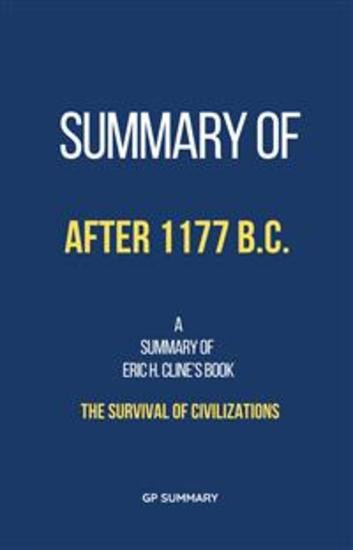
Summary of After 1177 BC by Eric H Cline: The Survival of Civilizations - cover

Summary of After 1177 BC by Eric H Cline: The Survival of Civilizations

GP SUMMARY

Publisher: BookRix

  • 0
  • 0
  • 0

Summary

DISCLAIMER

Please note that this book contains a summary of the original content, which is a condensation of the key ideas and information found in the original book.

Therefore, it is recommended to read the original book for a comprehensive and detailed understanding of the topics discussed.

This summary is provided for informational purposes only and is not intended to infringe upon the intellectual property rights of the original book.

Summary of After 1177 B.C. by Eric H. Cline: The Survival of Civilizations

IN THIS SUMMARIZED BOOK, YOU WILL GET:

	Chapter provides an astute outline of the main contents.
	Fast & simple understanding of the content analysis.
	Exceptionally summarized content that you may skip in the original book

After 1177 B.C. is a sequel to Eric Cline's 1177 B.C., detailing the aftermath of the collapse of the Late Bronze Age civilizations in the Aegean and Eastern Mediterranean. The book explores the resilience, transformation, and success of these societies in an age of chaos and reconfiguration. It highlights the collapse of powerful civilizations, leading to the emergence of new world orders and innovations like the use of iron and the alphabet. The book offers lessons for today's world about why some societies survive massive shocks while others do not, and why this period was a new age with new inventions and opportunities.
Available since: 04/20/2024.
Print length: 33 pages.

Other books that might interest you

  • Totem and Taboo - cover

    Totem and Taboo

    Sigmund Freud

    • 0
    • 0
    • 0
    "Totem and Taboo" by Sigmund Freud explores the origins of human culture, religion, and morality through a psychoanalytic lens. Freud draws parallels between primitive societies and modern neuroses, examining totemism, taboos, and the Oedipus complex. He argues that primal emotions and unconscious drives shape societal structures, including laws and religious practices. By analyzing rituals, myths, and prohibitions, Freud delves into the psychological underpinnings of group identity and authority. A groundbreaking work, it bridges anthropology and psychoanalysis, offering provocative insights into the shared roots of individual and collective behavior. Though controversial, it remains a foundational text for understanding human nature.
    Show book
  • Defending My Enemy - Skokie and the Legacy of Free Speech in America - cover

    Defending My Enemy - Skokie and...

    Aryeh Neier, Nadine Strossen,...

    • 0
    • 0
    • 0
    A new edition of the most important free speech book of the past half-century, with a new chapter by the author on some of the top First Amendment controversies of today 
    When Nazis wanted to express their right to free speech in 1977 by marching through Skokie, Illinois—a town with a large population of Holocaust survivors—Aryeh Neier, then the national executive director of the ACLU and himself a Holocaust survivor, came to the Nazis' defense. Explaining what many saw as a despicable bridge too far for the First Amendment, Neier spelled out his thoughts about free speech in his 1979 book Defending My Enemy. 
     
    Nearly fifty years later, Neier revisits the topic of free speech in a volume that includes his original essay along with a new chapter addressing present-day First Amendment battles, including the Charlottesville march, book bans, the heckler's veto, attacks on free speech on college campuses, and the threat to overturn the US Supreme Court decision in The New York Times v. Sullivan. Including a foreword by Congresswoman Eleanor Holmes Norton and an afterword by longtime free speech champion Nadine Strossen, Defending My Enemy offers razor-sharp analysis from the man Jameel Jaffer of the Knight First Amendment Institute describes as "an icon of justice and fearlessness."
    Show book
  • Being-Time - A Practitioner's Guide to Dogen's Shobogenzo Uji - cover

    Being-Time - A Practitioner's...

    Shinshu Roberts, Norman Fischer

    • 0
    • 0
    • 0
    A tour-de-force guide to Zen Master Dogen's most subtle and sophisticated philosophical premises: that being and time are inseparable. 


    Being-Time thoroughly explores Dogen's teaching on how we practice as Buddhas by understanding the relationship between being and time as it is—and as we perceive it to be. Using Dogen's Shobogenzo Uji (The True Dharma Eye, Being-Time), Shinshu Roberts offers a twofold analysis of this teaching: the meaning of the text and practice with the text, giving examples how we apply Dogen's complex teaching to our daily lives.
    Show book
  • Body Language - Decoding Nonverbal Communication for Better Understanding - cover

    Body Language - Decoding...

    Coral Nunez

    • 0
    • 0
    • 0
    Body language is an essential aspect of communication that often speaks louder than words. It encompasses a range of non-verbal signals that convey emotions, attitudes, and intentions, all without uttering a single word. From facial expressions and gestures to posture and eye contact, body language is a powerful tool in human interaction, influencing how we connect with others and how we are perceived in return. While verbal communication is often emphasized, non-verbal cues are just as important—sometimes even more so—when it comes to understanding the full message being communicated. 
      
    In fact, research suggests that a large percentage of our communication is conveyed through body language, with estimates ranging from 60% to 93%, depending on the context. The way we move, stand, and make eye contact can reveal a wealth of information about our true feelings, intentions, and state of mind. Whether we're aware of it or not, our body language is constantly transmitting messages to others, which is why it's crucial to understand the subtle cues we are sending out.
    Show book
  • Stalingrad - cover

    Stalingrad

    Kelly Mass

    • 0
    • 0
    • 0
    Stalingrad has changed names. It's now called Volgograd and is still one of the largest cities in Russia. But we can't ignore the fact that for a significant time in history, it was called Stalingrad, named after the tyrant and leader of the Soviet Union in the Second World War, Joseph Stalin. Let's explore the history of this city during the Second World War, and why the battles fought there were so horrendous and pivotal in history.At the time of the Battle of Stalingrad In Southern Russia, Germany and its allies combated the Soviet Union for control of Stalingrad (now Volgograd). It is just one of the bloodiest engagements in the history of warfare, with an approximated 2 million general losses. It's marked by intense close-quarters battle and direct attacks on people in air campaign. The German High Command was pushed to eliminate substantial army forces from other theaters of war after their defeat at Stalingrad.The Stalingrad battle has been represented in the movies “Stalingrad” and “Enemy at the Gates.” It has become a level in video games like the “Call of Duty” series. Its casualties were many. Its circumstances brutal and took a very long time. Let’s take a look at what took place, why it was such a heroic turning point for the Russians against Hitler’s Nazi armies, and what happened after the Germans were pushed back.
    Show book
  • Barred - Why the Innocent Can’t Get Out of Prison - cover

    Barred - Why the Innocent Can’t...

    Daniel S. Medwed

    • 0
    • 0
    • 0
    A groundbreaking exposé of how our legal system makes it nearly impossible to overturn wrongful convictions Thousands of innocent people are behind bars in the United States. But proving their innocence and winning their release is nearly impossible.  In Barred, legal scholar Daniel S. Medwed argues that our justice system’s stringent procedural rules are largely to blame for the ongoing punishment of the innocent. Those rules guarantee criminal defendants just one opportunity to appeal their convictions directly to a higher court. Afterward, the wrongfully convicted can pursue only a few narrow remedies. Even when there is strong evidence of a miscarriage of justice, rigid guidelines, bias, and deference toward lower courts all too often prevent exoneration.  Offering clear explanations of legal procedures alongside heart-wrenching stories of their devastating impact, Barred exposes how the system is stacked against the innocent and makes a powerful call for change.  “In our screwed-up legal system, it’s fairly easy to convict an innocent person and send them to prison. Tragically, and as Daniel S. Medwed explains so clearly in Barred, it is almost impossible to get them out. Punishing the innocent is not just a problem in other places. We do it every day in America.” ―John Grisham“By blending tales of real-life wrongful convictions with straightforward explanations of legal procedures, Medwed’s Barred demystifies the mysterious path for the innocent after trial. His clear and engaging writing style makes the topic accessible to anyone interested in the hazards of our criminal justice system. A must-read!”―Sister Helen Prejean, author of Dead Man Walking“Barred is a stunning account of the myriad procedural roadblocks that keep innocent people trapped in our nation’s prisons. With harrowing stories from his public-defense practice, Medwed reveals how prosecutors, judges, and other officials revere finality and efficiency over fairness and truth. By exposing this rampant disregard for defendants’ culpability, Barred powerfully calls into question the justice of the entire criminal punishment system and proposes urgent ways to mitigate its damage.”―Dorothy Roberts, author of Torn Apart“For every innocent prisoner we’ve freed over the past three decades, countless others remain behind bars. Barred brilliantly illustrates the absurdity of this situation: how it is far too easy to convict the innocent, and far too hard to correct those mistakes.” ―Barry Scheck, cofounder of the Innocence Project“For every newspaper photo of an innocent person exiting the prison gates, clutching the hand of their triumphant lawyer, there are uncountable others whom we will never allow to see that day—who will die in prison because our laws make it so difficult to prove their innocence in court. In Barred, Daniel S. Medwed gives us an urgent tour of the darkest corners of our judicial system, where persuasive evidence becomes trapped in a labyrinth of legal procedure. Underlying Medwed’s sharp legal analysis is a political question: Is this the country we want to be?” ―Maurice Chammah, author of Let the Lord Sort Them“A lucid and persuasive call for change.”―Publishers Weekly“Informative and poignant… [An] important addition to the literature on America’s addiction to incarceration.”―Kirkus“Eye-opening… Readers interested in criminal justice will find an elucidating look at the challenges and possibilities for the wrongfully convicted.”―Booklist
    Show book