Join us on a literary world trip!
Add this book to bookshelf
Grey
Write a new comment Default profile 50px
Grey
Subscribe to read the full book or read the first pages for free!
All characters reduced
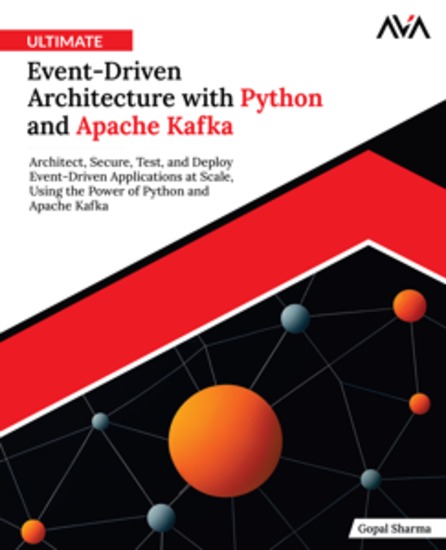
Ultimate Event-Driven Architecture with Python and Apache Kafka - Architect Secure Test and Deploy Event-Driven Applications at Scale Using the Power of Python and Apache Kafka - cover

Ultimate Event-Driven Architecture with Python and Apache Kafka - Architect Secure Test and Deploy Event-Driven Applications at Scale Using the Power of Python and Apache Kafka

Gopal Sharma

Publisher: Orange Education Pvt Ltd

  • 0
  • 0
  • 0

Summary

Build high-performance, scalable, and resilient systems using Python and Kafka.Key Features● Learn EDA fundamentals with real-world use case examples.● Master Kafka and Python to build event-driven applications.● Build secure, testable, and observable EDA-based systems.● Step-by-step design and hands-on coding for core EDA parts.Book DescriptionPython’s simplicity and flexibility, combined with Apache Kafka’s high-throughput, fault-tolerant messaging system, make them a powerful duo for building scalable, event-driven applications. Ultimate Event-Driven Architecture with Python and Apache Kafka brings together these two technologies to help developers and architects design modern, asynchronous systems capable of handling real-time data at scale.The book begins by introducing the fundamentals of Event-Driven Architecture (EDA), including its core principles, benefits, and real-world relevance. It then explores the essential components of an EDA system, guiding readers through design patterns, message flow, and architectural considerations. Security, testing, and observability are covered in depth to ensure robust and reliable systems.Later chapters dive into Apache Kafka concepts and demonstrate how to build and deploy practical, real-world solutions using Python. Hands-on examples and a complete use case walk-through ensure that readers can confidently apply what they’ve learned in production scenarios.Whether you're modernizing legacy systems or architecting from scratch, this book equips you to build event-driven systems that are scalable, resilient, and future-ready. Start your EDA journey with Python and Kafka today!What you will learn● Understand the core principles and components of event-driven architecture.● Learn to design scalable systems, using events, not requests.● Implement Kafka-based messaging in Python with real code examples.● Secure EDA systems with authentication and authorization practices.● Apply debugging, testing, and monitoring strategies for EDA systems.● Build a complete event-driven system, using Python and Kafka.Table of Contents1. Event-Driven Architecture: Introduction2. Components of Event-Driven Architecture3. Event-Driven Architecture: Real-World Examples4. Designing Event-Driven Architecture5. Security Best Practices6. Testing and Debugging7. Monitoring8. Apache Kafka: Concept9. Real-World Use Case with Python and Kafka      IndexAbout the AuthorsGopal Sharma is a highly accomplished senior technology leader and software architect, with over 27 years of experience driving innovation, and delivering impactful solutions across enterprise software, digital technologies, and data engineering. He has demonstrated expertise in Data and Analytics strategies and technologies, Information Security, Deep Learning, Predictive Analytics, Cloud Computing, and Enterprise Application Integration. He is a respected author, technical reviewer, and freelance writer, contributing to publications focused on Big Data, Data Science, and Enterprise technologies.In the dynamic realm of technology, Gopal Sharma’s journey is a testament to the enduring pursuit of knowledge. Starting as a mechanical engineer, Gopal’s life has been marked by a remarkable transformation, ultimately leading him to his current pursuit as an author.
Available since: 08/31/2025.
Print length: 246 pages.


Other books that might interest you

  • Humanoid Robots & Drones: How the Age of Smart Machines Will Revolutionize Our World - cover

    Humanoid Robots & Drones: How...

    Dr. Nick Coman, I. A.I.

    • 0
    • 0
    • 0
    “Humanoid Robots & Drones: How the Age of Smart Machines Will Revolutionize Our World” is a 24‑lecture audio expedition for anyone who likes their wonder with measurements. We chase robots, humanoids, and drones through restaurants, farms, warehouses, hospitals, disaster scenes, stadiums, and city skies—treating each as a solvable puzzle. How does a drone hold position in wind? Why does a humanoid’s shape matter for doors and stairs? When does a non‑humanoid robot beat a humanoid? More often than you’d guess.
     
    You’ll learn the working grammar of the field: motors, cameras, lidar, batteries, and the ugly truth about friction, glare, and radio noise. You’ll see how a drone’s navigation, thermal views, and geofences turn into defect lists, not pretty video; how warehouse robots schedule intersections; why “stop distance” and “payload versus endurance” make or break a plan; and how soft‑skinned humanoids handle the “last ten centimeters” that buildings were designed for human hands. We translate regulation and risk into simple playbooks you can actually use—what the rules permit, what insurers demand, and what keeps neighbors calm.
     
    Expect case studies with receipts: drone light shows that replace fireworks with quiet pixels; roof and bridge inspections before breakfast; farm rigs that spray where plants actually are; hospital runners and delivery bots that save steps and shoulders; telepresence poles and companion robots that help real people on real Tuesdays. The tone is sharp, funny, and unromantic: we puncture hype, celebrate craft, and name failure modes out loud.
     
    By the end, you’ll be able to read a spec sheet like a mechanic, design a credible first deployment, and argue—politely but mercilessly—about the next 10, 25, and 50 years. If you want an operator’s guide to the robots, humanoids, and drones that already work (and the ones that almost do), buckle in. The robots are clocked in, the drones are charged, and class is wheels‑up.
    Show book
  • Sustainable Water Management In Agriculture - Conserving a Precious Resource - cover

    Sustainable Water Management In...

    Ruchini Kaushalya

    • 0
    • 0
    • 0
    Struggling with water scarcity in agriculture? "Sustainable Water Management in Agriculture: Conserving a Precious Resource" is your solution. This comprehensive audiobook offers groundbreaking insights and effective strategies for sustainable water management. Learn from industry experts how to optimize water usage, improve crop yields, and save costs while contributing to environmental preservation. 
    Benefits:Expert Knowledge: Gain insights from seasoned professionals.Improved Yields: Optimize water usage for better crop production.Cost Savings: Reduce water wastage and save money.Environmental Impact: Contribute to a sustainable future. 
    What You’ll Gain:Practical Solutions: Easy-to-implement, tailored strategies.Case Studies: Real-life examples of successful practices.Sustainable Farming: Ecological and economic benefits.Latest Technology: Discover cutting-edge water conservation tools. 
    Ready to transform your agricultural practices? Click "Buy Now" and start your journey towards a sustainable future today!
    Show book
  • 12 Habits That Damage Your Brain - Surprising Behaviors That Harm Cognitive Health - cover

    12 Habits That Damage Your Brain...

    John Harpoon

    • 0
    • 0
    • 0
    Cognitive health is often overlooked until it begins to decline. In a world that is rapidly changing, we can easily forget how fragile our brains truly are. From the way we process information to our ability to recall memories, brain health affects every part of our daily lives. Yet, many of us unknowingly engage in habits that can damage our cognitive function over time. These seemingly harmless behaviors can lead to a range of mental health problems, including memory loss, mental fog, and even conditions like dementia. The good news is that by understanding how certain habits affect the brain, we can take steps to protect and improve our cognitive health. 
      
    The human brain is one of the most complex organs in the body. It is responsible for our thoughts, emotions, movements, and even the way we perceive the world around us. Despite its remarkable abilities, the brain is vulnerable to both internal and external factors that can have lasting consequences on its function. The habits we form daily play a crucial role in determining how well our brain performs. Even if we don’t feel immediate effects, bad habits can accumulate over time, leading to irreversible damage. 
      
    In this book, we explore twelve common habits that can harm cognitive health. These behaviors might seem harmless or even routine, but their impact on the brain can be far-reaching. From lack of sleep and chronic stress to poor dietary choices and sedentary living, many of these habits are all too familiar. However, understanding how these habits affect the brain is the first step in taking control of our mental health. Once we recognize the problem, we can implement strategies to protect our brain from further harm.
    Show book
  • Get in the Game - How to Level Up Your Business with Gaming Esports and Emerging Technologies - cover

    Get in the Game - How to Level...

    Jonathan Stringfield

    • 0
    • 0
    • 0
    In Get in the Game: How to Level Up Your Business with Gaming, Esports, and Emerging Technologies, decorated gaming and social media research and marketing executive Jonathan Stringfield delivers a roadmap to understanding and navigating marketing and business integrations into the gaming ecosystem: who plays games (and why), how modern games are created and oriented around the world of esports, and where brands can get involved with modern games. 


    This book explains the breadth and depth of the gaming audience, describing the rapidly changing demographics of modern games and the various motivations gamers have for playing games. It also unpacks the history of gaming and how it has impacted the creative processes and output from the industry. Finally, it offers a practical guide for brands wishing to integrate themselves into new gaming environments, with an emphasis on maximizing success for marketers, developers, content creators, and fans. 


    Perfect for marketing strategists, brand managers, and chief marketing officers, Get in the Game will also earn a place in the libraries of executives seeking to connect with the misunderstood yet largest segment in consumer entertainment.
    Show book
  • Stress to Calm in 7 Minutes for Nurses - cover

    Stress to Calm in 7 Minutes for...

    Janey Lee Grace, Beverley Densham

    • 0
    • 0
    • 0
    Are you a nurse feeling overwhelmed and stressed at work? Do you find it difficult to balance the demands of your job with your personal life?  Stress to Calm in 7 Minutes for Nurses is here to help!
    We understand the unique challenges that nurses face on a daily basis, from long hours to a heavy workload and constant multi-tasking. That's why we've designed a practical step-by-step guide that takes you through 7 one-minute tools specifically tailored to help you work through stress and find more peace and balance.
    Each tool is backed by science and designed to help you reduce stress levels, improve your work-life balance, and boost your mental health and wellbeing. These tools can be used anytime, anywhere – whether you're in a hospital, work situation or at home and when you see the improvement, you will be motivated to use them every day.
    With just 7 minutes a day, you can make a real difference in your stress levels and overall wellbeing. Join the Stress to Calm revolution and start living your best, stress-free life today!
    Show book
  • Thinking Small and Large: How Microbes Made and Can Save Our World - How Microbes Made and Can Save Our World - cover

    Thinking Small and Large: How...

    Peter Forbes

    • 0
    • 0
    • 0
    The environmental crisis will not be solved by battery technology. We are looking for answers in the wrong places. 
     
    Life began with the hydrogenation of CO2, and this is the process we must return to in order to heal the planet. Ground-breaking ongoing research into bacterial processes means our knowledge of bacterial processes is ever-expanding, and we can harness this new knowledge to develop a parallel carbon economy using engineered bacteria for fuel, food, and materials. This would enable rewilding on a vast scale, with the small land footprint of bacterial technologies solving the current conflict in land use between farming and fuel and materials production. 
     
    In this fascinating and illuminating book, Peter Forbes shines a light on this crucial technology and offers a tantalising glimpse at what is possible. To solve the big problems, sometimes you have to think small.
    Show book