Join us on a literary world trip!
Add this book to bookshelf
Grey
Write a new comment Default profile 50px
Grey
Subscribe to read the full book or read the first pages for free!
All characters reduced
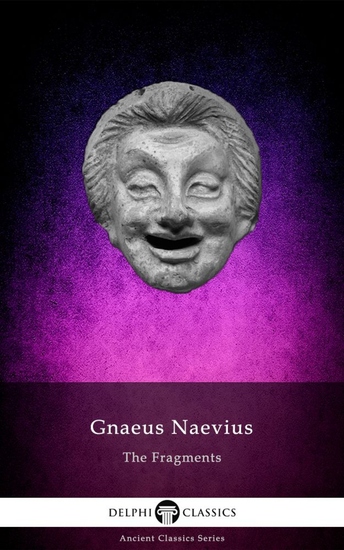
The Fragments of Gnaeus Naevius Illustrated - cover

The Fragments of Gnaeus Naevius Illustrated

Gnaeus Naevius

Publisher: Delphi Publishing Ltd

  • 0
  • 0
  • 0

Summary

The oldest native dramatist of Latin literature and the first Roman epic poet, Gnaeus Naevius flourished in the third century BC. He produced notable comedies, inspired by Greek models but adapted in an original manner, as well as tragedies and an epic poem. Though his works only survive today in fragments, they reveal a vivid and rapid narrative, mastered by the flow of Saturnian verse. His pioneering works would change the course of Latin literature, influencing Ennius’ ‘Annales’ and Virgil’s ‘Aeneid’. Delphi’s Ancient Classics series provides eReaders with the wisdom of the Classical world, with both English translations and the original Latin texts.  This eBook presents Naevius’ fragments, with illustrations, informative introductions and the usual Delphi bonus material. (Version 1)

 
* Beautifully illustrated with images relating to Naevius’ life and works* Features the fragments of Naevius, in both English translation and the original Latin* Concise introduction to the poet* Features E. H. Warmington’s translation, previously appearing in the Loeb Classical Library* Excellent formatting of the texts* Easily locate the fragments you want to read with individual contents tables* Two bonus biographies

 
CONTENTS:

 
The TranslationsThe Fragments of Naevius

 
The Latin TextsList of Latin Texts

 
The BiographiesGnaeus Naevius (1911)Life of Naevius (1936) by E. H. Warmington
Available since: 09/02/2024.
Print length: 1267 pages.
Other books that might interest you

  • The English Summer - cover

    The English Summer

    Holly Hopkins

    • 0
    • 0
    • 0
    *SHORTLISTED FOR THE 2022 FORWARD PRIZE FOR BEST FIRST COLLECTION* *A Poetry Book Society Special Commendation*
    
    Seaweed and sunburn. The death of a fridge. A 'pie-faced' St George upstaged by the horse.
    
    The English Summer confronts the illusions and paradoxes of history in poems that reimagine medieval anchorites and 18th-century follies, zombies and the Megabus.
    
    This is a landscape populated by overcrowded urban bedsits and burnt-out country piles, where ghosts of the past are sensed beneath dual carriageways and old gods emerge from rotting bindweed.
    
    Visceral and analytic at turns, Hopkins' startling collection probes at the undergrowth of English culture; a white-hot debut by a poet of singular vision.
    Show book
  • Hell I Love Everybody: The Essential James Tate - Poems - cover

    Hell I Love Everybody: The...

    James Tate

    • 0
    • 0
    • 0
    An essential collection of James Tate’s extraordinary poems that will captivate today’s readers, with a foreword by Terrance Hayes 
    Celebrating James Tate’s work as it transcends convention, time, and everything that tells us, “No, you can’t do that,” Hell, I Love Everybody gives us the poet at his best, his most intimate, hopeful, inventive, and brilliant. John Ashbery called Tate the “poet of possibilities,” and this collection records forays into possibilities for American poetry’s future. With a foreword by Terrance Hayes, it is sure to give readers new and old a lasting collection of favorites.
    Show book
  • This Is Not An Epiphany - cover

    This Is Not An Epiphany

    Tom Branfoot

    • 0
    • 0
    • 0
    Tom Branfoot's This is Not an Epiphany examines inner and outer landscapes that have become inhospitable; where people are 'burnt / by business as usual'. This collection is attentive to shifting landscapes where warehouses spring up on empty land, and the incremental austerities that constitute our living; its lyric absorbs the shocks and crises of survival within them.
    Show book
  • Light at the Torn Horizon - cover

    Light at the Torn Horizon

    Paul Murray

    • 0
    • 0
    • 0
    There is a fresh candor and a new ease of utterance in this fifth volume of poems by the Dominican writer Paul Murray. What most immediately impresses, in lyric after lyric, are the moments of quiet epiphany. But such moments of vision have not been easily achieved. Throughout the work, rather than avoid the “torn” and wounded areas of our lives, a range of feelings and experiences—unnamed, invading, threatening, desired—are courageously explored. In the end, the vision, the spiritual awareness that is attained, is the more persuasive and convincing for having first been tested. 
    Show book
  • Touch the Earth - Poems on The Way - cover

    Touch the Earth - Poems on The Way

    Drew Jackson

    • 0
    • 0
    • 0
    Gather it from memory.
    
    Let it touch the earth.
    In Touch the Earth, Drew Jackson continues the project he began in God Speaks Through Wombs, reflecting on the Gospel of Luke through poetry. Touch the Earth picks up in chapter nine and continues through the end of Luke's Gospel. Part protest poetry, part biblical commentary, Jackson presents the gospel story in all its liberative power. Here the gospel is the "fresh words / that speak of / things impossible."
    From the feeding of the multitude ("The best hosts always provide / take home containers") to the resurrection of Jesus ("the belly of mother Earth / is, indeed, a womb . . . the humus of life is where we become fully human"), this collection helps us hear the hum of deliverance—against all hope—that's been in the gospel all along.
    Show book
  • The Kingdom of Surfaces - Poems - cover

    The Kingdom of Surfaces - Poems

    Sally Wen Mao

    • 0
    • 0
    • 0
    In The Kingdom of Surfaces, award-winning poet Sally Wen Mao examines art and history—especially the provenance of objects such as porcelain, silk, and pearls—to frame an important conversation on beauty, empire, commodification, and violence. In lyric poems and wide-ranging sequences, Mao interrogates gendered expressions such as the contemporary “leftover women,” which denotes unmarried women, and the historical “castle-toppler,” a term used to describe a concubine whose beauty ruins an emperor and his empire. These poems also explore the permeability of object and subject through the history of Chinese women in America, labor practices around the silk loom, and the ongoing violence against Asian people during the COVID-19 pandemic. 
     
    At its heart, The Kingdom of Surfaces imagines the poet wandering into a Western fantasy, which covets, imitates, and appropriates Chinese aesthetics via Chinamania and the nineteenth-century Aesthetic Movement, while perpetuating state violence upon actual lives. The title poem is a speculative recasting of Through the Looking-Glass, set in a surreal topsy-turvy version of the eponymous China-themed 2015 Metropolitan Museum of Art Gala. The Kingdom of Surfaces is a brilliantly conceived call for those who recognize the horrors of American exceptionalism to topple the empire that values capital over lives and power over liberation.
    Show book